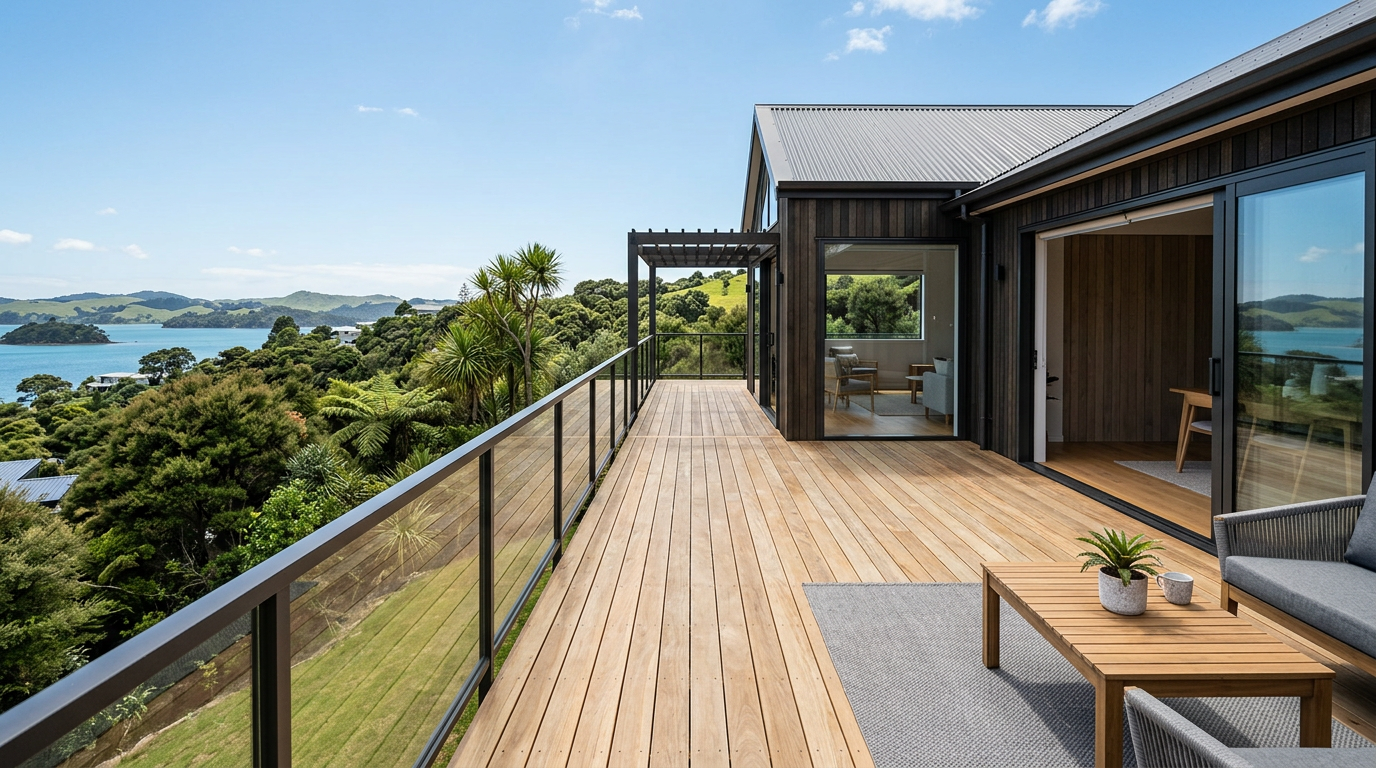
Many experienced deck builders in New Zealand will handle the building consent application on your behalf — but this isn't automatic, and it pays to confirm this upfront before signing any contract. Whether consent is needed at all depends on the size, height, and location of your proposed deck, so the first step is understanding what applies to your situation.
Does Your Deck Actually Need Building Consent?
Not every deck requires a building consent. Under Schedule 1 of the Building Act 2004, some low-level decks may be exempt from consent requirements. As a general guide, a deck that is no more than 1.5 metres above the ground (check with your council and the MBIE Building Performance website for the current threshold, as specific criteria apply) and meets certain other criteria may qualify as exempt work — but the rules have nuances, and exemptions can depend on your specific site, local council requirements, and how the deck connects to your home.
Always check with your local council before assuming your deck is exempt. What's exempt in one district may not be in another, and getting this wrong can cause costly problems when you sell your home or make an insurance claim. The MBIE Building Performance website has detailed guidance on Schedule 1 exemptions that's worth reading before you start.
Who Is Responsible for the Consent Application?
If consent is required, someone needs to lodge the application with your local council. This can be:
- Your deck builder — many experienced builders, particularly those registered as Licensed Building Practitioners (LBPs), will prepare and submit the application as part of their service.
- You, the homeowner — you are the owner of the project and technically the applicant, even if your builder does the legwork.
- A draughtsperson or architect — for more complex decks, a designer may prepare the plans and documentation needed for consent.
Because the homeowner is the legal applicant, you remain responsible for ensuring consent is obtained before work begins, regardless of who physically lodges the paperwork. Make sure your contract clearly states who is handling the consent application and who is paying the council fees.
What Does a Building Consent Application Involve?
A typical deck consent application will include:
- Site plan showing the deck's location on the property
- Construction drawings with dimensions, materials, and structural details
- Producer statements or engineering calculations if the deck is elevated or complex
- Completed application form and payment of council processing fees
Council fees vary depending on your local authority and the complexity of the project. As a rough guide, consent fees for a straightforward residential deck can range from a few hundred dollars to over a thousand dollars — check with your council for their current schedule.
Once consent is granted, inspections will be required at key stages of construction. Your builder should be familiar with this process and schedule inspections accordingly. At the end of the project, you'll need a Code Compliance Certificate (CCC) to confirm the work meets the NZ Building Code.
The Role of Licensed Building Practitioners
For restricted building work — which includes structural work on decks attached to a house — the work must be carried out or supervised by a Licensed Building Practitioner. Attaching a deck to your home's structure typically qualifies as restricted building work under NZ law.
Always ask your deck builder whether they hold a current LBP licence and what their licence class covers. You can verify this on the LBP register. An LBP must also provide you with a Record of Work on completion, which is an important document to keep with your property records.
What to Confirm With Your Builder Before Work Starts
Before signing a contract, get clear answers to these questions:
- Will you handle the building consent application, or is that my responsibility?
- Are you a Licensed Building Practitioner, and what is your licence class?
- Are council fees included in your quote, or are they extra?
- Will you schedule and attend the required inspections?
- Will you provide a Record of Work on completion?
Getting these details in writing protects both you and your builder and avoids misunderstandings mid-project.
NZ Building Code Standards for Decks
Decks must comply with the NZ Building Code, particularly Clause B1 (Structure) for strength and stability, and Clause F4 (Safety from Falling) for balustrades and edge protection. If your deck is elevated, balustrades are generally required when the deck is 1 metre or more above the ground, and they must meet specific height and strength requirements.
BRANZ is a great resource for technical guidance on deck construction standards, and your builder should be familiar with these requirements.
When to Call a Professional
If your deck is elevated, attached to your home, or involves any structural complexity, you should always engage a qualified, experienced deck builder — ideally one with LBP registration. Attempting to build a consent-required deck without proper consent is illegal and can affect your home's insurance and resale value.
You can find qualified local deck builders in your area through tradedirectory.co.nz, where you can compare tradespeople and read reviews from other homeowners.




 Licensed Building Practitioner (LBP)





