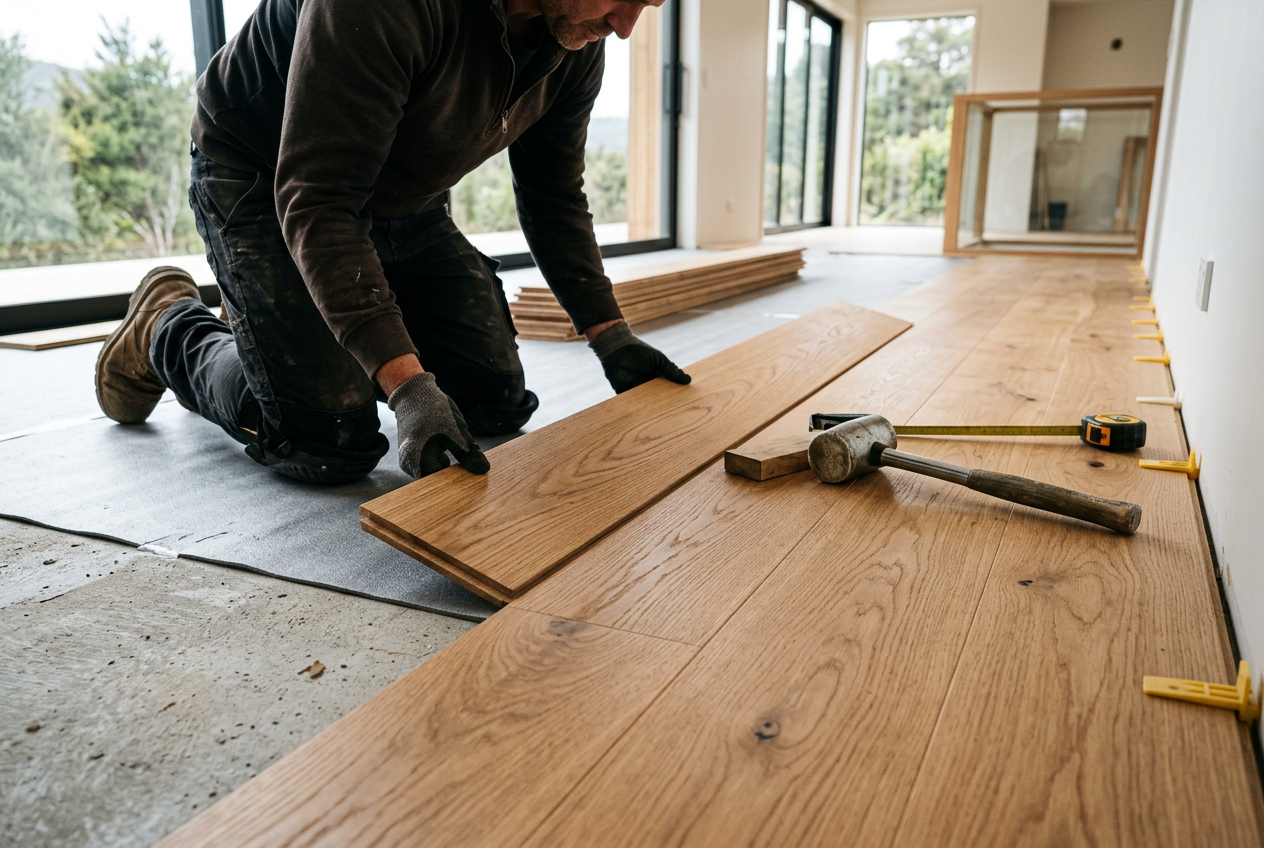
A flooring installer's quote should give you a clear, itemised breakdown of everything needed to complete the job — from materials and labour through to subfloor preparation and finishing touches. Understanding what's included (and what might be left out) helps you compare quotes fairly and avoid unexpected costs down the track.
What a Good Flooring Quote Should Cover
A professional flooring installer will typically provide a written quote that breaks the job into several key areas. Here's what you should expect to see:
1. Materials
Flooring product — The quote should specify the exact product, including brand, range name, colour, and dimensions. Whether it's engineered timber, luxury vinyl plank (LVP), carpet, or ceramic tiles, the product details matter. Reputable suppliers include Bunnings and Mitre 10, though many installers source from specialist flooring wholesalers.
Quantity and wastage allowance — A good installer will measure your space accurately and add a wastage factor (typically 5–15% depending on the product and room layout). This accounts for cuts, pattern matching, and offcuts.
Underlays and adhesives — These are often listed separately. Underlay type matters for comfort, acoustic performance, and moisture protection — especially in New Zealand homes where subfloor moisture can be an issue.
Trims and transitions — Scotia beading, threshold strips, and stair nosings are often overlooked but add up in cost. Make sure these are itemised.
2. Labour
Labour is usually quoted as either a per-square-metre rate or a fixed price for the job. The rate varies depending on:
- The type of flooring (tiles take longer to lay than vinyl)
- Room complexity (lots of angles, alcoves, or stairs)
- Your location in NZ (urban vs. rural)
As a rough guide, installation-only rates can range from around $20–$60+ per square metre, but this varies widely — always get at least two or three quotes.
3. Subfloor Preparation
This is one of the most commonly underestimated parts of a flooring job. A thorough quote will assess and price for:
- Levelling compounds — to flatten uneven concrete or timber subfloors
- Moisture testing and barriers — critical in NZ given our variable climate and the prevalence of older homes with no underfloor vapour barriers
- Removal of existing flooring — stripping old carpet, vinyl, or tiles is labour-intensive and may be quoted separately
- Repairs to the subfloor — fixing squeaky or damaged floorboards before new flooring goes down
Skipping proper subfloor prep is a leading cause of flooring failures, so don't be tempted to cut corners here. BRANZ provides good technical guidance on subfloor requirements for different flooring types.
4. Furniture Moving and Disposal
Some installers include furniture moving; others don't. Similarly, disposal of old flooring materials may or may not be included. Clarify this upfront to avoid surprises on the day.
5. GST
All quotes should clearly state whether GST is included or excluded. In New Zealand, GST is 15% and must be included in any final price presented to a consumer. If a quote says "plus GST," make sure you factor that in when comparing.
A Typical Quote Breakdown (Example Format)
| Line Item | Detail | Cost (approx.) |
|---|---|---|
| Flooring material | LVP, 180m², inc. 10% wastage | Itemised |
| Underlay | 5mm foam underlay | Itemised |
| Trims & transitions | Scotia, threshold strips | Itemised |
| Subfloor prep | Levelling compound, moisture barrier | Itemised |
| Labour – installation | Per m² rate | Itemised |
| Old floor removal | Carpet strip and disposal | Itemised |
| Total (incl. GST) | Total |
What to Watch Out For
- Vague descriptions — "supply and install flooring" with no product specs is a red flag. You need to know exactly what you're getting.
- No mention of subfloor prep — this often means it's not included and will be charged as an extra.
- No warranty information — ask about both the product warranty and the installer's workmanship guarantee.
- Unusually low quotes — these sometimes reflect inferior materials, skipped prep steps, or unlicensed labour.
For peace of mind, check that your installer is a member of a recognised trade body and has verifiable experience. You can find qualified local flooring installers on tradedirectory.co.nz.
NZ Building Code Considerations
Most standard flooring installations don't require a building consent, but there are exceptions — for example, if structural subfloor work is involved. If you're unsure, check with your local council. The MBIE Building Performance website has useful guidance on what work requires consent under Schedule 1 exemptions.
For wet areas like bathrooms and laundries, flooring must comply with NZ Building Code clause E3 (Internal Moisture). Make sure your installer is familiar with these requirements, particularly around waterproofing junctions.
When to Call a Professional
Flooring installation itself is not restricted trade work in New Zealand, so homeowners can legally lay their own flooring. However, if the job involves cutting into or modifying the subfloor structure, connecting to plumbing, or working near electrical cables, you'll need licensed tradespeople for those specific tasks. Electrical work must be carried out by a registered electrician (EWRB), and plumbing by a licensed plumber (PGDB).
For anything beyond a straightforward DIY install — particularly in older homes, wet areas, or where significant subfloor work is needed — it's well worth hiring an experienced flooring professional. A qualified installer will ensure the job meets manufacturer specifications (which is often required to validate product warranties) and NZ Building Code requirements.







