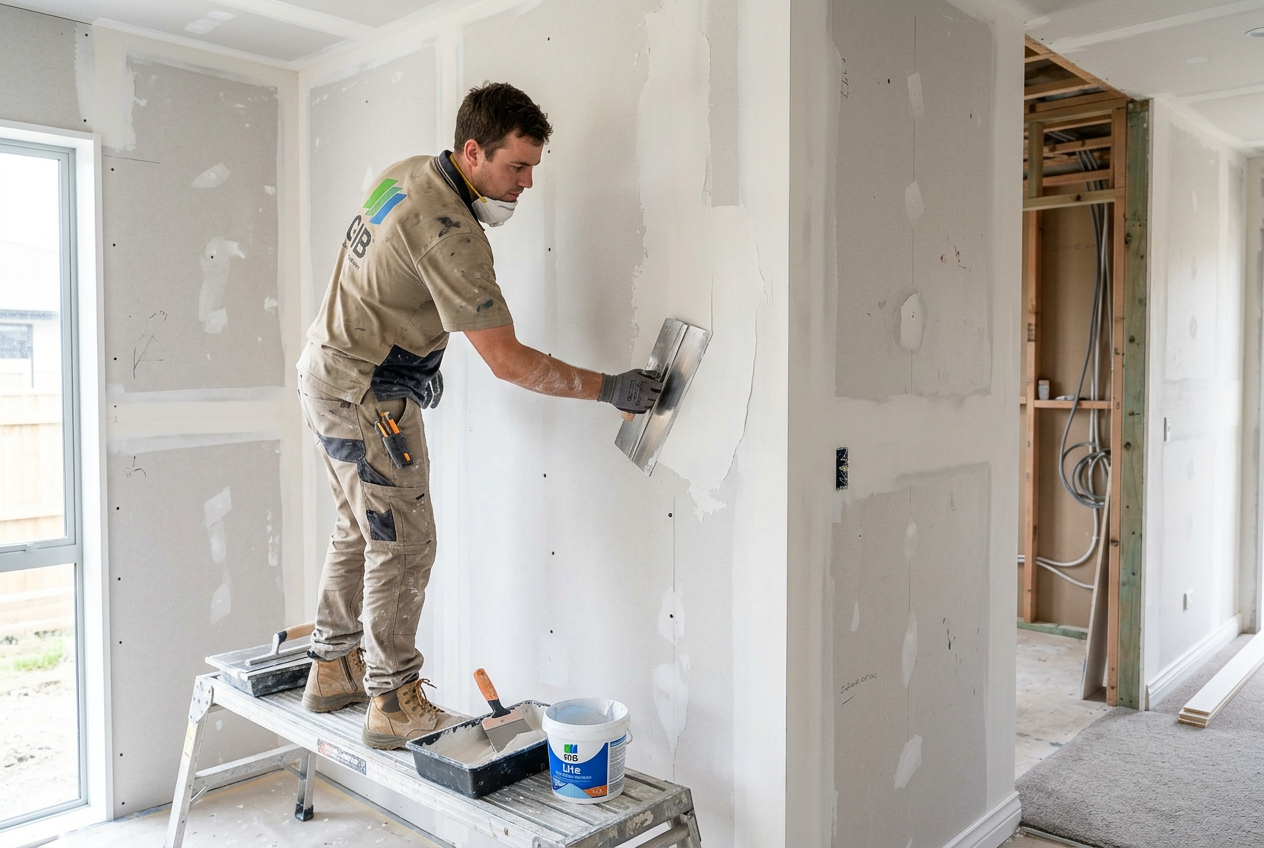
In New Zealand, plasterers and renderers are closely related trades — and many skilled tradespeople work across both. The key difference comes down to location: plasterers generally work inside a building on walls and ceilings, while renderers apply coatings to exterior surfaces. Understanding which one you need will help you get the right person for your job and avoid costly mistakes.
What Does a Plasterer Do?
A plasterer works primarily indoors, applying plaster-based products to interior walls and ceilings to create smooth, even surfaces ready for painting or other finishes. In modern NZ construction, this typically involves:
- Stopping and finishing GIB plasterboard (the most common interior lining system in NZ homes)
- Applying wet plaster or base coats to masonry or concrete block walls
- Creating decorative finishes such as Venetian plaster or textured effects
- Repairing cracks, holes, and damaged plaster in existing walls and ceilings
- Applying cornice and other ornamental plasterwork
Most new homes in NZ use GIB plasterboard for interior linings, so a large part of a modern plasterer's work is stopping (filling and finishing joints and fixings) to achieve a seamless, paint-ready surface.
What Does a Renderer Do?
A renderer works primarily outdoors, applying render (a mortar or acrylic-based coating) to the exterior of a building. Rendering serves two main purposes: weatherproofing and aesthetics. Common renderer tasks include:
- Applying cement-based render to concrete block, brick, or masonry walls
- Installing acrylic or polymer render systems over rigid foam insulation (EIFS — Exterior Insulation and Finish Systems)
- Applying texture coatings such as roughcast, pebbledash, or fine texture finishes
- Rendering over fibre cement substrates like James Hardie products
- Repairing cracked or damaged exterior render
- Applying base coats and top coats as part of a multi-layer weatherproofing system
In NZ's variable climate — with high UV exposure, coastal salt air, and significant rainfall in many regions — a well-applied render system is critical for keeping moisture out of the building envelope. This is directly relevant to the NZ Building Code Clause E2 (External Moisture), which sets requirements for how buildings must be protected from the weather.
How the Two Trades Overlap
Historically, plastering and rendering were considered one trade, and many experienced tradespeople in NZ are skilled in both. You'll often see businesses advertise as "plasterers and renderers" or simply "solid plasterers" — a term that covers both interior wet plaster work and exterior rendering, as opposed to "dry lining" or "stopping" which refers specifically to plasterboard finishing.
Here's a quick comparison:
| Feature | Plasterer | Renderer |
|---|---|---|
| Primary location | Interior | Exterior |
| Common substrates | Plasterboard, masonry, concrete | Masonry, block, fibre cement, foam board |
| Key purpose | Smooth finish for painting | Weatherproofing and aesthetics |
| Typical products | Stopping compounds, wet plaster | Cement render, acrylic render, texture coatings |
| NZ Building Code relevance | (no specific equivalent clause) | E2 (External moisture) |
Materials and Systems Used in NZ
Renderers in NZ work with a range of systems and products. Cement-based renders are traditional and durable, while acrylic and polymer renders offer flexibility and crack resistance — important in NZ's seismically active environment. Products from Sika and Ardex are commonly used in commercial and residential render systems.
For interior plastering, GIB stopping systems are the industry standard, with specific products for different levels of finish (from basic to ultra-smooth).
Top coats and paint finishes from Resene or Dulux are typically applied after the plasterer or renderer has completed their work.
Do You Need a Building Consent?
For most repair and maintenance rendering (like patching cracked render on an existing wall), a building consent is generally not required under Schedule 1 of the Building Act. However, if you're re-cladding a significant portion of your home or changing the cladding system, a consent is very likely needed. Always check with your local council before starting work — requirements vary by region and project scope. MBIE Building Performance has useful guidance on when consents are required.
When to Call a Professional
Rendering and solid plastering are skilled trades that require proper surface preparation, correct mixing ratios, and knowledge of how different systems perform in NZ conditions. Poor rendering can lead to moisture ingress, cracking, and delamination — expensive problems to fix. You should always hire a qualified renderer or plasterer for:
- Any new exterior render system or re-cladding work
- EIFS (foam board) render systems, which require specific installation knowledge
- Interior plaster work that will be visible (e.g., living areas, feature walls)
- Any work that may require a building consent
- Repairs to heritage or ornate plasterwork
A qualified tradesperson will also understand their obligations under the NZ Building Code and can advise on the right system for your specific substrate, climate zone, and exposure. You can find experienced local plasterers and renderers on tradedirectory.co.nz.
Sources & Further Reading
- MBIE Building Performance – Building Code Clause E2 (External Moisture)
- GIB – Interior Plasterboard Systems
- James Hardie – Fibre Cement Substrates
- BRANZ – Build Magazine and Technical Guidance
- Sika NZ – Render and Waterproofing Products
- Licensed Building Practitioners – Finding Qualified Tradespeople

 Licensed Building Practitioner (LBP)