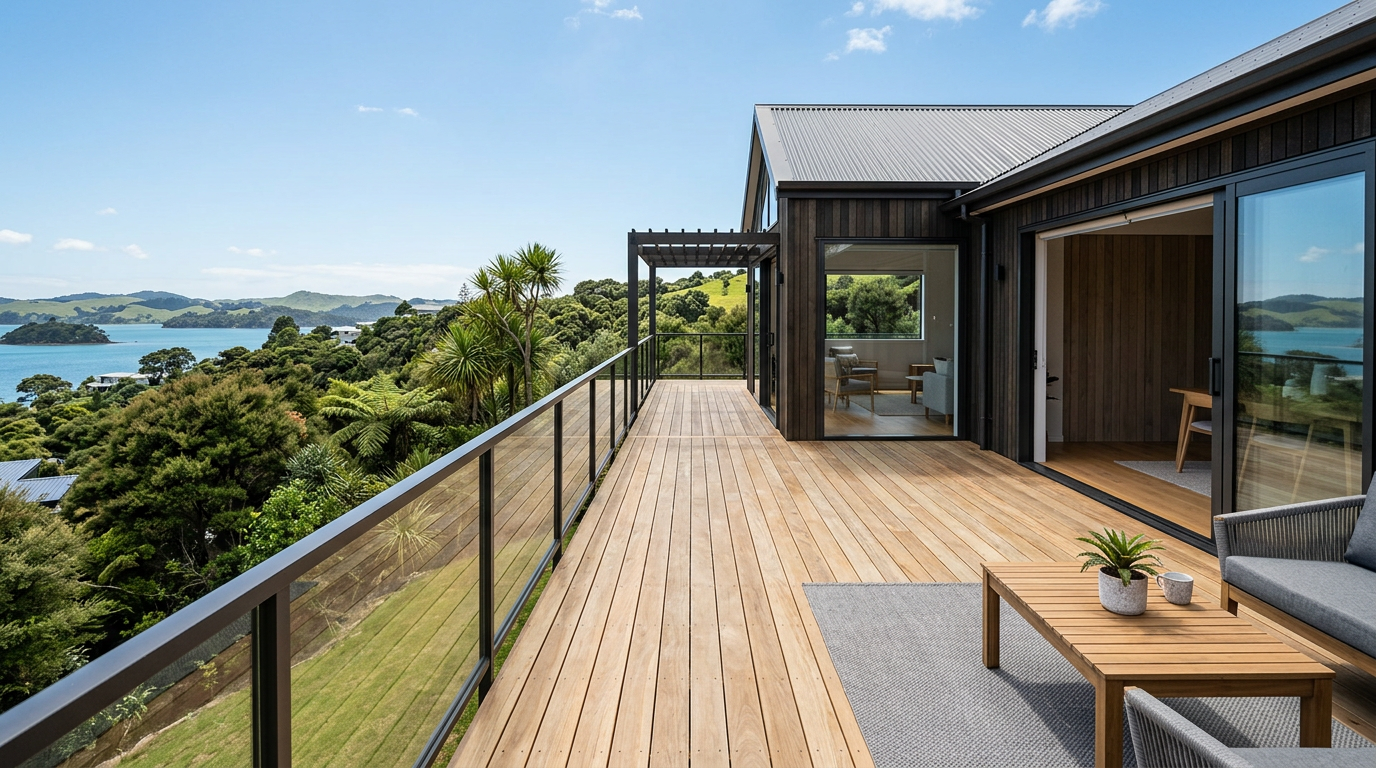
Fixing decking boards to steel joists is straightforward once you understand the right fasteners and technique — but get it wrong and you risk board movement, corrosion, or a deck that fails to meet the NZ Building Code. Whether you're using treated timber or composite decking, the method differs from fixing to timber joists and deserves careful attention.
Why Steel Joists Need a Different Approach
Timber joists allow screws to bite directly into the wood grain. Steel joists don't — you're threading into metal, which means you need self-drilling (tek) screws or pre-drilled pilot holes, and you must think carefully about galvanic corrosion. In New Zealand's coastal and high-humidity environments especially, using the wrong fastener can cause rapid rust staining and structural failure.
Steel-framed decks are popular because steel is dimensionally stable, resistant to warping, and well-suited to longer spans. However, the interface between steel and timber (or composite) introduces some specific challenges.
Choosing the Right Fasteners
This is the most critical decision. Your options include:
- Self-drilling tek screws — These have a drill-point tip that bores through the decking board and into the steel flange without a pilot hole. Choose screws rated for the steel thickness you're working with (typically 12–14 gauge for light structural steel).
- Pre-drilled and screwed — Drill a clearance hole through the board and a pilot hole into the steel, then fix with a suitable screw or bolt.
- Hidden clip systems — Many composite decking brands supply proprietary clips designed for steel subframes. These give a clean, fastener-free surface.
Corrosion Rating Matters
In New Zealand, the corrosion environment of your site determines the minimum fastener specification. BRANZ guidance and NZS 3604 both address corrosion zones. As a general rule:
| Environment | Minimum Fastener Spec |
|---|---|
| Inland / sheltered | Hot-dipped galvanised (HDG) or stainless steel |
| Coastal (within 500 m of sea) | Grade 316 stainless steel |
| Severe marine / industrial | Grade 316 stainless steel minimum |
Avoid zinc-plated or bright steel screws — they will corrode quickly, especially where treated timber is involved. Treated timber (H3.2 or H4 for ground contact) contains preservatives that accelerate corrosion of inferior fasteners.
Step-by-Step Fixing Method
1. Check Your Steel Flange Width
Most light structural steel joists (RHS or C-section purlins) have a flange of 50–75 mm. Your screw must land in the centre of the flange — mark a chalk line along the joist run if needed.
2. Pre-Drill the Decking Board (Recommended)
Even with self-drilling tek screws, pre-drilling a clearance hole through the decking board prevents splitting, especially near board ends. Drill at least 25 mm from the end of any board. For hardwood or dense composite, this step is essential.
3. Use the Correct Screw Length
The screw needs to pass through the full depth of the decking board and penetrate the steel flange by at least 3–4 threads. For a 45 mm thick timber board over 3 mm steel, a 65–75 mm screw is typically appropriate — but always check the screw manufacturer's specification.
4. Apply a Separation Layer if Required
Where treated timber sits directly on steel, consider using a closed-cell foam tape or proprietary isolation strip between the board and joist. This prevents moisture being trapped at the contact point, which accelerates both timber decay and steel corrosion. Some composite decking manufacturers require this — check your product's technical data sheet.
5. Maintain Board Spacing
Leave a 3–5 mm gap between boards for drainage and ventilation. Use spacers (offcuts of decking, tile spacers, or proprietary tools) to keep gaps consistent. Good drainage is important for compliance with MBIE Building Performance requirements around moisture management (NZ Building Code clause E3).
6. Fix at Every Joist
Every board must be fixed at every joist crossing — don't skip joists. Two fixings per board per joist is standard for boards wider than 90 mm.
Composite Decking on Steel Joists
Many composite decking systems are specifically designed for steel subframes. Brands available in NZ often supply T-clips or groove clips that hook into the board profile and screw down to the steel flange. This hides all fasteners and allows for thermal expansion — important because composite boards expand and contract more than timber. Always follow the manufacturer's installation guide, as deviating from it can void the product warranty.
You can find composite and timber decking products at Bunnings, Mitre 10, and PlaceMakers.
Building Consent Considerations
Decks over 1.5 m above ground level, or attached to the house in certain ways, generally require a building consent in New Zealand. Some lower decks may qualify as exempt work under Schedule 1 of the Building Act — but you must confirm this with your local council before starting. Never assume your project is exempt. See MBIE Building Performance for guidance on consent requirements.
If your deck is consented, the fixing method and fastener specification may need to be documented and inspected.
When to Call a Professional
If your steel subframe is part of a consented structure, or if you're unsure about the structural adequacy of the steel joists, engage a Licensed Building Practitioner (LBP). Deck construction may involve Restricted Building Work — confirm the specific criteria with your local council or MBIE. You can verify LBP status at Licensed Building Practitioners.
For complex or large decks, a qualified deck builder will ensure the fixing method, joist spacing, and fastener specification all meet the NZ Building Code and any consent conditions. Find experienced local deck builders on tradedirectory.co.nz.
Sources & Further Reading
- BRANZ — Decks and outdoor structures guidance
- MBIE Building Performance — Building consent information
- Licensed Building Practitioners — Find or verify an LBP
- Bunnings — Decking materials and fasteners
- PlaceMakers — Structural steel and decking products
- Standards NZ — NZS 3604 Timber-framed buildings




 Licensed Building Practitioner (LBP)





