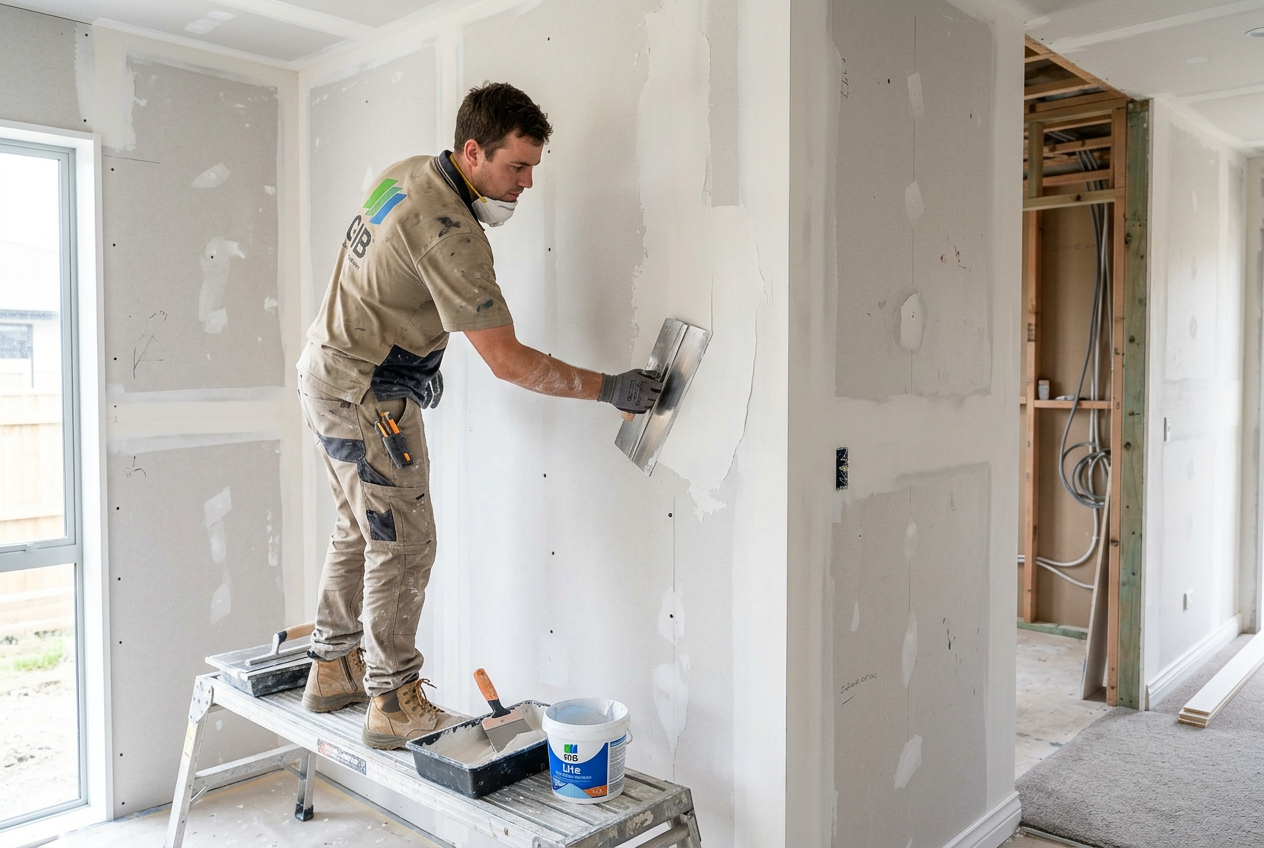
Whether you're renovating an older villa, building new, or patching up after a leak, the choice between solid plaster and plasterboard (GIB) is one of the most consequential decisions you'll make for your interior walls. Both systems have genuine strengths — and real limitations. Here's what you need to know before you commit.
What Is Solid Plaster?
Solid plaster (also called wet plaster or three-coat plaster) is a traditional wall finish applied in layers directly onto a substrate — typically timber lath, masonry, or a fibre-cement backing board. It's been used in New Zealand homes since the colonial era and is still the standard finish in many older villas and bungalows.
The process involves a scratch coat, a brown (or float) coat, and a final finish coat, each applied wet and left to cure. The result is a dense, hard wall surface that can be 15–25 mm thick in total. Skilled solid plasterers are a specialist trade, and good ones are increasingly hard to find.
Key characteristics:
- Extremely hard and durable when done well
- Excellent sound dampening
- Naturally resistant to minor knocks and dents
- Requires significant drying time between coats
- Repairs can be tricky to blend invisibly
- Higher upfront labour cost
What Is Plasterboard (GIB)?
Plasterboard — most commonly known in New Zealand by the GIB brand — is a manufactured panel made from a gypsum plaster core sandwiched between two layers of paper liner. Sheets are fixed to a timber or steel framing system, then the joints and fixings are stopped (filled and taped) and sanded smooth before painting.
GIB is the dominant interior lining system in New Zealand new builds and has been since the 1970s. It's fast to install, widely available at Mitre 10, Bunnings, and PlaceMakers, and comes in a range of specialist types including moisture-resistant, fire-rated, and acoustic boards.
Key characteristics:
- Fast installation — walls can be painted within days
- Consistent, predictable results
- Wide range of specialist products
- Softer surface — more prone to dents and dings
- Joints can crack or telegraph through paint over time
- DIY-friendly for basic repairs
Head-to-Head Comparison
| Criteria | Solid Plaster | GIB Plasterboard |
|---|---|---|
| Durability | Very high — hard, dense surface | Moderate — softer, dents more easily |
| Sound insulation | Excellent (mass helps) | Good, improved with acoustic GIB |
| Finish quality | Seamless, no joints | Joints visible if stopping is poor |
| Moisture resistance | Good on masonry; varies on timber | Use moisture-resistant GIB in wet areas |
| Fire resistance | Good (masonry base) | Good with fire-rated GIB (e.g. GIB Fyreline®) |
| Installation speed | Slow — days to weeks with curing | Fast — days |
| Rough cost guide | Higher labour cost overall | Lower labour cost overall |
| Repairs | Difficult to blend invisibly | Relatively straightforward |
| DIY suitability | Not recommended — specialist skill | Basic repairs are DIY-friendly |
| NZ availability of tradespeople | Specialist, fewer available | Widely available |
| Heritage/character match | Ideal for villas and bungalows | Can look out of place in older homes |
| NZ Building Code compliance | Yes, when correctly specified | Yes — well-established compliance pathway |
Cost Considerations
As a rough guide only, solid plaster is generally more expensive than GIB lining when you factor in labour. The multi-coat process, curing time, and specialist skill required all add up. GIB installation is faster, which means lower labour hours — though a high-quality stopping and finishing job still takes real skill and time.
Materials for GIB are straightforward to price at your local merchant. Solid plaster costs vary more widely depending on the substrate, the number of coats, and the plasterer's experience. Always get at least two or three quotes from qualified tradespeople — you can find local plasterers on tradedirectory.co.nz.
Don't forget to factor in ongoing costs: solid plaster, if well maintained, may need less frequent attention over decades. GIB walls in high-traffic areas may need patching and repainting more often.
NZ-Specific Considerations
New Zealand's climate varies enormously — from the humid subtropics of Northland to the cold, damp winters of Otago. BRANZ research highlights that moisture management is critical in NZ wall systems. In wet areas (bathrooms, laundries), the NZ Building Code clause E3 requires appropriate wet-area linings. GIB offers dedicated moisture-resistant products for these zones; solid plaster on a suitable backing can also comply, but specification matters.
For heritage homes — villas, bungalows, and inter-war houses — solid plaster is often the right choice to maintain character and match existing walls. Replacing solid plaster with GIB in these homes can reduce resale appeal and may affect heritage classifications in some councils.
For new builds, GIB is the standard and is well-supported by the NZ Building Code compliance pathway under MBIE Building Performance guidelines.
What a Homeowner Can (and Can't) Do
Plastering and stopping are not restricted trades in New Zealand — unlike electrical or plumbing work — so homeowners can legally do their own GIB stopping and solid plaster repairs. However, skill matters enormously. Poor stopping shows up badly under paint, especially in raking light.
For solid plaster, DIY is generally not recommended unless you have prior experience. The mixing ratios, application technique, and timing between coats require real expertise. A botched solid plaster job is expensive to fix.
For GIB, small patch repairs are well within reach of a capable DIYer. Larger areas — full rooms, wet-area linings, or fire-rated assemblies — are best left to a professional plasterer or GIB stopper.
Safety note: When working on older solid plaster walls (pre-1980s), be aware that some older homes may contain asbestos in textured finishes or backing materials. If in doubt, have the material tested before sanding or disturbing it. WorkSafe NZ has guidance on managing asbestos safely.
Our Recommendation
Here's practical guidance for the most common NZ scenarios:
- Renovating a villa or bungalow? Stick with solid plaster where possible. It matches the character of the home, maintains thermal mass, and preserves resale value. Find a specialist solid plasterer — they're worth the search.
- Building new or doing a modern renovation? GIB is the sensible, cost-effective choice. Use the right product for each area (moisture-resistant in wet zones, acoustic where noise matters, fire-rated where required).
- Patching an existing solid plaster wall? Hire a solid plasterer for anything larger than a small hole. Blending new plaster into old is a genuine skill.
- On a tight budget? GIB will almost always be more affordable and faster to complete.
- Prioritising sound or thermal performance? Solid plaster's mass gives it a natural edge, but modern GIB systems with insulation can close the gap significantly.
Neither system is universally better — the right choice depends on your home, your budget, and your goals. When in doubt, talk to a qualified plasterer who can assess your specific situation.

 Master Painters NZ member








