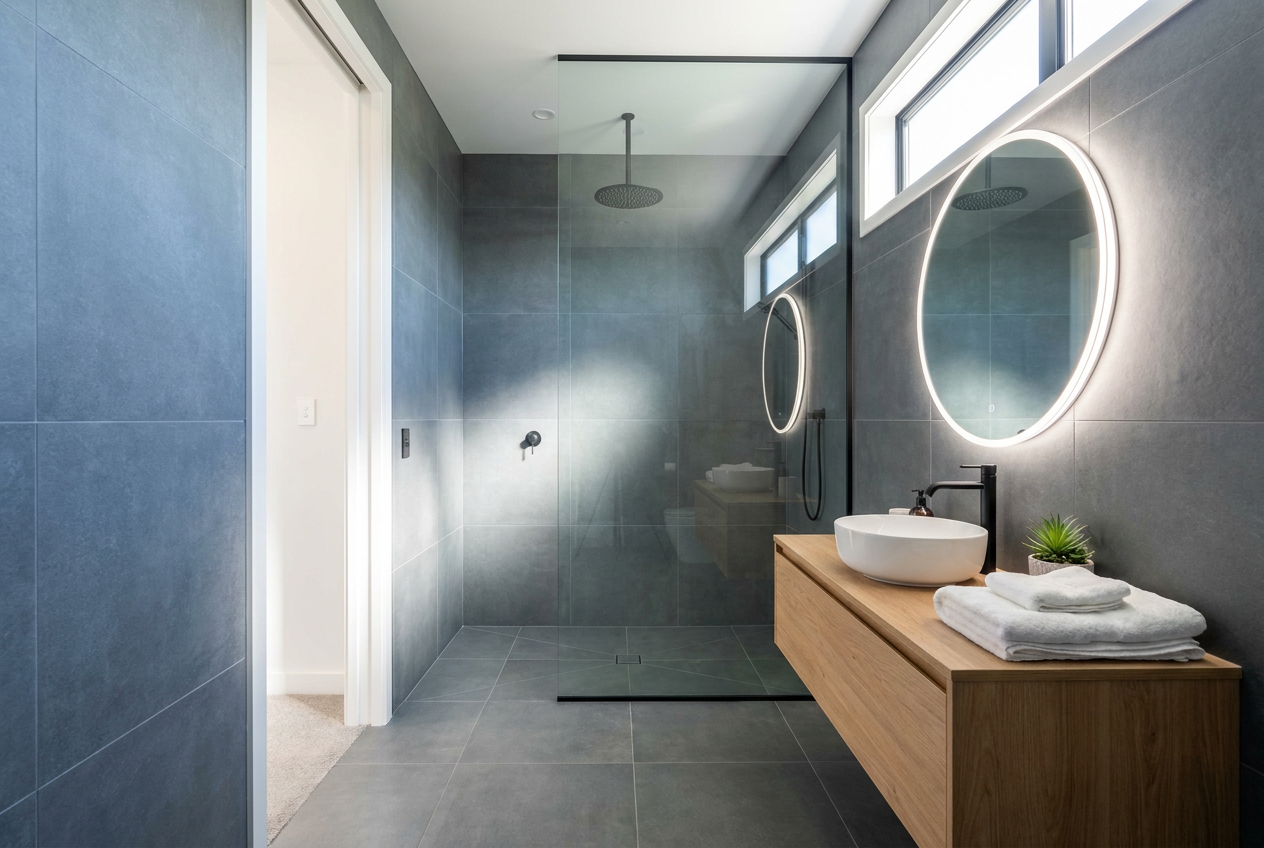
Waterproofing is one of those jobs that's invisible once it's done — but get it wrong and you're looking at rotting framing, mould, and a very expensive repair bill. If you're renovating a bathroom, laundry, or any wet area in your home, you'll likely be choosing between a sheet membrane and a liquid-applied membrane. Both can do the job well, but they suit different situations, substrates, and budgets. Here's a balanced breakdown to help you make the right call.
Why Waterproofing Matters in NZ
Under the NZ Building Code, wet areas like showers, baths, and laundries must be waterproofed to prevent moisture damage to the building structure. The key compliance document is Acceptable Solution E3/AS1, which covers internal wet areas. Any waterproofing work in these zones must meet these requirements — whether you're doing a full renovation or a like-for-like repair.
BRANZ research consistently shows that water damage from failed wet-area waterproofing is one of the most common and costly defects in NZ homes. Getting this right from the start is non-negotiable.
What Is a Sheet Membrane?
A sheet membrane is a pre-manufactured waterproofing layer — typically made from polyethylene, modified bitumen, or a fabric-reinforced composite — that is bonded or mechanically fixed to the substrate before tiling. Common formats include self-adhesive sheets and heat-welded rolls.
Sheet membranes offer a consistent, factory-controlled thickness, which means fewer variables on site. They're particularly well-suited to large floor areas, commercial applications, and situations where you need a guaranteed minimum thickness across the whole surface. Brands like Ardex and Mapei supply sheet membrane systems used widely in NZ.
Pros:
- Uniform thickness — no thin spots from uneven application
- Fast to install over large, flat areas
- Good for high-traffic or commercial wet areas
- Less dependent on applicator skill for thickness consistency
Cons:
- Harder to detail around penetrations, corners, and drains
- Requires careful lapping and sealing at joins
- Less flexible on complex or curved substrates
- Generally needs a professional for best results
What Is a Liquid Membrane?
A liquid-applied membrane is a coating — usually acrylic, polyurethane, or epoxy-based — that is brushed, rolled, or trowelled onto the substrate in one or more coats. It cures to form a seamless, flexible waterproof layer. Products from Sika, Ardex, and Mapei are commonly specified by NZ waterproofers and tilers.
Liquid membranes are the most widely used option in NZ residential bathrooms. Their seamless nature makes them excellent at detailing around drains, pipe penetrations, internal corners, and wall-to-floor junctions — the spots most likely to leak.
Pros:
- Seamless application — no joins to fail
- Excellent for complex shapes, corners, and penetrations
- Easier to apply in confined spaces
- Wide range of products for different substrates (concrete, GIB Aqualine, fibre cement)
- Some products are DIY-friendly for straightforward applications
Cons:
- Thickness depends heavily on applicator skill and number of coats
- Longer cure time between coats
- Can be under-applied if not carefully measured
- Some products are sensitive to temperature and humidity during application
Head-to-Head Comparison
| Criteria | Sheet Membrane | Liquid Membrane |
|---|---|---|
| Thickness consistency | Excellent — factory controlled | Variable — depends on applicator |
| Seamless coverage | No — joins must be lapped and sealed | Yes — fully seamless when applied correctly |
| Complex detailing | Difficult around drains/penetrations | Excellent — brushes into all corners |
| Substrate flexibility | Best on flat, large areas | Suits most substrates incl. GIB Aqualine |
| Durability | Very high if joins are sound | Very high if correct DFT achieved |
| NZ Building Code compliance | Yes, when correctly installed | Yes, when correctly installed |
| DIY suitability | Low — joins are critical | Moderate — simpler products available |
| Typical application speed | Faster on large flat floors | Slower (multiple coats, cure time) |
| Rough cost guide | Moderate–high (materials + labour) | Moderate (materials often lower cost) |
| Best for | Large floors, commercial, slab-on-ground | Residential bathrooms, showers, laundries |
Cost ranges vary significantly by project size, product choice, and region. Always get quotes from qualified local tradespeople.
Cost Considerations
As a rough guide only, liquid membrane materials tend to be less expensive per square metre than sheet membranes, but labour costs can be similar once you factor in the multiple coats and cure times required. Sheet membranes can be faster to lay over large open floors, which may offset the higher material cost on bigger jobs.
For a standard NZ residential bathroom (typically under 10 m²), the difference in total waterproofing cost between the two systems is often modest. Where costs diverge more noticeably is on large commercial or multi-unit projects. Always get at least two or three quotes from qualified waterproofers — you can find local professionals on tradedirectory.co.nz.
DIY vs Licensed Tradesperson
Some liquid membrane products are marketed as DIY-friendly, and for a straightforward laundry or small bathroom floor, a competent homeowner can apply them. However, achieving the correct dry film thickness (DFT) — typically specified by the manufacturer and required for Building Code compliance — takes care and experience. Under-application is the most common failure point.
For anything involving plumbing penetrations, shower drains, or work connected to the drainage system, be aware that certain work is legally restricted under the Plumbers, Gasfitters and Drainlayers Act. Connecting or altering sanitary plumbing must be carried out by a licensed tradesperson registered with the PGDB. Similarly, any electrical work in wet areas is restricted work under the EWRB — always use a registered electrician.
For full bathroom renovations or any work requiring a building consent, waterproofing must be inspected and signed off. Check with your local council and refer to MBIE Building Performance for guidance on when consent is required.
Safety note: Some membrane products contain solvents or isocyanates. Always work in a well-ventilated space, wear appropriate PPE, and follow the manufacturer's safety data sheet. Check WorkSafe NZ guidelines if you're unsure.
Our Recommendation
For most NZ residential bathrooms and showers, a quality liquid-applied membrane is the practical choice. Its seamless nature handles the complex geometry of a typical bathroom far better than sheet membrane, and there are excellent compliant products readily available from suppliers like Mitre 10, Bunnings, and PlaceMakers.
Choose a sheet membrane if you're waterproofing a large, flat concrete floor (such as a slab-on-ground laundry or a commercial kitchen), or where a guaranteed minimum thickness across a wide area is critical and the substrate is simple and flat.
In either case, the quality of the installation matters far more than the product itself. If you're not confident in achieving the required coverage and detailing, hire a qualified waterproofer or tiler with waterproofing experience. A botched waterproofing job will cost far more to fix than getting it right the first time.

 Site Safe


 SiteWise

 Licensed Building Practitioner (LBP)




