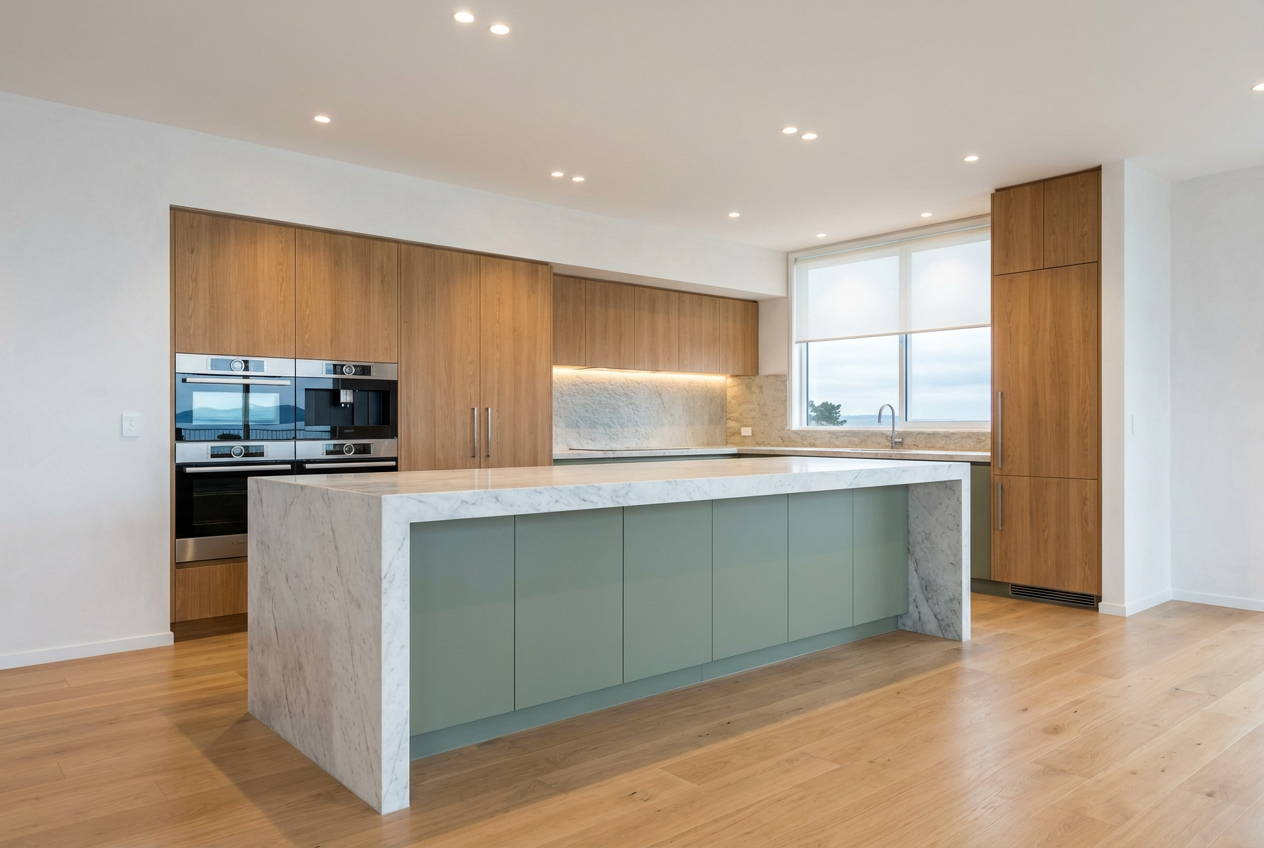
Choosing the right board material for your kitchen cabinets is one of those decisions that looks simple on the surface but has a real impact on how your kitchen holds up over the years. Whether you're renovating on a budget, going for a high-end custom fit-out, or somewhere in between, the material inside those cabinet doors matters — especially in a New Zealand kitchen where humidity, coastal air, and hard daily use are all part of the picture.
What Are the Three Options?
Melamine board (sometimes called melamine-faced chipboard or MFC) is a particleboard or MDF core with a thin melamine resin paper fused to the surface. It comes pre-finished in a huge range of colours and textures, making it the go-to for flat-pack and production cabinetry.
MDF (Medium Density Fibreboard) is an engineered wood product made from fine wood fibres bonded with resin under heat and pressure. It has a smooth, consistent surface that takes paint and veneer exceptionally well, but it is heavier and more vulnerable to moisture than plywood.
Plywood is made from thin layers (plies) of real wood veneer glued together with alternating grain directions. This cross-grain construction gives it excellent strength, screw-holding ability, and moisture resistance — qualities that make it a favourite among custom cabinet makers.
Head-to-Head Comparison
| Criteria | Melamine Board | MDF | Plywood |
|---|---|---|---|
| Durability | Moderate — surface can chip at edges | Good surface hardness, edges vulnerable to moisture | Excellent — strong, resists racking |
| Moisture resistance | Low–moderate (standard); moisture-resistant grades available | Low (standard); MR MDF available but still limited | Good — especially marine or structural ply |
| Weight | Moderate | Heavy | Moderate–heavy depending on grade |
| Screw holding | Moderate — can strip in particleboard core | Moderate — better than chipboard, worse than ply | Excellent — screws grip well into plies |
| Finish options | Pre-finished (limited customisation) | Excellent for paint, veneer, wrap | Good for veneer; can be painted |
| Cost (rough guide) | Most affordable | Mid-range | Mid to higher cost |
| DIY suitability | Easy to work with standard tools | Manageable but heavy and dusty | Requires more skill and sharp tools |
| NZ coastal/humid suitability | Poor unless moisture-resistant grade used | Poor unless MR grade; still not ideal | Better choice near coast or in humid areas |
| Sustainability | Uses wood waste; formaldehyde emissions vary | Uses wood waste; check E0/low-emission grades | More wood per sheet; FSC options available |
Melamine Board: The Practical Everyday Choice
Melamine is the material you'll find in most flat-pack kitchens from the big box stores and in the majority of production cabinetry in New Zealand. Its main advantages are cost and convenience — it arrives pre-finished, so there's no painting or sealing required. The surface is easy to wipe clean, which suits a kitchen environment well.
The weak point is the edges and the core. Standard melamine board uses a particleboard core that swells badly when it gets wet — think under-sink cabinets or areas near a dishwasher. Edge-banding helps protect exposed edges, but if that banding lifts or chips, moisture gets in fast. For kitchens in humid regions or coastal areas, always specify moisture-resistant (MR) melamine board.
From a DIY perspective, melamine is forgiving to cut and assemble, though you'll want a fine-tooth blade to avoid chipping the surface.
MDF: The Painter's Favourite
MDF shines when you want a flawlessly smooth painted finish. Because it has no grain and a perfectly consistent surface, it takes primer and topcoat beautifully — which is why it's the standard choice for painted cabinet doors and decorative panels. Resene and Dulux both offer cabinet-specific paint systems that work well over primed MDF.
The downsides are weight and moisture sensitivity. Standard MDF will swell and delaminate if it gets wet, and even MR-grade MDF is not truly waterproof. MDF is also heavy — full MDF cabinet carcasses can put real strain on wall fixings, so make sure your wall framing and fixings are up to the job in line with NZS 3604 requirements for timber-framed buildings.
MDF produces very fine dust when machined, so always wear a P2 respirator and work in a ventilated space. WorkSafe NZ has guidance on managing wood dust exposure.
Plywood: The Premium Performer
Among professional cabinet makers, plywood — particularly 18mm structural or furniture-grade ply — is widely regarded as the best all-round carcass material. Its cross-laminated construction means it resists warping, holds screws firmly (even at edges), and handles moisture far better than MDF or standard particleboard.
For NZ kitchens, especially in coastal towns like Tauranga, Nelson, or Wellington where salt air and humidity are real factors, plywood carcasses are a sound long-term investment. BRANZ research consistently highlights moisture management as a critical factor in kitchen durability.
Plywood does cost more per sheet, and working with it well requires sharp tools and a bit more skill — tear-out on the face veneer can be an issue if you're not careful. Edges also need treatment (iron-on veneer tape or solid timber lipping) since the raw ply edge isn't attractive. That said, for a kitchen that needs to last 20+ years, the extra investment is usually worth it.
Cost Considerations
As a rough guide only, melamine board is generally the most affordable option per sheet, MDF sits in the mid-range, and furniture-grade plywood tends to cost more — though prices vary by supplier and sheet thickness. Bunnings, Mitre 10, and PlaceMakers all stock a range of sheet materials, and it's worth getting quotes from a local timber merchant for larger jobs.
Remember that material cost is only part of the picture. Labour, hardware, and finishing can easily outweigh the board cost, so choosing a slightly better material often adds less to the total job than you'd expect.
Our Recommendation
Here's honest, practical guidance for common NZ scenarios:
- Budget renovation or rental property: Moisture-resistant melamine board for carcasses, with solid or MDF doors. Practical, cost-effective, and easy to replace.
- Mid-range family kitchen: MDF doors (painted) over plywood carcasses. You get the best of both — a beautiful painted finish on doors with a durable, moisture-resistant box behind it.
- High-end or coastal kitchen: Plywood throughout, with solid timber or high-pressure laminate doors. Built to last in tough NZ conditions.
- DIY-friendly build: Melamine flat-pack or pre-cut melamine panels are the most forgiving for a capable home handyperson.
For anything beyond basic flat-pack assembly, we'd strongly encourage working with a qualified cabinet maker. A skilled tradesperson will know which materials suit your specific kitchen layout, local climate, and budget — and their work will stand up far better over time. You can find experienced local cabinet makers on tradedirectory.co.nz.