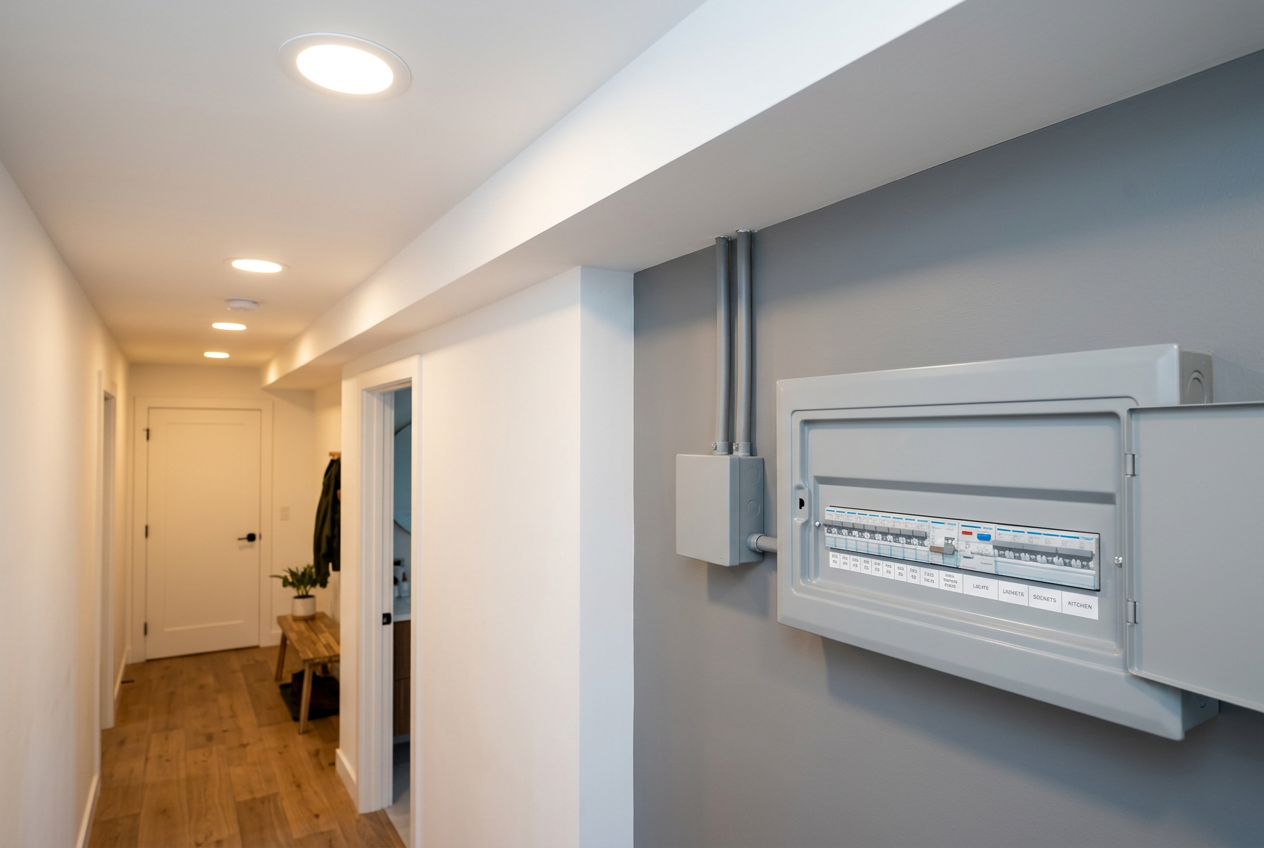
Choosing between LED and halogen downlights might seem like a small decision, but it has a surprisingly big impact on your power bill, your home's safety, and your day-to-day comfort. If you still have halogen downlights installed — and many New Zealand homes do — this guide will help you understand exactly what you're dealing with and why most electricians will tell you the same thing: it's time to make the switch.
Overview: Halogen Downlights
Halogen downlights were the go-to recessed lighting choice for New Zealand homes through the 1990s and 2000s. They produce a warm, bright light that many homeowners still find appealing. However, they come with some serious drawbacks that are hard to ignore.
Halogens work by passing electricity through a tungsten filament inside a halogen gas-filled capsule. This process generates a lot of heat — a standard 50W halogen can reach surface temperatures of over 200°C. That heat doesn't just waste energy; it creates a genuine fire risk, particularly where downlights are recessed into insulated ceilings. BRANZ research has highlighted ceiling fires caused by halogens in contact with or too close to insulation as a recurring issue in NZ homes.
Halogens also burn out relatively quickly, typically lasting around 2,000 hours, meaning frequent bulb replacements.
Overview: LED Downlights
LED (Light Emitting Diode) downlights have become the modern standard for good reason. They use a fraction of the electricity of halogens — a quality LED can replace a 50W halogen using as little as 8–10W — while producing comparable or better light output.
LEDs run cool to the touch, dramatically reducing fire risk in ceiling cavities. They last far longer (often 25,000–50,000 hours is quoted by manufacturers), meaning far fewer replacements. They're also available in a wide range of colour temperatures, from warm white (similar to halogen) through to cool daylight tones, giving you flexibility in how your rooms feel.
For New Zealand homeowners, LEDs also align well with the Energywise guidance on reducing household energy consumption — lighting is one of the easier wins.
Head-to-Head Comparison
| Criteria | Halogen Downlights | LED Downlights |
|---|---|---|
| Energy use | High (typically 35–50W per globe) | Low (typically 8–12W per globe) |
| Heat output | Very high (fire risk in ceilings) | Very low (cool to touch) |
| Lifespan | Short (~2,000 hours) | Long (25,000–50,000 hours) |
| Fire risk | Significant near insulation | Minimal |
| Light quality | Warm, familiar tone | Wide range of colour temps available |
| Running cost | Higher power bills | Significantly lower power bills |
| Upfront cost | Low per globe | Higher per fitting, but pays back quickly |
| Maintenance | Frequent globe changes | Rarely needs attention |
| NZ insulation compatibility | Requires clearance (IC-F rated fittings needed) | IC-rated LEDs sit flush with insulation safely |
| DIY suitability | Globe swap only (if same fitting) | Fitting replacement is restricted electrical work |
Cost Considerations
As a rough guide only, individual LED downlight fittings typically cost more upfront than halogen globes. However, the running cost difference is substantial. With power prices in New Zealand continuing to rise, replacing ten 50W halogens with 10W LEDs can save a meaningful amount on your annual power bill — Consumer NZ has noted lighting as one of the more straightforward areas for households to cut energy costs.
Factor in the reduced frequency of globe replacements and the labour saved on maintenance, and LEDs generally pay for themselves within a few years. Many electricians offer competitive rates for a full downlight switchover, especially if done in one visit.
NZ-Specific Safety and Compliance Considerations
This is where it gets important. New Zealand's Building Code clause G7 covers interior lighting, and fire safety around ceiling penetrations is taken seriously. Halogen downlights that are not correctly installed with adequate clearance from insulation are a known fire hazard — if your home has bulk insulation in the ceiling, this is a real concern worth checking.
LED downlights rated IC-F (Insulation Contact — Fire rated) can be installed in direct contact with ceiling insulation, which is a significant safety advantage. Always check the fitting's rating before purchase.
For compliance and peace of mind, check MBIE Building Performance guidance on electrical installations in your home.
What Is Restricted Electrical Work?
This is critical: replacing a downlight fitting (the whole fixture) is restricted electrical work under New Zealand law and must be carried out by a registered electrician. This includes swapping halogen fittings for LED fittings, running new circuits, or altering wiring.
What a homeowner can do is replace a like-for-like globe in an existing fitting — for example, swapping a dead halogen globe for another halogen globe of the same type, without touching any wiring.
If you're upgrading from halogen fittings to LED fittings, you need a licensed electrician. The Electrical Workers Registration Board (EWRB) maintains a register of licensed practitioners — always check your electrician is registered before work begins.
Safety note: Never attempt to rewire or replace downlight fittings yourself. Incorrect electrical work is dangerous and illegal in New Zealand, and can void your home insurance.
Our Recommendation
For the vast majority of New Zealand homeowners, switching to LED downlights is the right call — and the sooner, the better.
- If you have halogens near ceiling insulation: This is a safety issue, not just an efficiency one. Get a registered electrician to assess and replace the fittings promptly.
- If you're renovating or building new: Specify IC-F rated LED downlights from the outset. Brands like Philips and others widely available at Mitre 10 and Bunnings offer solid options.
- If your halogens are working fine but you want to save on power: Plan a switchover with a local electrician. It's a straightforward job and the payback period is reasonable.
- If you're a landlord: Under the Healthy Homes Standards, you have obligations around safe and adequate lighting. Halogen downlights near insulation could present a compliance risk worth addressing.
To find a qualified, registered electrician near you, search tradedirectory.co.nz — it's always worth getting a couple of quotes for a full-home switchover.

 Site Safe
 Licensed Electrical Inspector







