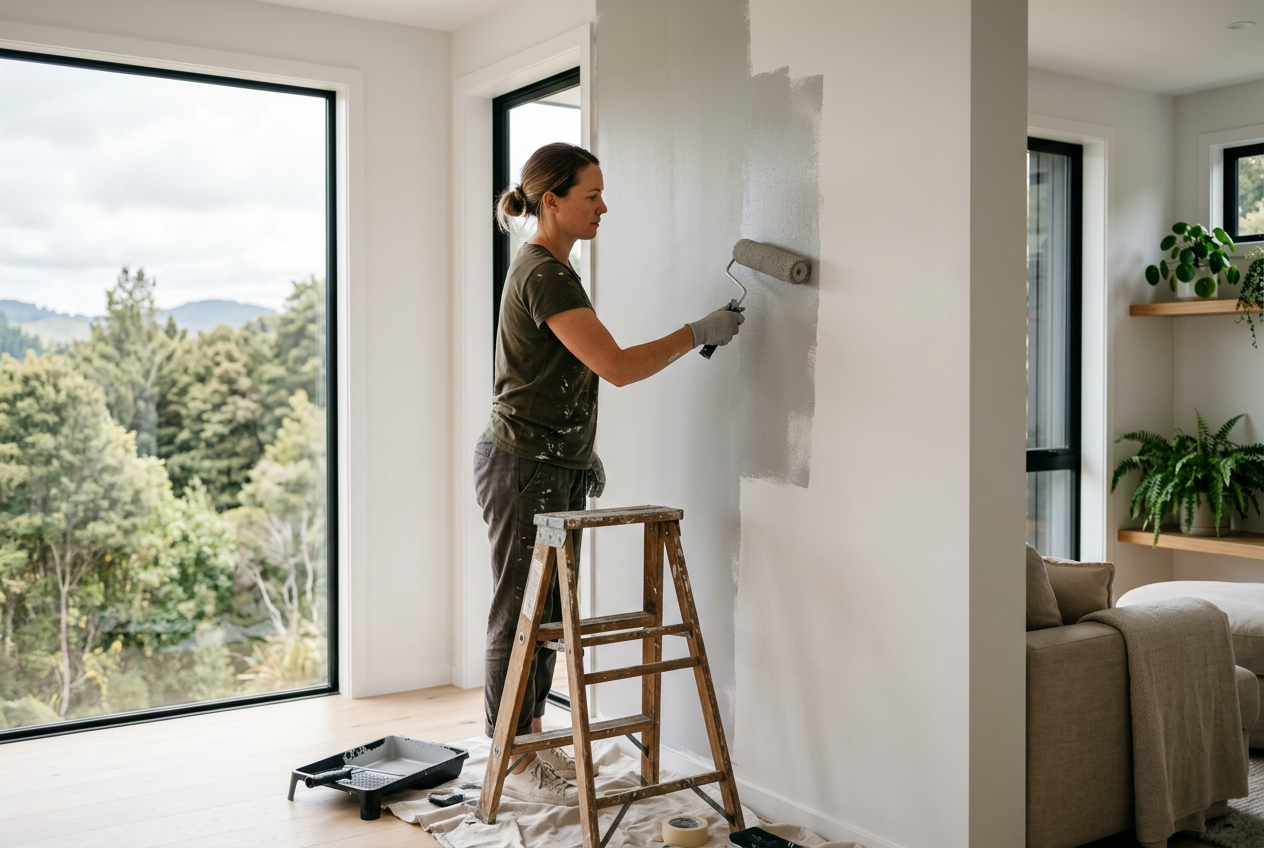
Grabbing a leftover tin of paint from the garage is tempting — but if it's the wrong type for the job, you could end up with peeling walls, health risks, or a finish that looks terrible within a season. Understanding the difference between interior and exterior paint isn't just trade knowledge; it's genuinely useful for any NZ homeowner planning a painting project.
What Makes Interior and Exterior Paint Different?
At first glance, both types are liquid colour in a tin. But the formulations are quite different, designed for very different environments.
Interior paints are engineered for low odour, low VOC (volatile organic compound) emissions, and easy cleaning. They're designed to resist scuffing, staining, and the wear and tear of daily indoor life. Because they're used inside, manufacturers prioritise indoor air quality — a big deal in well-sealed modern NZ homes.
Exterior paints are built to survive the outdoors: UV radiation, rain, wind, temperature swings, and in many parts of New Zealand, salt air and high humidity. They contain stronger resins, UV stabilisers, mildewcides, and fungicides that help them flex with the substrate as it expands and contracts through the seasons. These additives are what make exterior paint tough — but they're also what makes it unsuitable for indoor use.
BRANZ research consistently highlights that moisture management and UV exposure are the two biggest enemies of exterior coatings in New Zealand, which is why exterior paint chemistry is so specialised.
Can You Use Exterior Paint Inside?
Technically, exterior paint will stick to interior walls. But you really shouldn't use it indoors, and here's why:
- VOCs and fumes: Exterior paints contain biocides (mildewcides and fungicides) and higher levels of VOCs. Indoors, these can off-gas for days or weeks, causing headaches, respiratory irritation, and in poorly ventilated spaces, more serious health concerns. WorkSafe NZ advises careful management of VOC exposure in enclosed spaces.
- Finish quality: Exterior paints are formulated to be more flexible and weather-resistant, not to give the smooth, washable finish you want on interior walls.
- Odour: The smell can linger long after the paint has dried, which is unpleasant in living areas.
- Overkill on cost: Exterior paint is generally more expensive. Using it inside wastes money on properties you simply don't need indoors.
The verdict: Don't use exterior paint inside, especially in bedrooms, living areas, or anywhere with limited ventilation.
Can You Use Interior Paint Outside?
This is where the damage really shows. Interior paint used outdoors will typically:
- Fade quickly — it lacks UV stabilisers, so colour degrades fast under the NZ sun.
- Peel and crack — interior paint doesn't flex with temperature changes, leading to early failure.
- Grow mould — without mildewcides, exterior surfaces painted with interior paint become a feast for mould and mildew, particularly in humid regions like Auckland, Northland, and the West Coast.
- Fail to adhere — moisture penetration causes bubbling and flaking, often within a single season.
In short, using interior paint outside is a false economy. You'll be repainting far sooner, and the prep work to fix a failed paint job costs more than doing it right the first time.
Head-to-Head Comparison
| Feature | Interior Paint | Exterior Paint |
|---|---|---|
| UV resistance | Low — fades outdoors quickly | High — UV stabilisers protect colour |
| Flexibility | Low — not designed for substrate movement | High — flexes with temperature changes |
| Mildew/mould resistance | Minimal | Strong — contains biocides |
| VOC levels | Low — safer for indoor air quality | Higher — biocides and stronger resins |
| Finish quality indoors | Excellent — smooth, washable | Poor — not optimised for interior use |
| Durability outdoors | Poor — fails within months | Excellent — years of protection |
| Cost (rough guide) | Moderate | Moderate to higher |
| DIY suitability | Easy and safe for homeowners | Fine outdoors; avoid using indoors |
| NZ climate suitability | Indoors only | Designed for NZ conditions |
NZ Brands and What They Offer
All the major NZ paint brands clearly separate their interior and exterior ranges — and for good reason.
- Resene offers an extensive range of both, with their Lumbersider and Sonyx ranges for exterior timber and their SpaceCote range for interior walls.
- Dulux has dedicated exterior weathershield products and interior wash-and-wear formulations.
- Wattyl produces the popular Solagard exterior range alongside interior options.
All three brands provide technical data sheets that clearly state the intended use — always check these before buying.
The Grey Area: Garages, Sheds, and Semi-Exposed Areas
Some spaces blur the line — a garage, a covered deck, a carport, or an enclosed porch. Here's a practical guide:
- Covered decks and carports: Use exterior paint. Even under cover, these surfaces face humidity, temperature swings, and indirect UV.
- Internal garages: Interior paint is generally fine on walls, but use a floor-specific product on concrete floors.
- Sheds: Exterior paint on the outside; interior paint is fine inside if it's a dry, enclosed space you spend time in.
- Bathrooms and wet areas: Neither standard interior nor exterior paint is ideal — use a dedicated bathroom paint or tile paint formulated for high humidity. Check the NZ Building Code's E3 wet area requirements for context on moisture management.
Cost Considerations
As a rough guide, exterior paints tend to cost more per litre than equivalent interior paints, reflecting the more complex chemistry involved. Using the wrong paint and having to repaint early will always cost more than buying the right product first time — both in materials and labour if you hire a painter.
If you're unsure what a job should cost or want a professional finish, find a qualified local painter on tradedirectory.co.nz.
Our Recommendation
Always use paint for its intended purpose. The formulations exist for good reasons, and the consequences of getting it wrong range from a poor finish to genuine health risks.
- Painting interior walls, ceilings, or trim? Use a quality interior paint. Low-VOC options are best for bedrooms and children's rooms.
- Painting exterior weatherboards, fascias, or fences? Use a dedicated exterior paint suited to your substrate (timber, fibre cement, masonry).
- Unsure about a specific surface or product? Ask at your local Resene ColorShop, Mitre 10, or Bunnings — or better yet, get advice from a qualified painter.
For large or complex jobs, a Licensed Building Practitioner or experienced painter will ensure the right products are used correctly, saving you time, money, and frustration.

 BCITO Qualified

 Master Painters NZ
 Site Safe