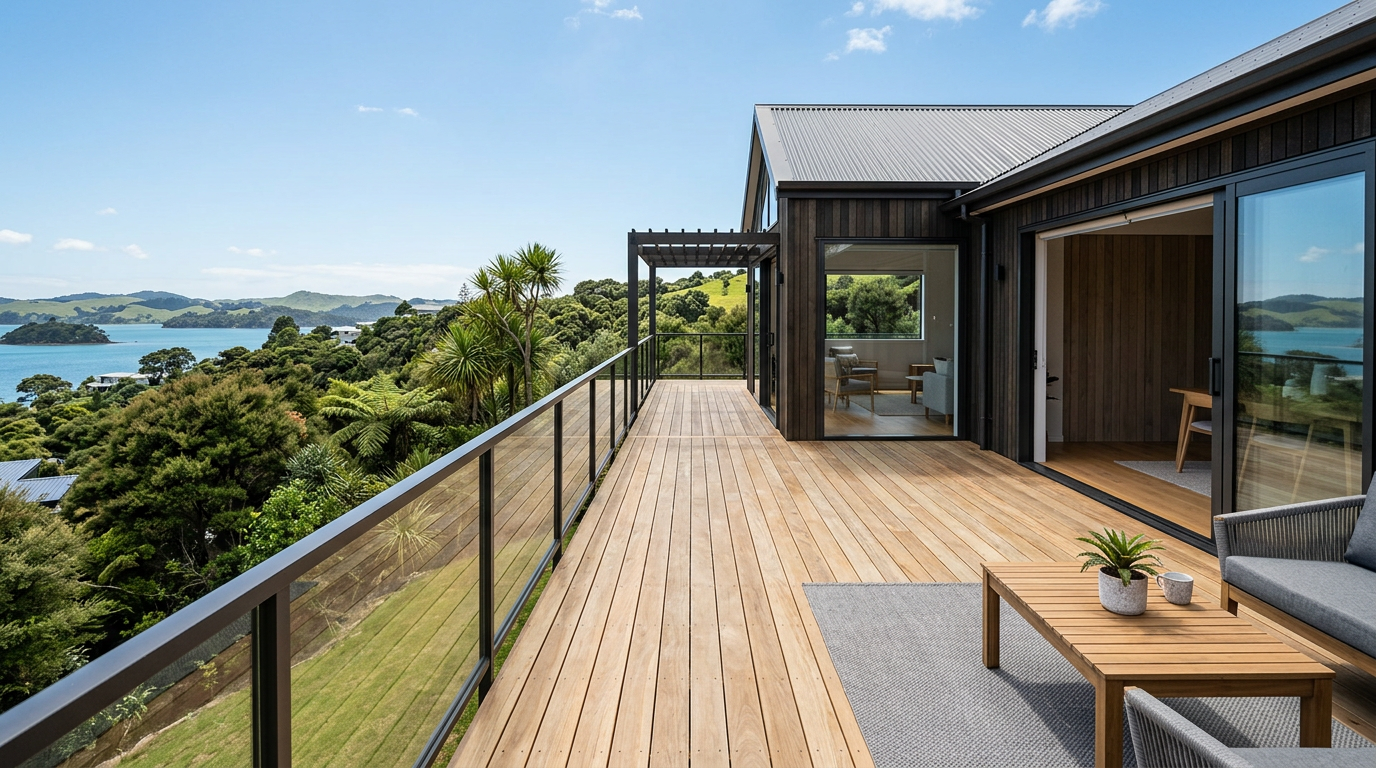
Getting your bearer size right is one of the most important structural decisions when building a deck. Choose too small and your deck could sag, bounce, or even fail — choose too large and you're wasting money. The good news is that for most straightforward residential decks, NZS 3604:2011 (Timber-Framed Buildings) provides span tables that take the guesswork out of it.
What Is a Bearer and What Does It Do?
A bearer is a horizontal structural member that sits on top of your posts and supports the joists above it. It transfers the load from the deck surface down through the posts and into the foundations. Getting the sizing right means understanding how much load the bearer must carry and over what distance it must span.
The Key Variables That Determine Bearer Size
Before you can select a bearer size, you need to nail down four things:
- Span – the distance between the supports (posts) the bearer sits on
- Tributary width – how much of the deck's load the bearer is responsible for (roughly half the joist span on each side)
- Load – residential decks are typically designed for a 1.5 kPa live load plus dead load (the weight of the deck itself)
- Timber species and grade – common NZ options include SG8 or SG10 radiata pine (H3.2 treated for exposed outdoor use), or hardwoods like kwila
Using the NZS 3604 Span Tables
NZS 3604:2011 is the go-to reference for timber-framed construction in New Zealand, and it includes span tables specifically for deck bearers. Here's how to use them:
- Determine your bearer span – measure the distance between post centres.
- Calculate the load width – this is the area of deck the bearer supports. For a bearer running down the middle of a deck, the load width is typically half the joist span on each side added together.
- Find the correct table – NZS 3604 organises bearer tables by load width (e.g., 1.8 m, 2.4 m, 3.0 m, etc.).
- Read off the required size – the table will give you minimum bearer dimensions (depth × width in mm) for your span and timber grade.
As a rough guide only, a 140 × 45 mm SG8 bearer might suit a short 1.5 m span with a modest load width, while a 190 × 45 mm or 190 × 90 mm section may be needed for longer spans or heavier loads. Always confirm against the actual tables — don't rely on rules of thumb for structural decisions.
Important: NZS 3604 applies to low-risk, standard residential situations. If your deck is high off the ground (over 1 m), attached to a multi-storey building, or in a high-wind zone, you may need specific engineering input.
Timber Treatment and Species
All timber used in outdoor decking must be appropriately treated for its hazard level. Bearers in contact with or close to the ground require H4 treatment at minimum; those above ground but exposed to weather need at least H3.2. Check the MBIE Building Performance guidance and your timber supplier's specifications. PlaceMakers and Bunnings both stock a range of treated structural timber suitable for deck framing.
Do You Need a Building Consent?
In New Zealand, many decks require a building consent. Under Schedule 1 of the Building Act, some low decks may be exempt — but the rules have conditions and your local council has the final say. Always check with your local council before starting work. If consent is required, your plans will need to show bearer sizes and how they comply with NZS 3604 or an engineer's design. MBIE Building Performance has clear guidance on consent exemptions.
Double or Triple Bearers
Sometimes a single section isn't large enough for your span. In these cases, you can double or triple bearers (two or three pieces of timber bolted together). NZS 3604 includes provisions for this — a doubled 190 × 45 mm bearer, for example, can span considerably further than a single piece. Make sure members are properly fixed together with galvanised or stainless steel bolts at the correct centres.
A Simple Worked Example
| Variable | Example Value |
|---|---|
| Bearer span (post to post) | 2.4 m |
| Load width (tributary area) | 1.8 m |
| Timber grade | SG8 H3.2 |
| Minimum bearer size (indicative) | 190 × 45 mm (single) |
Always verify against the actual NZS 3604 span tables — this is illustrative only.
When to Call a Professional
While NZS 3604 empowers confident DIYers to size bearers for standard decks, there are situations where you should engage a Licensed Building Practitioner (LBP) or a structural engineer:
- Your deck is more than 1 m above the ground
- The deck is attached to the house and could affect the building envelope
- You're in a high-wind or seismic zone
- The span or load falls outside the NZS 3604 tables
- Your council requires engineering sign-off as part of the consent process
A qualified deck builder will size bearers correctly, ensure your consent documentation is in order, and give you peace of mind that the structure is safe. You can find experienced local deck builders on tradedirectory.co.nz.




 Licensed Building Practitioner (LBP)





