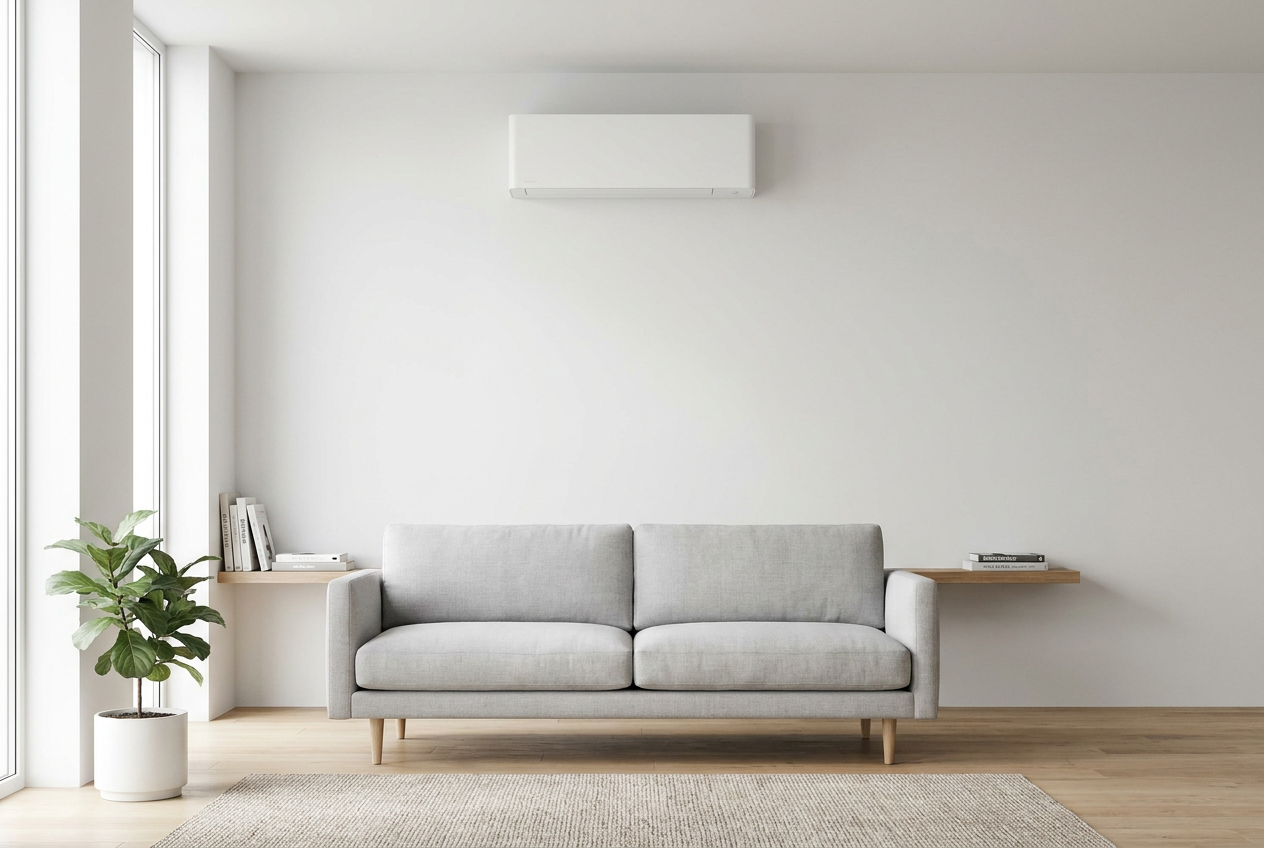
If your heat pump remote seems to stop working whenever you rearrange the lounge, the culprit is almost certainly infrared (IR) signal obstruction. Most heat pump remotes use IR light — the same technology as a TV remote — which travels in a straight line and cannot pass through solid objects. The good news is there are several straightforward fixes you can try yourself before calling a technician.
How Heat Pump IR Remotes Work
Your remote control sends a beam of infrared light to a small receiver window on the indoor unit (the wall-mounted head). IR light is invisible to the naked eye but behaves like a torch beam — it needs a clear line of sight. Anything solid between the remote and the receiver (a bookshelf, a tall sofa, curtains, or even a large pot plant) can block or scatter the signal, making the unit unresponsive.
The receiver window is usually a small dark or tinted panel on the front face of the indoor unit. Check your owner's manual if you're unsure where it is.
Practical DIY Fixes
1. Rearrange Your Furniture Layout
The simplest solution is to ensure there is a clear sightline from your usual seating position to the indoor unit. Even shifting a sofa 30–40 cm can make a significant difference. Aim to keep the area directly in front of the receiver window free of tall furniture.
2. Use the Remote at a Slight Angle
IR receivers on most heat pumps accept signals from a fairly wide angle — often up to 45° either side of centre. If you can't move furniture, try pointing the remote at a slight angle toward the unit rather than directly at it. Some signals can also bounce off light-coloured walls or ceilings, so experimenting with angles is worthwhile.
3. Install an IR Repeater or Extender
An IR repeater kit (sometimes called an IR extender) is a low-cost device that picks up your remote's signal from one location and re-transmits it to the indoor unit via a small wired or wireless emitter placed right at the receiver window. These are available from electronics retailers and some hardware stores. They typically plug into a standard power outlet and require no special wiring — well within DIY territory.
4. Upgrade to a Wi-Fi Smart Controller
Many modern heat pumps can be paired with a Wi-Fi controller or smart adapter (such as those compatible with Mitsubishi Electric, Daikin, Fujitsu, or Panasonic units). These replace or supplement the IR remote with an app on your smartphone, meaning furniture placement becomes completely irrelevant. Check with your heat pump brand's NZ distributor or a qualified installer to confirm compatibility with your specific model.
5. Reposition the Indoor Unit's Receiver (Specialist Option)
Some indoor units allow the IR receiver to be repositioned or an external receiver to be wired in at a more convenient location. This is a job for a qualified heat pump installer, as it involves opening the unit and potentially modifying wiring.
Quick Comparison: Fix Options at a Glance
| Fix | DIY Friendly? | Approximate Cost (guide only) | Best For |
|---|---|---|---|
| Rearrange furniture | Yes | Free | Simple layouts |
| Angle technique | Yes | Free | Temporary fix |
| IR repeater kit | Yes | $20–$80 | Permanent obstruction |
| Wi-Fi smart controller | Usually yes | $100–$300+ | Modern convenience |
| External IR receiver wiring | No — installer needed | Varies | Complex installs |
Costs are approximate guides only and will vary by brand, model, and supplier.
Check the Basics First
Before assuming furniture is the problem, rule out these common issues:
- Low or flat batteries — replace with fresh AA or AAA batteries and test again.
- Dirty receiver window — gently wipe the dark receiver panel on the indoor unit with a soft, dry cloth. Dust and grime can reduce sensitivity.
- Bright sunlight or strong artificial light — intense light sources near the receiver can interfere with IR signals. Try closing blinds and testing again.
- Remote damage — point the remote at your smartphone camera and press a button. If you see a faint purple/white flash on screen, the remote is transmitting. No flash may mean a faulty remote.
Healthy Homes and Heat Pump Placement
If you're a landlord, it's worth knowing that Tenancy Services Healthy Homes standards require compliant heating in rental properties. A heat pump that can't be operated reliably due to poor placement or signal issues could be considered non-compliant. Ensuring your unit is accessible and functional is part of meeting those obligations.
For general guidance on heat pump efficiency and placement in NZ homes, Energywise has useful resources on getting the most from your heating system.
When to Call a Professional
Most of the fixes above are straightforward DIY tasks. However, you should contact a qualified heat pump installer if:
- You want an external IR receiver wired into your indoor unit — this involves opening the unit and modifying internal wiring, which should only be done by someone with the appropriate training.
- You're considering relocating the indoor unit entirely to a better position — this involves refrigerant handling, which is restricted work in New Zealand and must be carried out by a certified refrigeration/heat pump technician.
- Your remote or control board appears faulty and needs replacement or reprogramming.
For refrigerant-related work, always use a technician certified under the relevant NZ requirements. You can find qualified local heat pump installers on tradedirectory.co.nz to get the job done safely and correctly.
For broader building and compliance questions, MBIE Building Performance is a reliable reference for NZ homeowners.



 ISO 9001






