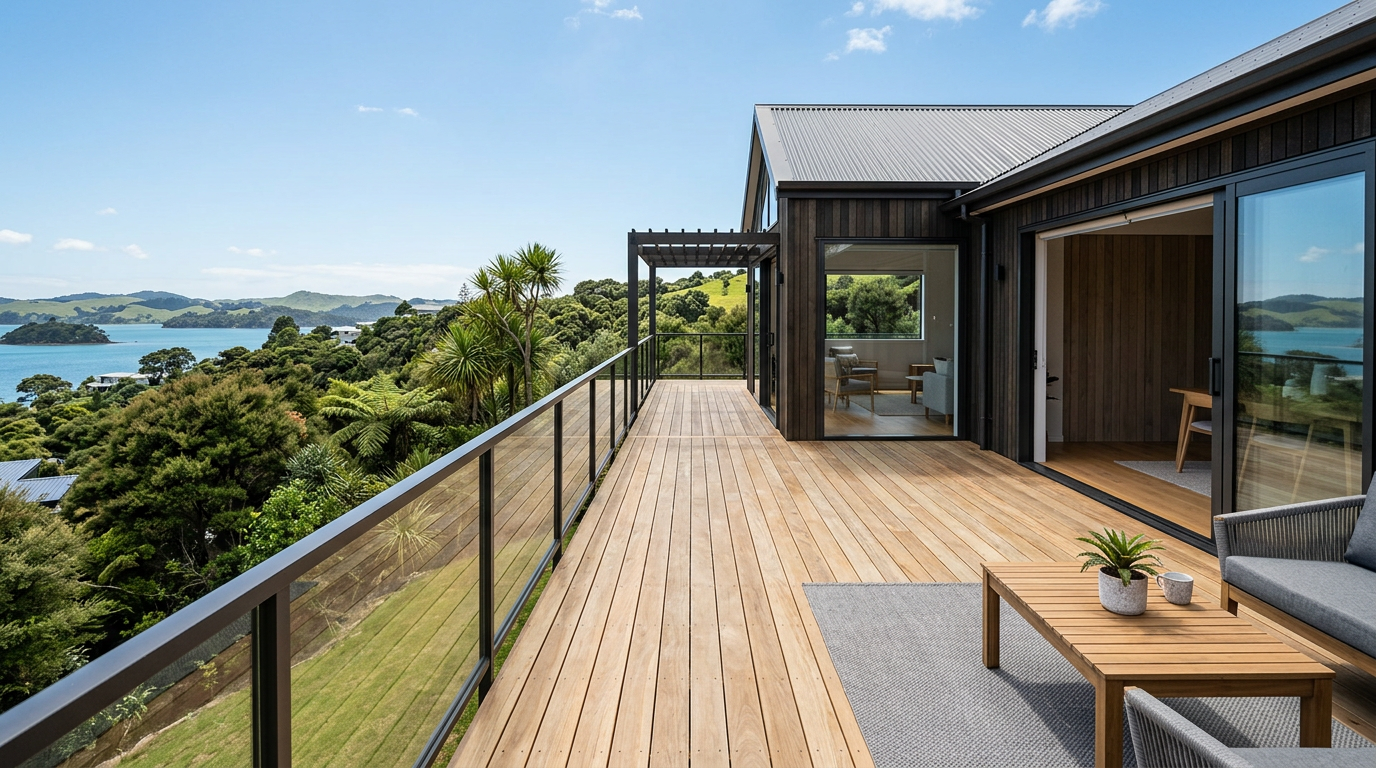
Paying a deck builder the full amount before a single board is laid is a significant financial risk, and it's not standard practice in the New Zealand building trade. While it's normal for builders to ask for a deposit or progress payments, a demand for 100% upfront should raise a red flag. Here's what you need to know to protect yourself.
Why Full Upfront Payment Is a Red Flag
Reputable tradespeople generally don't need full payment before starting work. A demand for the entire sum upfront can indicate cash flow problems, a lack of business stability, or — in the worst cases — a scam. If a builder disappears with your money before completing the job, recovering it can be difficult and stressful.
This doesn't mean every builder who asks for a larger-than-usual deposit is dishonest, but it does mean you should ask questions and understand your rights before handing over any money.
What Is a Fair Payment Structure?
A reasonable payment schedule for a deck build in New Zealand typically looks something like this:
| Stage | Typical Payment |
|---|---|
| Deposit on signing contract | 10–20% of total cost |
| Materials delivered / work begins | 20–30% |
| Midpoint / framing complete | 20–30% |
| Practical completion | Remaining balance |
This structure protects both parties — you're not paying for work that hasn't happened, and the builder isn't funding the entire project out of their own pocket. Always agree on the schedule in writing before work starts.
Your Rights Under NZ Consumer Law
If you're hiring a builder as a private homeowner, you're protected by the Consumer Guarantees Act 1993 and the Fair Trading Act 1986. These laws require that services are carried out with reasonable care and skill, and that the trader doesn't mislead you. Consumer NZ has plain-English guidance on your rights when hiring tradespeople.
If a dispute arises, you may be able to take a claim to the Disputes Tribunal (for amounts up to $30,000) without needing a lawyer.
Always Use a Written Contract
Before any money changes hands, insist on a written contract that clearly sets out:
- Scope of work — exactly what is being built, including dimensions, materials, and any extras
- Payment schedule — amounts and trigger points (not just dates)
- Timeline — start date and estimated completion
- Variations process — how changes to scope are agreed and priced
- Consent responsibilities — who is responsible for obtaining any required building consent
A verbal agreement is very hard to enforce. A written contract protects you both.
Building Consent — Don't Overlook It
Many decks in New Zealand require a building consent from your local council. Under Schedule 1 of the Building Act 2004, some low-level decks may be exempt, but the rules depend on the height of the deck, its proximity to boundaries, and other factors. Always confirm with your local council whether consent is needed — don't rely solely on the builder's advice.
For more on the Building Code and consent requirements, MBIE Building Performance is the authoritative source. If consent is required, the builder should be a Licensed Building Practitioner (LBP) to carry out or supervise the restricted building work.
Check the Builder's Credentials
Before agreeing to anything, verify:
- LBP licence — Search the LBP register at lbp.govt.nz to confirm they hold a current licence in the relevant class (usually Carpentry)
- GST registration — Legitimate businesses trading above the GST threshold must be registered
- References — Ask for at least two recent references from completed deck projects and follow them up
- Insurance — Confirm they hold public liability insurance
Practical Steps If a Builder Insists on Full Payment
If a builder won't budge from their demand for full upfront payment, here's what to do:
- Ask why — A genuine explanation (e.g., a large custom timber order requiring pre-payment) may be reasonable for a portion of costs, not the full amount.
- Offer a compromise — Propose a fair progress payment schedule as outlined above.
- Get a second quote — Use this as an opportunity to compare. You can find qualified local deck builders on tradedirectory.co.nz.
- Walk away if needed — If they refuse any reasonable payment structure, it's often safer to find someone else.
- Never pay cash without a receipt — Always pay by bank transfer so you have a clear record.
When to Call a Professional
Deck building that involves restricted building work (generally decks more than 1.5 metres above ground, or attached to a house in certain ways) must be carried out or supervised by a Licensed Building Practitioner. If your deck also involves electrical work (such as outdoor lighting or power points), that must be done by a registered electrician — see EWRB for more information. For any plumbing connections, check PGDB.
If you're unsure about any aspect of your project, engaging a qualified professional from the start is always the safest approach. A good deck builder will welcome your questions and be transparent about costs, credentials, and process.




 Licensed Building Practitioner (LBP)