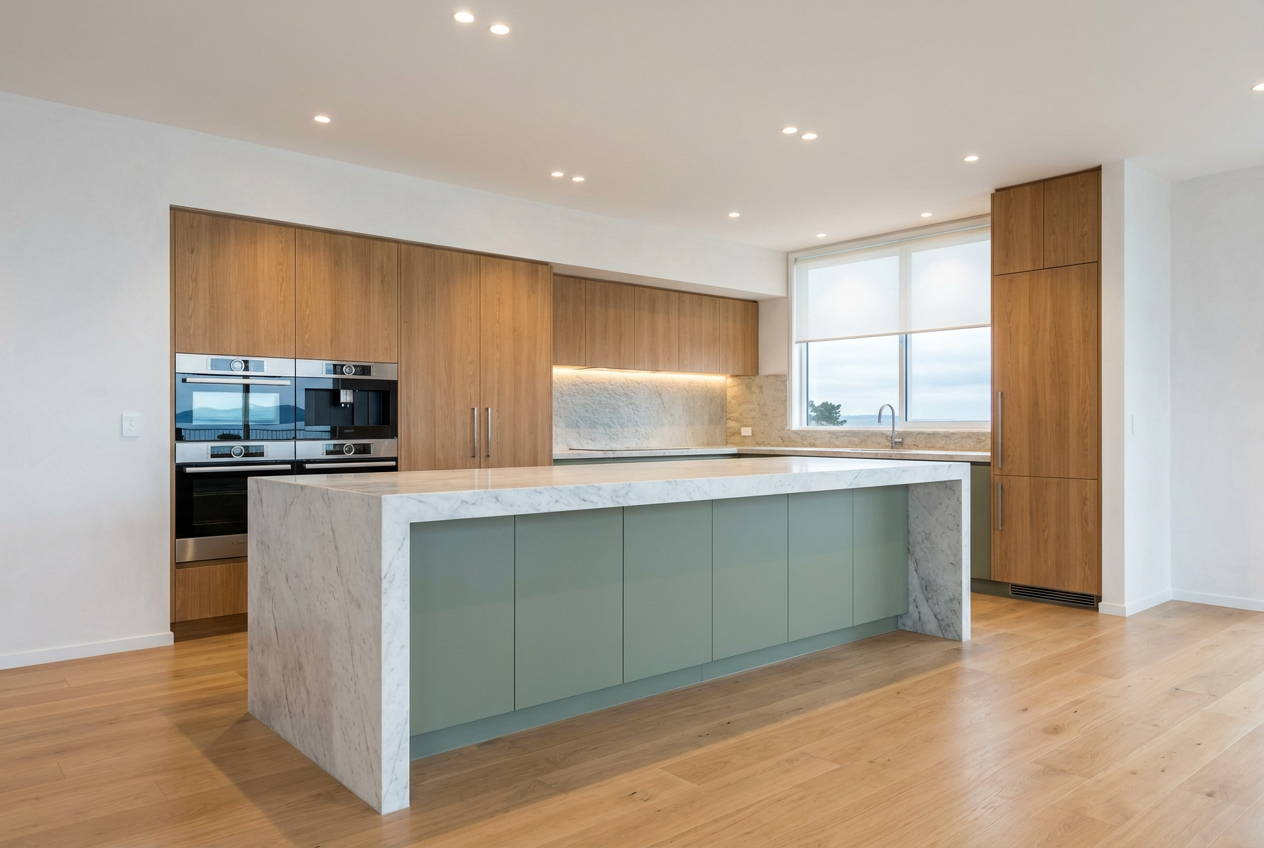
A warped cabinet door is a frustrating but surprisingly common problem in New Zealand homes, where humidity swings — especially in kitchens, bathrooms, and coastal properties — can cause timber and MDF doors to twist or bow over time. The good news is that in many cases you can straighten a warped door without replacing it, using a few simple techniques and a bit of patience.
Why Cabinet Doors Warp
Understanding the cause helps you choose the right fix — and prevent it happening again. Cabinet doors warp when one face absorbs or loses moisture faster than the other, causing uneven expansion or contraction. Common culprits include:
- Unfinished or poorly sealed backs — if only the front face is painted or sealed, moisture enters through the bare back
- Steam and humidity — particularly near dishwashers, sinks, and stovetops
- Direct sunlight — UV and heat dry out one side faster than the other
- Low-quality MDF or particleboard — more susceptible than solid timber or quality plywood
- Poor storage or installation — doors stored flat on a damp concrete floor before installation can warp before they're even hung
BRANZ provides useful guidance on moisture management in NZ homes, which is worth reading if warping is a recurring issue.
Assess the Warp First
Before you start, lay the door on a flat surface (a workbench or flat floor) and identify the type of warp:
- Bow — the door curves along its length or width (like a gentle arch)
- Twist — opposite corners lift off the flat surface (also called a wind or cup)
- Cup — the door curves across its width
A bow or cup is generally easier to fix than a twist. Use a straightedge or spirit level to measure how severe the warp is. If the gap is more than about 6–8 mm across the door's face, the fix may be more involved.
Method 1 – Moisture and Weight (Best for Mild Bows)
This is the most straightforward approach and works well on solid timber and MDF doors with a gentle bow.
- Remove the door from its hinges and lay it on a flat surface.
- Dampen the concave (hollow) side — place damp towels or a wet cloth on the hollow face. For MDF, be careful not to over-saturate; light dampness is enough.
- Weight it down — place heavy, flat objects (stacks of books, concrete blocks, or clamps to a flat board) evenly across the door, with the convex (raised) side facing down.
- Leave it for 24–72 hours, checking periodically. The goal is to let the drier, concave side absorb a little moisture and relax.
- Once straightened, seal all faces and edges immediately with a quality primer and paint to lock in the moisture balance. Resene and Dulux both offer suitable interior primers for timber and MDF.
Important tip
Always seal all six faces of a cabinet door — front, back, and all four edges — to prevent future warping. This is the single most effective preventive measure.
Method 2 – Hinge and Hardware Adjustment (Best for Slight Twists)
Sometimes what looks like a warp is actually a hinge alignment issue. Modern concealed (euro-style) hinges are adjustable in three directions — in/out, up/down, and side to side — and can compensate for a small amount of twist or misalignment.
- With the door hung, use a screwdriver or hex key to adjust the hinge screws.
- Most concealed hinges have a depth adjustment screw (moves the door in or out from the cabinet face) and a lateral adjustment screw (moves it side to side).
- Work methodically — adjust one hinge at a time and check the door gap with each change.
- If the door has older butt hinges, check that the hinge recesses (mortises) are cut evenly and that no screws are loose or stripped.
You can find replacement concealed hinges and adjustment tools at Bunnings or Mitre 10.
Method 3 – Clamping to a Straight Board (Best for Moderate Warps)
For a more stubborn warp, try clamping the door to a known-flat piece of timber or MDF:
- Source a straight, flat board slightly larger than the door (18 mm MDF sheet works well).
- Place the door convex-side down on the flat board.
- Clamp firmly at multiple points along the length and width.
- Leave clamped for several days — some cabinetmakers leave doors clamped for up to a week.
- Release slowly and check. Repeat if needed.
For severe or persistent warps, a cabinetmaker may use a router sled or thicknesser to skim the door face flat — this is a workshop technique best left to a professional.
Preventing Future Warping
- Seal all faces and edges before and after installation
- Ensure good kitchen and bathroom ventilation — Energywise has helpful advice on ventilation in NZ homes
- Avoid placing cabinet doors near direct heat sources like ovens or dishwasher vents
- Use moisture-resistant MDF (sometimes called MR MDF) in wet areas
- Store replacement doors vertically or flat on a level surface before installation
When to Call a Professional
If the warp is severe (more than 8–10 mm), the door is delaminating, or multiple doors are affected throughout the kitchen, it's worth calling a qualified cabinet maker or joiner. They can assess whether the issue is the doors themselves, the cabinet carcasses, or an underlying moisture problem in the home. A professional can also machine-flatten doors and re-seal them properly in a controlled workshop environment.
You can find experienced local cabinet makers and joiners on tradedirectory.co.nz.
Note: Cabinet door repairs are not restricted building work under the NZ Building Code, so no building consent is required. However, if warping is linked to a moisture or weathertightness issue in the building itself, you may need to consult MBIE Building Performance or your local council.