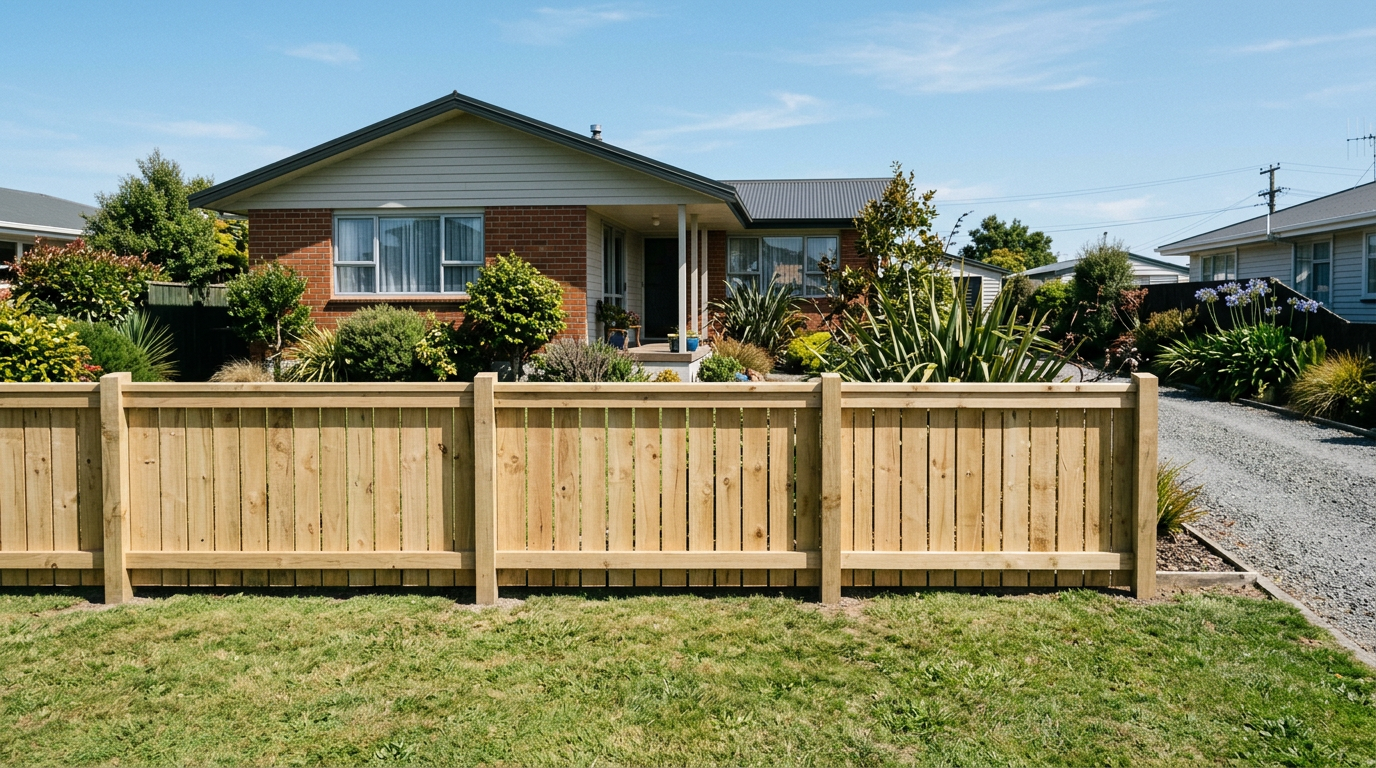
A long fence run bows in the middle when the posts are spaced too far apart, set too shallowly, or lack adequate bracing — and NZ's variable soils and wind conditions make this a common problem. The good news is that with the right post spacing, diagonal stays, and a few practical tricks, you can straighten an existing fence or build a new one that stays true for years.
Why Long Fence Runs Bow
Bowing happens when the rails and palings push outward under their own weight and wind load, and the posts can't resist that lateral force. Common causes include:
- Posts spaced too far apart (over 2.4 m is often too wide for standard timber fencing)
- Posts not set deep enough in the ground
- Soft or wet soil that allows post movement
- No diagonal bracing or mid-run stays
- Rails that have warped or dried out unevenly
In exposed or coastal NZ locations, wind load is a significant factor. BRANZ publishes guidance on wind zones across New Zealand, and fences in high-wind areas need more robust bracing than sheltered suburban sections.
Correct Post Spacing and Depth
As a general rule for standard timber paling or picket fences:
| Fence height | Recommended post spacing | Minimum post depth in ground |
|---|---|---|
| Up to 1.2 m | Up to 2.4 m | 450–500 mm |
| 1.2 m – 1.8 m | 1.8 m – 2.4 m | 600 mm |
| 1.8 m – 2.1 m | 1.5 m – 1.8 m | 700–750 mm |
These are general guides — always check with your local council and consider your specific soil type and wind exposure. Posts in sandy or loose soil may need to go deeper or be set in concrete.
Adding a Mid-Run Strainer or Intermediate Post
The simplest fix for an existing bowing run is to add an intermediate post at the midpoint of the bow. Dig a new hole, set a post to the correct depth (in concrete if the soil is soft), and attach your rails to it. This immediately halves the unsupported span and dramatically reduces flex.
For very long runs (over 15–20 m), consider adding strainer posts — heavier-gauge posts, often 100 × 100 mm timber or steel, set deeper and sometimes in concrete — at regular intervals to anchor the run.
Diagonal Bracing Techniques
Diagonal stays are the most effective way to brace a fence run against bowing and racking. There are two main approaches:
1. Angled Prop Stay
A timber prop (typically 75 × 50 mm or 100 × 50 mm) is fixed at an angle from the base of the post to a point on the rail or an adjacent post. The prop pushes back against the direction of lean. This works well on corner and end posts.
2. Wire Straining (for post-and-rail or farm-style fences)
A high-tensile wire is run diagonally from the top of one post to the base of the next, then tensioned with a wire strainer. This pulls the posts upright and keeps the run straight. It's a classic NZ rural fencing technique and very effective on longer runs.
3. Horizontal Rail Tension
For timber paling fences, make sure your top and bottom rails are straight, properly fixed, and not warped. A bowed rail will pull the palings with it. Replace any badly warped rails and use two fixing points per paling to keep everything aligned.
Concrete vs Compacted Backfill
There's ongoing debate about whether to concrete posts in or use compacted backfill. Both can work well:
- Concrete (a dry-mix or wet-pour) gives maximum stability, especially in soft or wet soils. Allow at least 24–48 hours to cure before loading the post.
- Compacted backfill (gravel or the original soil rammed in layers) is easier to remove if you need to replace a post later, and works fine in firm, well-draining ground.
In clay-heavy NZ soils that expand and contract with moisture, some fencers prefer compacted gravel backfill to reduce heaving. Ask a local fencer what works best in your area.
Checking and Correcting an Existing Bow
- Stretch a string line along the full fence run at rail height to see exactly where and how much it bows.
- Identify whether the bow is caused by post movement, rail warp, or both.
- If posts have moved, you may need to excavate and re-set them, or add new intermediate posts.
- If rails are warped, replace them and use a string line to keep new rails straight during fixing.
- Once posts are plumb and rails are straight, add diagonal bracing or stays to hold the position.
A post level or standard spirit level will help you confirm posts are plumb (vertical) in both directions before backfilling.
Materials and Where to Find Them
Timber posts, rails, and bracing timber are available from Bunnings, Mitre 10, and PlaceMakers. Use H4-treated timber for any timber going in or near the ground — this is the NZ standard for in-ground contact and is essential for durability in our climate.
Building Consent Considerations
Most residential boundary fences under 2 m high don't require a building consent under Schedule 1 of the Building Act, but always confirm with your local council before starting work — rules vary by district and there may be specific requirements around retaining walls, shared boundaries, or heritage overlays. The MBIE Building Performance website has useful guidance on consent exemptions.
When to Call a Professional
If your fence run is long, on a slope, in high-wind exposure, or the bowing is severe, it's worth getting a qualified fencer to assess the job. A professional will have the right tools to pull posts plumb, tension wire correctly, and ensure the whole run is structurally sound. You can find experienced local fencers on tradedirectory.co.nz.





