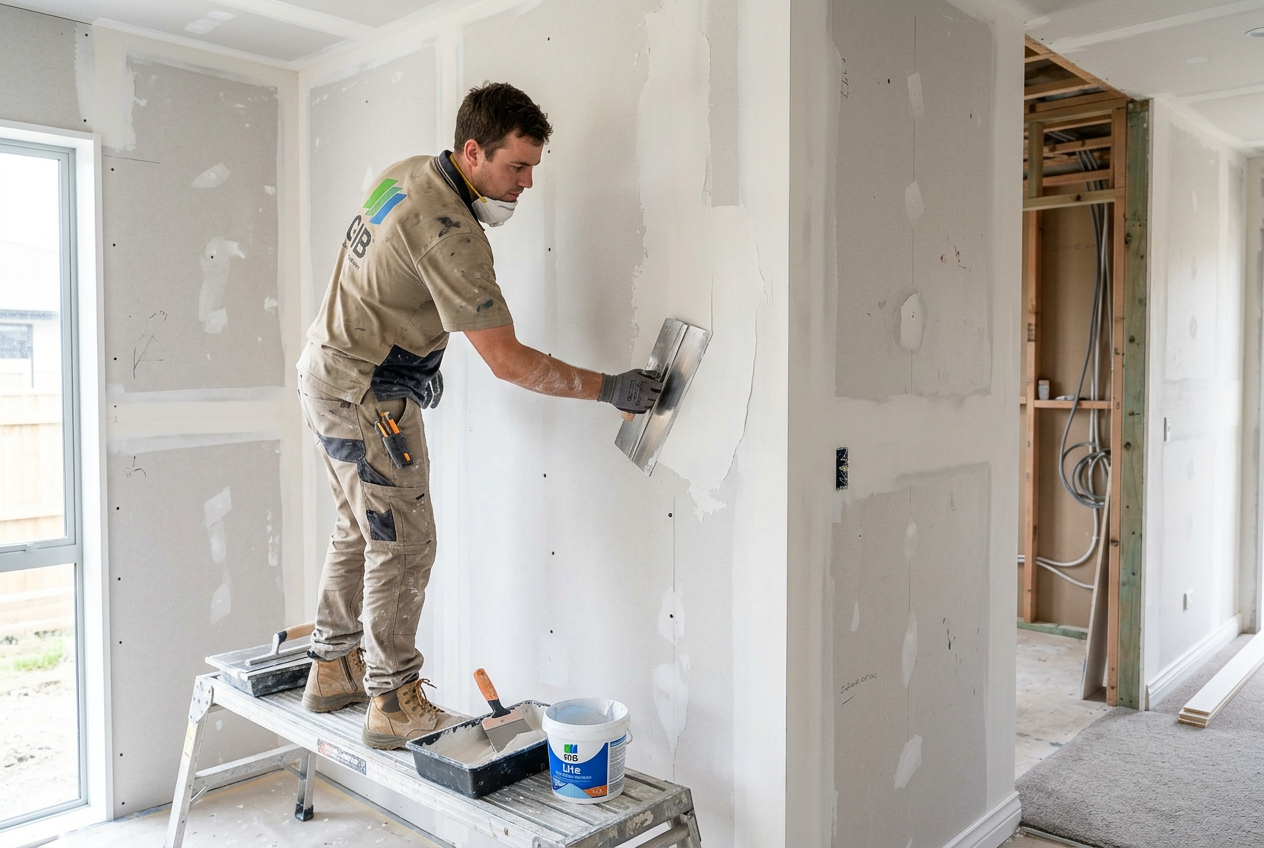
Choosing the right plasterboard might seem straightforward until you're standing in the aisle at Bunnings or PlaceMakers staring at several different GIB products. Get it wrong and you could end up with a wall that fails a building inspection, deteriorates in a wet area, or doesn't meet the bracing requirements of the NZ Building Code. This guide breaks down the three most common GIB plasterboard types so you can make a confident, informed decision.
What Is GIB Plasterboard?
GIB is the dominant plasterboard brand in New Zealand, manufactured by Winstone Wallboards. It's a gypsum-based panel used to line interior walls and ceilings in the vast majority of NZ homes. While the core material is similar across the range, each product has a specific formulation, facing, or structural role that makes it suited — or unsuited — to particular applications.
Under the NZ Building Code, interior linings must meet performance requirements around moisture resistance (Clause E3), structural bracing (Clause B1), and fire safety (Clause C). Picking the right board from the start keeps your project compliant and avoids costly remediation later.
GIB Standard: The Everyday Workhorse
GIB Standard (also called GIB Ultraline in some configurations) is the go-to lining board for general interior walls and ceilings in dry, non-structural areas. It has a paper-faced gypsum core and comes in a range of thicknesses — most commonly 10 mm for walls and 13 mm for ceilings.
It's cost-effective, easy to cut and fix, and takes paint and texture coatings well. For living rooms, bedrooms, hallways, and most ceiling applications, standard board is entirely appropriate. It is not suitable for wet areas or locations where it will be exposed to sustained moisture.
GIB Aqualine: Built for Wet Areas
GIB Aqualine is specifically engineered for wet and high-humidity areas such as bathrooms, ensuites, laundries, and kitchen splashback zones. It has a moisture-resistant gypsum core and a water-repellent facing that resists the penetration of moisture far better than standard board.
Building Code Clause E3 (Internal Moisture) requires that wet area linings be durable and moisture-resistant. BRANZ research consistently shows that moisture ingress behind linings is one of the leading causes of building defects in NZ homes — particularly in our humid coastal and northern regions. Using Aqualine in these areas is considered best practice and is often specified by designers and building consent documents.
Importantly, Aqualine is moisture-resistant, not waterproof. It still requires proper waterproof membrane systems (such as those from Ardex or Mapei) behind tiled surfaces, and correct sealing at junctions. It should not be used as a substitute for a proper wet area system.
GIB Braceline: Structural Bracing in a Board
GIB Braceline is a high-density, 12 mm plasterboard designed to provide structural bracing in timber-framed walls. Rather than installing separate bracing elements (like let-in braces or steel strap bracing), Braceline panels are fixed to the framing in a specific pattern to achieve a rated bracing unit value under NZS 3604:2011 (Timber-framed buildings).
This makes it popular in new builds and renovations where engineers or designers have specified plasterboard bracing as part of the structural solution. The fixing schedule is critical — Braceline must be installed exactly as per the GIB fixing guide to achieve its rated bracing value. This is not a board you improvise with.
Braceline can also be used as a general lining board in dry areas, but its primary value is structural. It is not moisture-resistant and should not be used in wet areas.
Head-to-Head Comparison
| Feature | GIB Standard | GIB Aqualine | GIB Braceline |
|---|---|---|---|
| Primary use | General dry lining | Wet & humid areas | Structural bracing walls |
| Moisture resistance | Low | High | Low |
| Structural bracing | No | No | Yes (rated) |
| Common thickness | 10 mm, 13 mm | 10 mm, 13 mm | 12 mm |
| Relative cost (guide only) | $ (lowest) | $$ (moderate premium) | $$ (moderate premium) |
| NZ Building Code relevance | General lining | Clause E3 (moisture) | Clause B1 (structure) |
| DIY-friendly? | Yes | Yes (with correct system) | Requires precise fixing schedule |
| Suitable for ceilings? | Yes | Yes (humid areas) | Not typically |
| Paintable / tileable? | Paint only | Paint or tile (with membrane) | Paint only |
Cost Considerations
As a rough guide only, GIB Standard is the most affordable option per sheet. Aqualine and Braceline carry a moderate price premium — typically in the range of 20–40% more per sheet than standard board, though prices vary by supplier and sheet size. Always get current pricing from Mitre 10, PlaceMakers, or Bunnings, as building material costs fluctuate.
The real cost consideration is getting it wrong. Using standard board in a wet area can lead to mould, structural damage, and failed inspections — remediation costs far outweigh the small savings on board price. Similarly, omitting Braceline where it's been specified in a bracing plan can result in a building that doesn't meet earthquake or wind load requirements.
What a Homeowner Can DIY — and What Needs a Pro
Fixing plasterboard is generally not restricted building work under the Building Act, so homeowners can tackle it themselves in many situations. However:
- Stopping (taping and plastering) the joints to a professional finish is a skilled trade. Poor stopping is very obvious once painted. Hiring a qualified plasterer from tradedirectory.co.nz will save you time and frustration.
- Wet area systems involving waterproof membranes should be installed correctly and may be subject to building consent. Check with your local council.
- Braceline installation must follow the GIB fixing schedule precisely to achieve the rated bracing value. If this is part of a consented structural bracing plan, the work may need to be carried out or supervised by a Licensed Building Practitioner (LBP).
- Any work involving electrical or plumbing behind walls is restricted work and must be done by a registered electrician (EWRB) or licensed plumber (PGDB).
Safety note: When cutting plasterboard, wear a dust mask rated P2 or better. Gypsum dust is an irritant. Work in a ventilated space and dispose of offcuts responsibly.
Our Recommendation
Here's a simple decision guide for common NZ scenarios:
- Bedroom, lounge, hallway, or study? → GIB Standard is all you need.
- Bathroom, ensuite, laundry, or kitchen splashback wall? → GIB Aqualine, paired with an appropriate waterproof membrane system behind tiles.
- Bracing wall specified by your designer or engineer? → GIB Braceline, installed strictly to the manufacturer's fixing schedule.
- Not sure what's been specified? → Check your building consent documents, or ask a qualified plasterer or LBP to review the plans before you buy materials.
When in doubt, always go up a grade rather than down. The cost difference between board types is small; the cost of fixing a mistake is not.

 Master Painters NZ member








