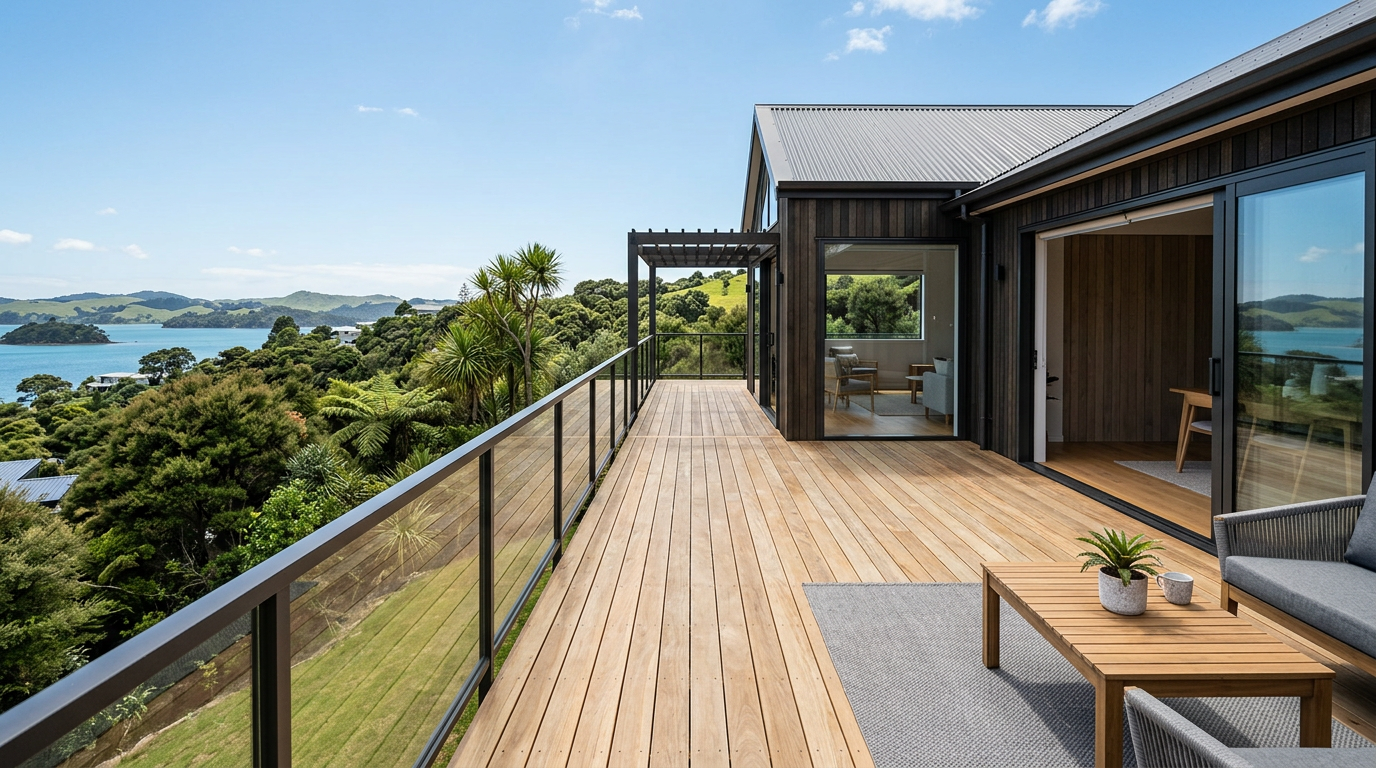
Technically, treated pine framing timber can be laid as a deck surface, but it is generally not recommended and in most cases will give you a poor result. Framing timber and decking boards are graded, treated, and dimensioned for very different purposes — and mixing them up can lead to a deck that warps, splinters, and deteriorates far sooner than it should.
What's the Difference Between Framing Timber and Decking Boards?
The key differences come down to treatment level, grade, and profile.
- Framing timber (the structural stuff used for joists, bearers, and posts) is typically graded to structural standards and treated to H3.2 for above-ground exterior use, or H4/H5 for in-ground contact. It is sawn square-edged and is not intended to be walked on or to shed water effectively.
- Decking boards are specifically graded and profiled for surface use. They are usually treated to at least H3.2 (for above-ground decks), come in a rounded or radiused edge profile to reduce splintering, and are often dried or seasoned to reduce movement after installation.
Framing timber is typically rough-sawn, which means it can be quite rough underfoot and prone to splintering — not ideal for bare feet on a summer afternoon.
Treatment Levels and the NZ Building Code
Under the NZ Building Code, decking must be durable enough to last the expected life of the building. Clause B2 (Durability) requires that structural and exposed elements meet minimum service life requirements — generally 15 years for elements that are difficult to replace, and 5 years for easily replaceable ones.
For deck framing (joists, bearers, posts), H3.2 to H5 treatment is required depending on whether the timber is above ground, in ground, or in contact with concrete. For the decking surface boards themselves, H3.2 is the minimum for above-ground exterior exposure in most NZ conditions.
Framing timber is often treated to H3.2, so the treatment level may technically meet the requirement for surface boards — but treatment level alone doesn't make it suitable. Always check the timber's stamp and confirm with your local council if you're unsure about compliance.
Why Framing Timber Performs Poorly as a Deck Surface
Moisture Movement and Warping
Framing timber is often sold unseasoned or partially seasoned, meaning it still contains significant moisture. Once laid flat and exposed to sun and rain, it will dry unevenly and is very likely to cup, bow, and twist — leaving you with a wavy, uneven surface that's both unsightly and a trip hazard.
Splintering
The rough-sawn surface of framing timber is not finished for foot traffic. Even after sanding, the grain structure means it can splinter readily, especially as it weathers.
No Drainage Profile
Decking boards are typically profiled with a slight camber or groove to help shed water and reduce the risk of water pooling. Flat framing timber holds water on its surface, accelerating rot and creating slip hazards.
Appearance
Framing timber is not graded for appearance. You're likely to get more knots, rough patches, and inconsistency than with purpose-made decking.
What Should You Use Instead?
For a quality, long-lasting deck surface in New Zealand, consider these options:
| Material | Pros | Cons |
|---|---|---|
| Treated pine decking (H3.2) | Affordable, widely available, paintable/stainable | Needs regular maintenance, can still move |
| Hardwood decking (e.g. kwila/merbau) | Durable, attractive, dense | More expensive, needs oiling |
| Composite decking | Low maintenance, consistent look | Higher upfront cost |
| Radiata pine decking boards | Cost-effective, NZ-grown | Softer than hardwood |
Purpose-made treated pine decking boards are readily available from suppliers like Bunnings, Mitre 10, and PlaceMakers. They are specifically dimensioned (commonly 90×19 mm or 140×19 mm), profiled, and graded for surface use.
Do You Need a Building Consent?
In New Zealand, many decks are exempt from building consent under Schedule 1 of the Building Act, but this depends on the deck's height, size, and proximity to boundaries or other structures. As a general guide, decks under 1.5 m above ground and within certain size limits may be exempt — but the specific height and size thresholds should be confirmed with your local council — but always confirm with your local council before starting work, as rules vary. You can find general guidance at MBIE Building Performance.
For structural framing work on a deck, if you're not confident in your abilities, it's worth consulting a Licensed Building Practitioner (LBP) who can ensure the work meets code.
Finishing and Maintenance
Whatever timber you choose for your deck surface, proper finishing is essential. A quality exterior decking oil, stain, or paint from suppliers like Resene or Dulux will protect the timber from UV and moisture. Plan to re-coat every 1–2 years depending on your climate and the product used.
When to Call a Professional
If your deck is elevated (over 1 m), attached to the house, or requires a building consent, it's strongly advisable to engage a qualified deck builder or LBP. Structural errors on elevated decks can be dangerous. A professional will also know the correct timber specifications, fixing methods, and spacing requirements to meet the NZ Building Code. You can find experienced local deck builders on tradedirectory.co.nz.



 Licensed Building Practitioner (LBP)