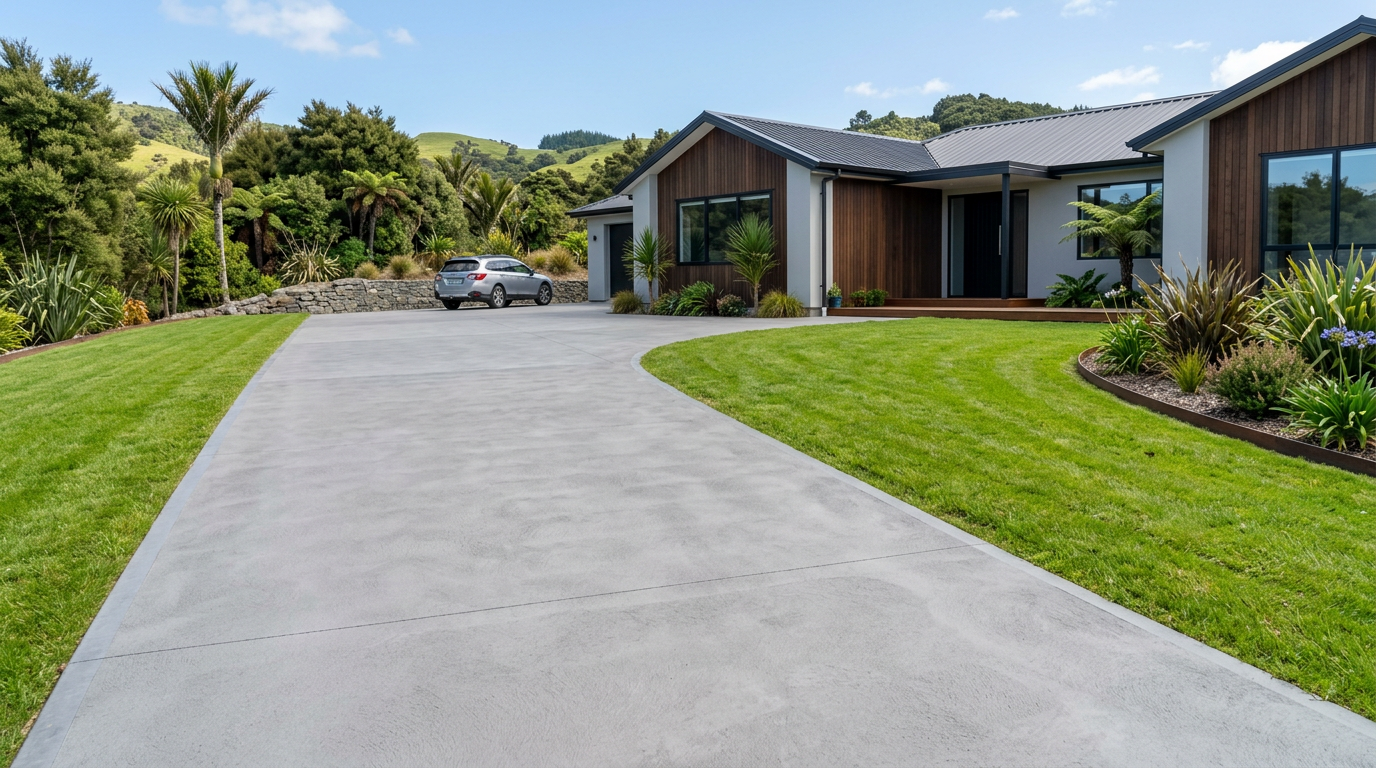
Yes, you can use a hired concrete pump for a steep driveway pour — and for many steep sites it's actually the best option. Wheelbarrowing or chuting concrete up a significant gradient is slow, exhausting, and risks the mix stiffening before it's placed. A pump gets concrete exactly where you need it, quickly and consistently. That said, steep driveway pours involve real planning, the right concrete mix, and a clear understanding of what you can and can't do yourself.
Why a Concrete Pump Makes Sense on a Steep Driveway
On a driveway with a gradient steeper than roughly 1:8 (about 12%), direct chuting from a ready-mix truck becomes difficult or impossible. A line pump (trailer-mounted, with flexible hose) or a boom pump (truck-mounted with an articulated arm) can place concrete precisely without the truck needing to access the site at all.
Key advantages:
- Concrete reaches the pour zone fast, reducing the risk of premature setting
- Less manual handling on a slippery, steep surface
- Consistent placement reduces cold joints and honeycombing
- Smaller access footprint — useful on tight suburban sections
For most residential driveways, a line pump hired through a local concrete or equipment hire company is sufficient. Boom pumps are typically used for larger commercial pours.
Getting the Concrete Mix Right for Pumping
Not every concrete mix pumps well. You'll need to specify a pumpable mix when ordering from your ready-mix supplier. Key points:
- Minimum slump of around 80–100 mm is generally needed for pumping (confirm with your pump hire company and concrete supplier)
- Aggregate size should typically be no larger than 20 mm for standard line pumps — check the pump's specification sheet
- Pump mix additives (plasticisers) may be recommended by your supplier to improve workability without adding excess water
- Avoid mixes with very low water-cement ratios unless a suitable plasticiser is used
For a driveway, a standard 25 MPa or 30 MPa mix is common in NZ residential work. On a steep gradient, 30 MPa is often preferred for durability and resistance to surface wear. Always discuss your specific gradient and use with your concrete supplier.
Planning the Pour on a Steep Gradient
Steep driveways need extra thought before the truck arrives:
Formwork and reinforcing
- Formwork must be braced firmly — wet concrete is heavy and will push hard against forms on a slope
- Steel reinforcing mesh (typically 665 or 768 mesh for residential driveways) or deformed bar should be correctly positioned on chairs to maintain cover — usually 40–50 mm from the bottom
- Consider transverse construction joints every 3–4 metres to control cracking and make the pour manageable in sections
Surface texture
- On steep driveways, a broom finish (brushed transversely across the slope) is essential for traction — a smooth trowel finish will be dangerously slippery when wet
- Exposed aggregate is another popular NZ option for grip
Pump hose placement
- Plan where the pump hose will run before the truck arrives — hoses filled with concrete are heavy and awkward to move
- Keep hose bends as gentle as possible to avoid blockages
Do You Need a Building Consent?
In New Zealand, building consent may be required for a new driveway or significant alterations, depending on your council and the specifics of the work. Some driveway work may qualify as Schedule 1 exempt building work under the Building Act 2004, but this depends on factors like retaining walls, drainage, and proximity to boundaries.
Always check with your local council before starting. You can find general guidance at MBIE Building Performance. Getting this wrong can cause issues when you sell the property.
Safety on the Day
Concrete pumping on a steep site carries real risks. Keep these in mind:
- Never stand downhill of a loaded pump hose — a blockage and sudden release can cause serious injury
- Wear waterproof gloves, gumboots, and eye protection — wet concrete is caustic and will burn skin
- Ensure the pump operator (if hired with an operator) is experienced with sloped residential pours
- Keep children and bystanders well clear of the work zone
- Concrete trucks are heavy — check your kerb, footpath, and driveway apron can handle the load, and notify your council if the truck needs to park on the road
Refer to WorkSafe NZ for general guidance on safe concrete work practices.
Drainage and the NZ Building Code
Driveways must drain correctly to avoid water pooling or directing runoff onto neighbouring properties or into the house. The NZ Building Code Clause E1 (Surface Water) is relevant here. On a steep driveway, channel drains or slot drains at the base are commonly required. Check requirements with your council and ensure any drainage connections to the stormwater system comply with local rules.
For guidance on stormwater and surface water, BRANZ is a reliable NZ resource.
When to Call a Professional
While an experienced DIYer can manage parts of a driveway pour, a steep site significantly raises the complexity. Consider hiring a qualified driveway layer or concrete contractor if:
- Your driveway gradient exceeds 1:5 (20%) — formwork, reinforcing, and finishing become much more demanding
- You're unsure about mix design, pump sizing, or formwork bracing
- The project involves retaining walls, drainage structures, or work near boundaries (some of this may be restricted building work requiring a Licensed Building Practitioner)
- You've never operated a concrete pump before — pump hire companies often supply an operator, which is worth the extra cost on a tricky pour
You can find experienced local driveway layers and concrete contractors on tradedirectory.co.nz.
Sources & Further Reading
- MBIE Building Performance – Building consents and exempt work
- BRANZ – Construction and building guidance
- WorkSafe NZ – Concrete and construction safety
- Licensed Building Practitioners – When LBP work is required
- Bunnings NZ – Concrete and driveway supplies
- Mitre 10 NZ – Concrete forming and reinforcing
 Site Safe
 SiteWise

 ISO 9001 / 45001 / 14001



 SARNZ (Scaffolding Association)