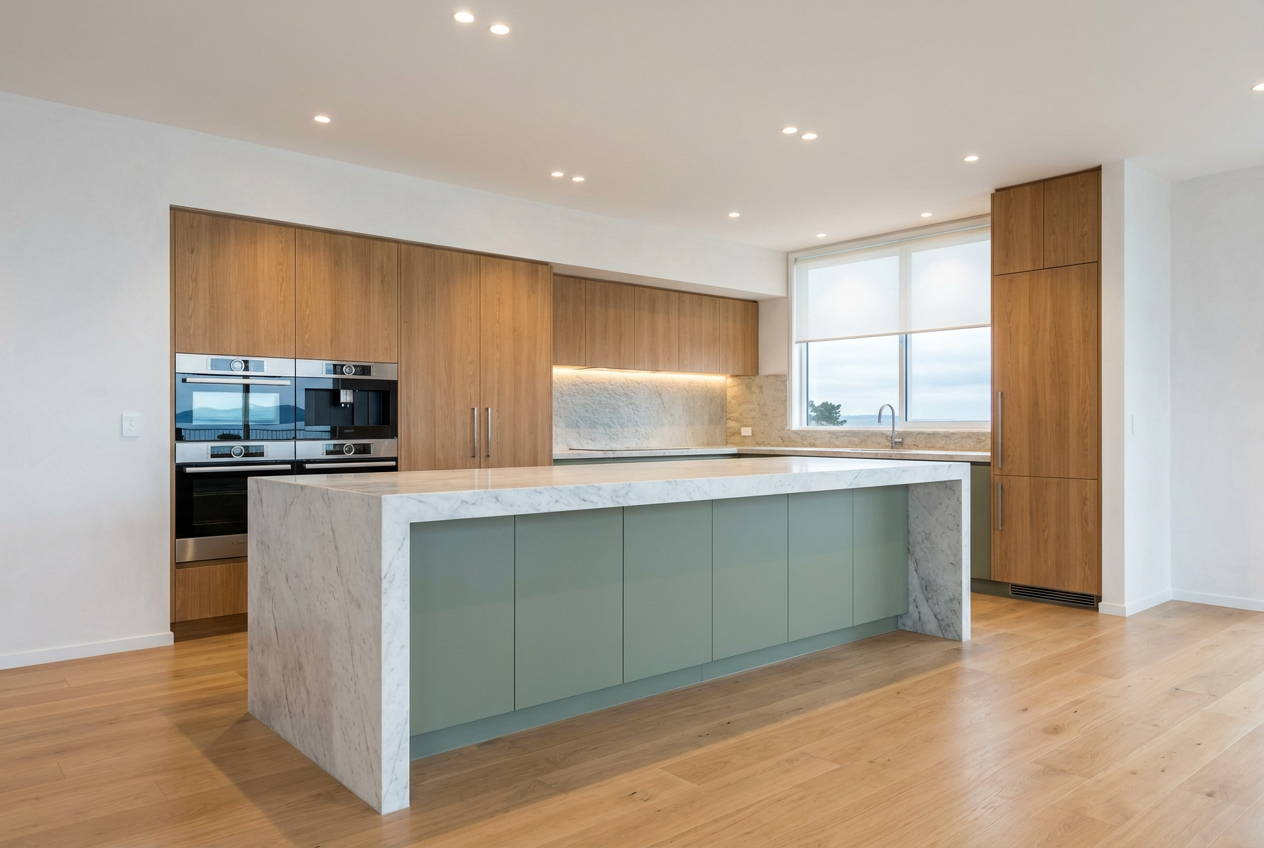
Yes, you can absolutely replace cabinet doors without replacing the whole carcass — and it's one of the most cost-effective ways to refresh a kitchen or bathroom in a New Zealand home. As long as your existing carcasses (the box frames behind the doors) are structurally sound, swapping the doors alone can give you a near-new look for a fraction of a full kitchen replacement.
Is Your Carcass Worth Keeping?
Before ordering new doors, inspect your carcasses carefully. Look for:
- Water damage or swelling — common in NZ kitchens near the sink or dishwasher, and in bathrooms subject to steam
- Sagging shelves or delaminating panels — a sign the board has lost its integrity
- Out-of-square boxes — can make fitting new doors tricky
- Mould or rot — particularly relevant in older NZ homes with poor ventilation
If the carcasses are solid, level, and dry, you're good to go. Minor surface wear on the inside of the box is fine — it won't be visible once the new doors are hung.
Measuring Up: Getting It Right First Time
Accurate measuring is the most critical step. Cabinet door sizing depends on whether your doors are overlay (covering the face frame or carcass edge) or inset (sitting flush inside the opening). Most modern NZ flat-pack and custom kitchens use full overlay doors.
For overlay doors:
- Measure the width and height of the carcass opening
- Add your overlay amount (typically 10–19 mm per side, depending on your hinge system)
- Allow a consistent gap between adjacent doors (usually 2–4 mm)
For inset doors:
- Measure the opening precisely and subtract 2–3 mm all around for clearance
Always measure each opening individually — even in the same run of cabinets, openings can vary slightly, especially in older homes.
Choosing the Right Hinges
The hinge system is what makes or breaks a door replacement job. The vast majority of NZ kitchens use concealed cup hinges (commonly called Blum, Grass, or Häfele-style hinges). These sit in a 35 mm diameter hole bored into the back of the door.
Key things to check:
- Hinge cup diameter — almost universally 35 mm, but confirm before drilling
- Overlay type — full overlay, half overlay, or inset hinges are not interchangeable
- Soft-close vs standard — soft-close hinges are now the NZ standard for new installs and are worth the small extra cost
- Mounting plate compatibility — if you're keeping the existing mounting plates on the carcass, make sure your new hinges are compatible (most major brands cross-reference)
If you're unsure, take an old hinge to your local Bunnings or Mitre 10 for matching, or ask a cabinet maker.
Door Materials and Finishes
New Zealand suppliers offer cabinet doors in a wide range of materials:
| Material | Pros | Cons |
|---|---|---|
| Moisture-resistant MDF (MR MDF) | Paintable, stable, affordable | Heavier; edges need sealing |
| Polyurethane (PU) wrapped | Durable, easy-clean, many colours | Can't be repainted easily |
| Timber veneer | Natural look, premium feel | Higher cost, needs care |
| Laminate / Melamine | Hard-wearing, budget-friendly | Limited profiles |
| Solid timber | Classic NZ look | Can move with humidity |
For painted doors, use a moisture-resistant MDF substrate and finish with a quality kitchen-grade paint. Resene and Dulux both offer suitable waterborne enamel ranges suited to NZ conditions.
Step-by-Step: Hanging Your New Doors
- Remove old doors — unscrew from the mounting plates; most concealed hinges release with a single screw or clip
- Mark hinge positions on the new doors — typically 100 mm from the top and bottom edges, with additional hinges for doors over 900 mm tall
- Bore hinge cup holes — use a 35 mm Forstner bit in a drill press or handheld drill with a guide for accuracy; depth is usually 12–13 mm
- Fit hinges into cups and clip or screw onto the existing mounting plates
- Adjust for alignment — concealed hinges allow three-axis adjustment (up/down, in/out, side to side) using the adjustment screws
- Check gaps and alignment across the whole run before final tightening
Handles and Hardware
While you have the doors off, it's the perfect time to update handles and knobs. Mark handle positions consistently using a simple cardboard template to keep everything uniform across all doors and drawers.
When to Call a Professional
Door replacement is generally DIY-friendly, but consider engaging a qualified cabinet maker or kitchen installer from tradedirectory.co.nz if:
- Your carcasses are out of square and need shimming or rebuilding
- You want custom-sized or custom-profile doors that require specialist machinery
- You're dealing with a large kitchen and want a guaranteed professional finish
- The job involves moving or modifying any plumbing, electrical, or gas connections — these are restricted trades in New Zealand. Plumbing and drainlaying work must be carried out by a licensed tradesperson registered with the Plumbers Gasfitters & Drainlayers Board, and electrical work must be done by a registered electrician under the Electrical Workers Registration Board.
Safety note: If you're working near the rangehood or any gas appliances, do not interfere with gas connections under any circumstances. Gas work is restricted and must be completed by a licensed gasfitter.