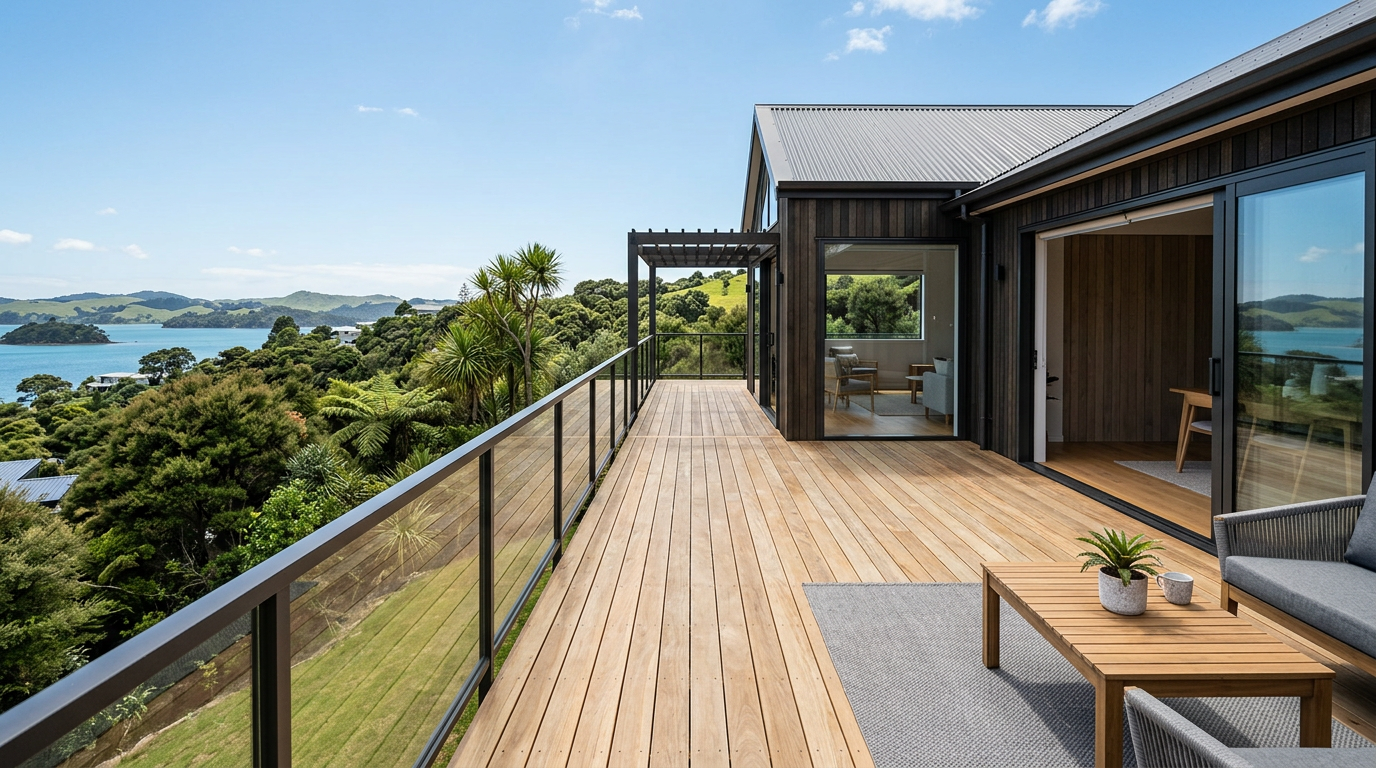
Yes, you can absolutely lay decking boards diagonally — typically at a 45-degree angle to the framing — and it's a popular choice for adding visual interest to a deck. The trade-off is that diagonal laying increases material waste compared to a standard straight lay, so you'll need to plan your quantities carefully before heading to the timber yard.
Why Choose Diagonal Decking?
Diagonal decking creates a dynamic, eye-catching look that can make a deck feel wider or longer depending on the angle used. It's a well-established technique used by deck builders throughout New Zealand and suits both timber and composite decking products. Beyond aesthetics, a diagonal lay can also help disguise minor irregularities in a rectangular deck outline.
How Diagonal Laying Affects Your Framing
Before you start, it's important to understand that diagonal decking places different demands on your subframe. Because the boards run at 45 degrees, the span between joists effectively increases relative to the board direction. This means:
- Joist spacing may need to be reduced. Where you might normally space joists at 450 mm centres for straight laying, diagonal laying often requires joists at 350 mm centres or closer, depending on the board thickness and species. Always check the decking manufacturer's span tables.
- Blocking and noggins become more important at the perimeter to give a solid fixing point for the angled cut ends.
- Bearer and joist sizing should still comply with NZS 3604 or your engineer's specification if the deck is over 1.5 m above ground or outside the scope of NZS 3604.
If your deck requires a building consent, your local council will want to see that the framing meets the New Zealand Building Code. Always confirm consent requirements with your council — some decks under 1.5 m in height may be exempt under Schedule 1, but this depends on your specific situation. Check MBIE Building Performance for general guidance.
Calculating Waste for Diagonal Decking
This is where diagonal laying has a real cost impact. When boards run at 45 degrees, every board that crosses a corner or edge must be cut at an angle, leaving a triangular offcut. The shorter the boards and the more corners your deck has, the more waste you'll generate.
As a general guide:
| Laying Pattern | Typical Waste Allowance |
|---|---|
| Straight (parallel to house) | 5–10% |
| Diagonal (45°) | 15–20% |
| Herringbone or chevron | 20–25%+ |
These are approximate figures — your actual waste will depend on the deck shape, board length, and how efficiently you can reuse offcuts. A simple rectangular deck will sit at the lower end; an L-shaped or irregular deck will push waste higher.
Tips to Minimise Waste
- Order longer boards where possible. Longer lengths mean fewer end cuts and better coverage per board.
- Plan your layout on paper first. Sketch the deck to scale and work out where the longest runs fall.
- Reuse offcuts for shorter sections near the house wall or steps.
- Start from the centre of the deck and work outward symmetrically — this keeps the pattern balanced and can reduce offcuts at both edges.
Fixing Methods for Diagonal Boards
The fixing approach is the same as for straight decking — face screwing, hidden clip systems, or a combination — but pay attention to the following:
- End fixings are critical. The angled cut ends near the perimeter must land on a joist or blocking, not in mid-air. Plan your framing so there's always solid timber to fix into within 50 mm of any board end.
- Hidden clip systems (such as those used with composite decking) work well diagonally but require careful spacing to maintain consistent gaps.
- Stainless steel fasteners are strongly recommended in coastal or high-moisture NZ environments to prevent corrosion staining on the timber.
Choosing the Right Timber or Composite
Popular NZ decking timbers for diagonal laying include treated pine (H3.2 or H4 depending on exposure), kwila (merbau), and hardwoods like vitex. Composite decking from brands available at Bunnings or Mitre 10 also works well diagonally, though always check the manufacturer's maximum span specifications, as these differ from timber.
For treated timber, ensure the treatment level meets the requirements of BRANZ guidance and the NZ Building Code for the exposure zone your deck sits in.
When to Call a Professional
Diagonal decking is achievable for a confident DIYer, but there are situations where a qualified deck builder is the smarter choice:
- Your deck is over 1.5 m above ground, which typically requires a building consent and may involve restricted structural work.
- The deck is attached to the house (a ledger-fixed deck), which affects weathertightness and structural connections — both areas where errors can be costly.
- You're unsure about joist sizing or spacing for the diagonal span.
- You want a complex pattern such as herringbone or a multi-angle design.
A Licensed Building Practitioner (LBP) with a carpentry licence is the right person for structural deck work. You can find qualified local deck builders on tradedirectory.co.nz to get quotes and advice specific to your project. Check LBP licensing at Licensed Building Practitioners.




 Licensed Building Practitioner (LBP)





