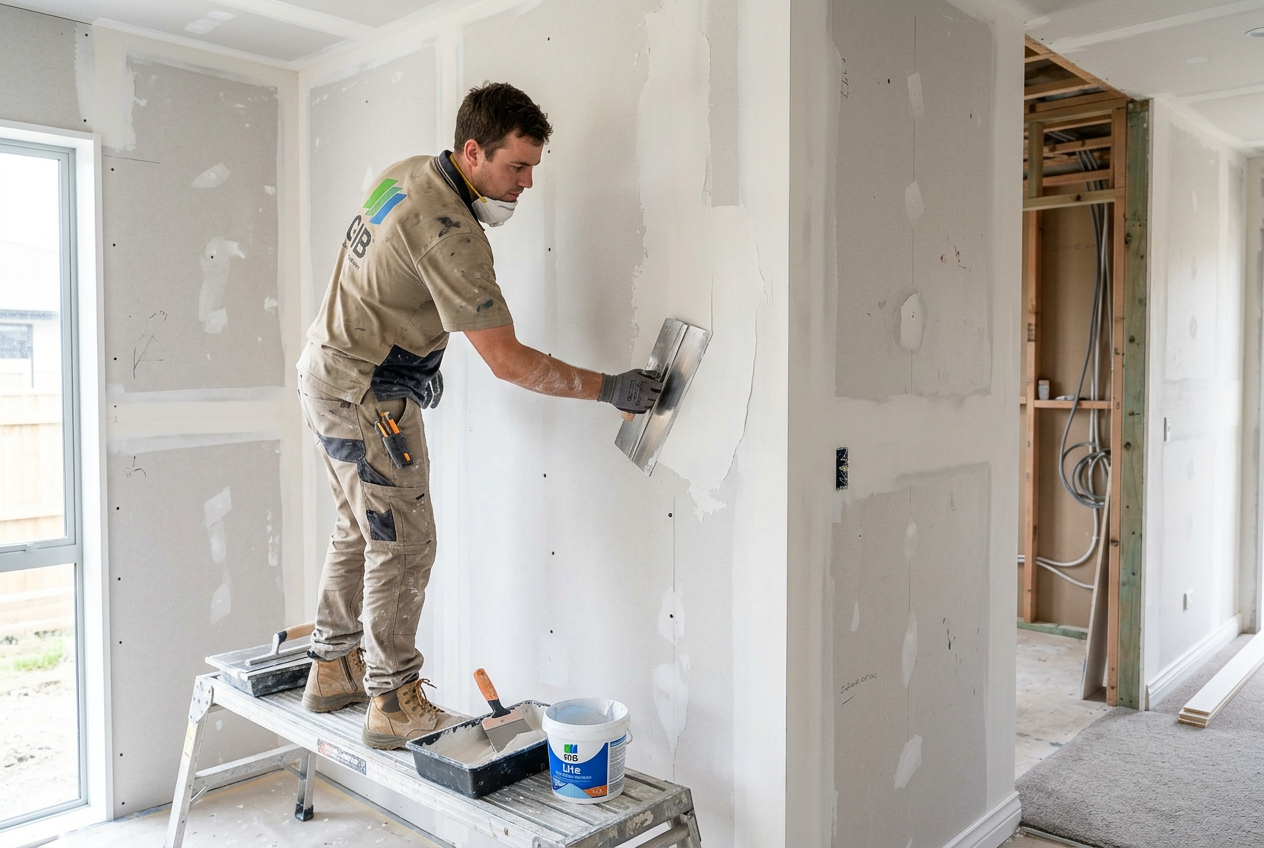
Installing GIB Braceline yourself is technically possible in some situations, but it sits in a legally sensitive area involving building consents, restricted building work (RBW), and structural requirements under the NZ Building Code. Before you pick up a screwgun, it pays to understand exactly where the line is — because getting it wrong can affect your home's earthquake resistance and your ability to sell or insure the property.
What Is GIB Braceline and Why Does It Matter?
GIB Braceline is a 12 mm structural plasterboard manufactured by GIB specifically for use as a bracing element in timber-framed walls. Unlike standard GIB board, Braceline is engineered to resist racking forces — the sideways loads that earthquakes and high winds place on a building. It is commonly specified as part of a home's bracing system under NZS 3604 (the standard for timber-framed buildings) and must be installed precisely to achieve its rated bracing values.
Because bracing walls are a structural component, any work on them is treated seriously under New Zealand law.
Is a Building Consent Required?
This is the first question to answer. If you are:
- Building a new home — a building consent is almost certainly required, and the bracing design will be part of the consented plans.
- Renovating or altering an existing bracing wall — consent is likely required unless the work clearly falls under a Schedule 1 exemption.
- Like-for-like replacement of damaged lining on an existing consented bracing wall — this may be exempt, but you should confirm with your local council before starting.
Schedule 1 of the Building Act 2004 lists work that doesn't need a consent, but structural alterations are generally not included. Always check with your local council — do not assume your project is exempt. You can find guidance at MBIE Building Performance.
What Is Restricted Building Work?
Restricted building work (RBW) is work that must be carried out or supervised by a Licensed Building Practitioner (LBP). Structural work — including the installation of bracing elements — falls under RBW in most circumstances.
This means that even if you are a competent DIYer, you may not legally be able to carry out or sign off on the installation of a Braceline bracing wall without LBP involvement. An LBP must issue a Record of Work on completion, which is lodged with your council.
Owner-builders are a partial exception: if you own and live in the home, you can apply for an owner-builder exemption to carry out some RBW yourself. However, this exemption has conditions, does not apply to all types of RBW, and you must notify your council. Check the current rules at MBIE Building Performance before relying on this pathway.
The Technical Side: Getting the Installation Right
Even setting aside the legal requirements, GIB Braceline installation is more demanding than hanging standard plasterboard. To achieve the specified bracing rating, you must follow the GIB fixing schedule exactly, including:
- Correct fastener type and size — typically self-drilling screws at specified centres — refer to the current GIB Braceline fixing schedule for the correct fastener size and spacing requirements, as these vary by application.
- Correct framing — studs, noggings, top and bottom plates must meet the specified dimensions and spacing. GIB's technical literature specifies minimum framing requirements.
- Edge distances — screws must not be too close to board edges or they won't develop full holding strength.
- Continuous perimeter fixing — every edge of the sheet must be fixed to framing; unsupported edges compromise the bracing value.
- No gaps or short sheets — the sheet layout must follow the bracing wall design.
Getting any of these details wrong reduces the bracing value of the wall, potentially leaving your home under-braced for earthquake or wind loads. New Zealand's seismic environment makes this a genuine safety issue, not just a paperwork one. BRANZ has useful technical resources on bracing and structural lining systems.
What Can a Homeowner Safely Do?
If consent and LBP requirements are satisfied, a homeowner may be able to assist with:
- Preparing the work area and clearing the space.
- Cutting and handling boards under the supervision of a licensed tradesperson.
- Finishing work such as stopping, sanding, and painting — these are generally not restricted.
For the stopping and finishing of GIB Braceline, standard GIB stopping compounds and techniques apply. Resene, Dulux, and Wattyl all offer suitable interior paints for the finished surface — see Resene, Dulux, or Wattyl for product advice.
When to Call a Professional
You should engage a qualified professional if:
- A building consent is required (an LBP must carry out or supervise the structural work).
- You are unsure whether your project is exempt from consent.
- The bracing design needs to be calculated or verified — this may require a structural engineer.
- You are not confident in reading and following the GIB fixing schedules precisely.
- The work involves alterations to existing framing, which adds further complexity.
A licensed plasterer or builder with LBP registration can install GIB Braceline correctly, provide the required Record of Work, and give you peace of mind that your home's structure meets the NZ Building Code. You can find qualified local tradespeople on tradedirectory.co.nz.
Safety Note
Bracing walls are a life-safety system. Under-braced homes are at greater risk of serious damage or collapse in an earthquake. Never cut corners on structural work — if in doubt, get professional advice.

 Master Painters NZ member