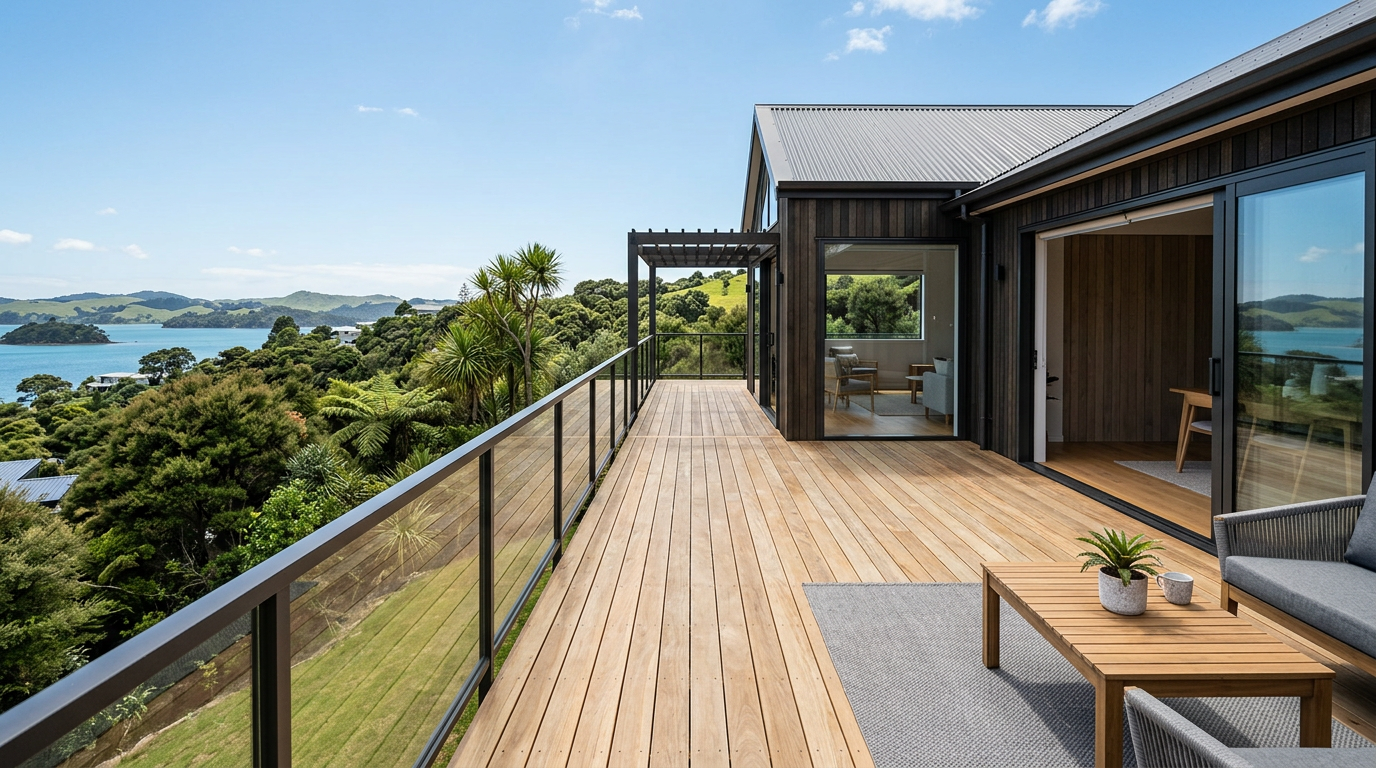
Choosing the right decking material is one of the most important decisions you'll make for an outdoor living space in New Zealand. Our climate ranges from the humid, high-UV subtropics of Northland to the cold, wet winters of Southland and the salt-laden coastal winds that batter properties from Gisborne to Greymouth — and your deck material needs to handle whatever your region throws at it. This guide walks you through the main options, what affects performance and longevity, consent requirements, and how to find a qualified tradesperson to get the job done right.
Why NZ Weather Makes Material Choice Critical
New Zealand's environment is genuinely tough on outdoor structures. Key factors include:
- High UV radiation — NZ has some of the highest UV levels in the world, which degrades untreated timber and fades some composite products rapidly.
- Moisture and humidity — particularly in Auckland, Northland, and the West Coast, where persistent dampness accelerates rot and fungal growth in susceptible timbers.
- Salt air — coastal properties within roughly 500 m of the sea face accelerated corrosion of fixings and degradation of some finishes.
- Freeze-thaw cycles — in Central Otago, the Mackenzie Basin, and alpine areas, water that penetrates porous materials can cause cracking as it freezes.
- Wind — exposed sites on Cook Strait, Hawke's Bay, and Canterbury plains need decks engineered for uplift loads.
Always consult with a qualified local tradesperson who understands your specific microclimate, and check requirements with your local council before starting.
Main Decking Material Options
1. Treated Pine (H3.2 and H4)
Treated pine is the most widely used and affordable decking timber in NZ. It is readily available from PlaceMakers, Mitre 10, and Bunnings.
- H3.2 treatment is suitable for above-ground exterior use where the timber is not in contact with the ground.
- H4 treatment is required where timber is in ground contact or in very wet conditions — for example, posts set into the ground.
- Treated pine must be sealed and stained regularly (typically every 1–3 years depending on exposure) to prevent surface checking and UV greying.
- It is cost-effective upfront but has higher ongoing maintenance costs than some alternatives.
- Fixings must be stainless steel or hot-dip galvanised to resist corrosion, especially in coastal areas.
2. Hardwood Timber (Kwila, Vitex, Garapa)
Imported hardwoods such as Kwila (Merbau), Vitex, and Garapa offer excellent natural durability and an attractive appearance.
- Hardwoods are naturally resistant to rot and insect attack, reducing maintenance frequency.
- Kwila in particular is popular in NZ for its rich reddish-brown colour, though it does bleed tannins initially — protect surrounding surfaces and waterways during installation.
- These timbers still benefit from periodic oiling (typically annually) to maintain appearance and resist UV damage.
- Sourcing from sustainably certified suppliers (look for FSC certification) is strongly encouraged.
- Hardwoods are generally more expensive than treated pine upfront; get written quotes from your supplier and installer as prices vary.
3. Composite Decking
Composite decking is made from a blend of recycled timber fibre and plastic (usually polyethylene or PVC). It has grown significantly in popularity across NZ.
| Feature | Composite | Treated Pine | Hardwood |
|---|---|---|---|
| Maintenance | Very low | High | Medium |
| UV resistance | Good–Excellent (varies by brand) | Poor (needs coating) | Good (with oiling) |
| Slip resistance | Good (grooved profiles) | Variable | Variable |
| Lifespan (typical) | 25–30+ years | 15–25 years (maintained) | 25–40+ years |
| Upfront cost | Higher | Lower | Medium–High |
| Eco credentials | Often uses recycled content | Plantation grown | Varies by source |
- Look for composite products with a capped surface layer, which significantly improves stain, fade, and moisture resistance.
- In NZ's high-UV environment, choose products with proven UV inhibitors — ask suppliers for local performance data or check BRANZ for any relevant research.
- Composite decking can get hot underfoot in direct summer sun — a consideration for north-facing decks in warmer regions.
4. Aluminium Decking
Aluminium decking is the premium, lowest-maintenance option. It will not rot, warp, splinter, or support mould growth.
- Ideal for coastal and high-moisture environments.
- Naturally corrosion-resistant; fixings should still be stainless steel.
- Can be slippery when wet unless a textured or grooved profile is specified — always check the slip-resistance rating.
- Higher upfront cost than timber, but very low lifetime maintenance cost.
- Available from specialist suppliers; your local deck builder can advise on sourcing.
5. Modified Timber (Accoya, Thermally Modified)
Modified timbers such as Accoya (acetylated radiata pine) offer the look and workability of timber with dramatically improved durability and dimensional stability — they are less prone to swelling, shrinking, and rot.
- Well suited to NZ's variable climate.
- Typically carry long manufacturer durability warranties — confirm details with the supplier.
- Higher cost than standard treated pine; get written quotes.
NZ Building Code and Consent Requirements
Decks are structures and are subject to the NZ Building Code, particularly:
- B1 (Structure) — the deck must be structurally sound and able to carry the required loads.
- B2 (Durability) — materials and fixings must meet minimum durability requirements for their exposure environment.
- E1 (Surface Water) — drainage from the deck must not cause problems for the building or neighbouring properties.
- E2 (External Moisture) — where a deck is attached to or close to the building envelope, it must not create moisture ingress risk.
Building consent is required for most decks over 1.5 m above ground level (or in some cases other thresholds depending on the specific exemption criteria), and for any deck attached to a building that requires structural connection. Some low-level decks may qualify as Schedule 1 exempt work — but this depends on your specific situation, site, and local council. Always confirm with your local council before starting work. You can find guidance at MBIE Building Performance.
Timber used in structural applications must comply with NZS 3604 (Timber-framed buildings) where applicable.
Choosing and Vetting a Qualified Tradesperson
Always get multiple quotes from qualified tradespeople and check references before hiring. When assessing a deck builder:
- Confirm they hold a current Licensed Building Practitioner (LBP) licence — this is required for restricted building work, which includes structural work on decks attached to homes.
- Ask for examples of previous deck projects in similar NZ conditions to yours.
- Check that they specify the correct timber treatment class and fixing grade for your site.
- Ensure their quote includes consent application costs if required.
- Use quality materials suited to NZ conditions — a good tradesperson will advise on this.
You can find qualified local deck builders on tradedirectory.co.nz.
Maintenance Tips by Material
- Treated pine: Clean annually, re-oil or re-stain every 1–3 years, check and replace any corroding fixings.
- Hardwood: Oil annually (or as manufacturer recommends), inspect for checking or movement.
- Composite: Wash down periodically with soapy water; check manufacturer guidelines — most require minimal intervention.
- Aluminium: Rinse with fresh water (especially in coastal areas) to remove salt deposits.
Plan your project budget carefully, including a contingency for unexpected substructure repairs, consent fees, or site-specific requirements.
When to Call a Professional
Call a qualified tradesperson — ideally an LBP — for any deck that:
- Is attached to your house (restricted building work requiring an LBP).
- Is elevated more than 1 m above ground (structural and safety considerations).
- Requires a building consent.
- Involves ground-contact posts or footings (concrete work, correct H4 treatment).
- Is in a coastal, high-wind, or high-moisture environment where specification errors are costly.
For electrical work on or near a deck (outdoor lighting, power points), this is restricted electrical work that must be carried out by a registered electrician — see the Electrical Workers Registration Board for more information. Never attempt electrical work yourself.
Sources & Further Reading
- MBIE Building Performance — Building Code and consents
- BRANZ — Research and technical guidance for NZ construction
- Licensed Building Practitioners — Find or verify an LBP
- WorkSafe NZ — Safe work on construction projects
- PlaceMakers — Timber and decking materials
- Standards NZ — NZS 3604 and other relevant standards



 Licensed Building Practitioner (LBP)





