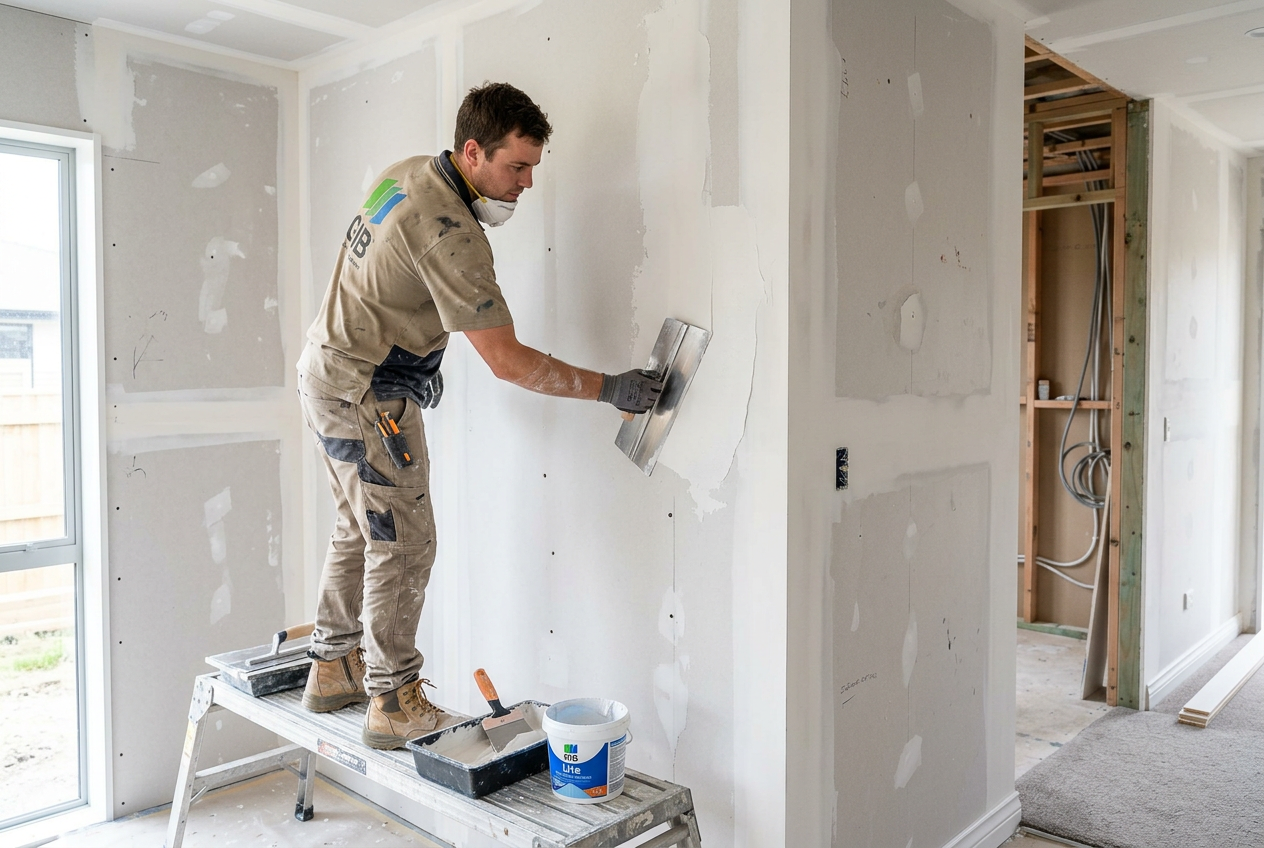
Whether you're renovating an older home or planning a new build, understanding the difference between solid plaster and plasterboard (also called gib board or drywall) will help you make smarter decisions and have better conversations with your tradesperson. Both are common wall and ceiling systems in New Zealand, but they suit different situations, budgets, and building styles.
What Is Solid Plaster?
Solid plaster (sometimes called wet plaster or render) is a traditional system where a cement- or lime-based mix is applied in one or more coats directly onto a substrate — typically a metal or timber lath, masonry, or fibre-cement sheet. Once cured, it forms a hard, monolithic surface.
In New Zealand, solid plaster is common in homes built before the 1970s, and it remains popular for exterior cladding systems (such as those using James Hardie fibre-cement substrates) and for feature walls, arches, and curved surfaces where a seamless finish is desired.
Key characteristics of solid plaster:
- Applied wet and trowelled by hand — a skilled, time-intensive process
- Typically 10–25 mm thick depending on the system
- Very hard and durable once cured
- Excellent fire resistance and acoustic performance
- Can be difficult and costly to repair if cracked
- Requires a qualified, experienced plasterer
What Is Plasterboard?
Plasterboard (commonly known in NZ by the brand name GIB) is a manufactured panel made from a gypsum plaster core sandwiched between two layers of paper liner. Sheets are fixed to a timber or steel framing system, then the joints and fixings are stopped (filled and sanded) to create a smooth, paint-ready surface.
Plasterboard became the dominant interior lining system in NZ from the 1970s onwards because it is faster and more cost-effective to install than solid plaster. GIB offers a wide range of boards for different applications — standard, moisture-resistant, fire-rated, and acoustic — making it highly versatile.
Key characteristics of plasterboard:
- Installed as dry sheets, then stopped and finished
- Standard thickness is commonly 10 mm or 13 mm
- Faster to install than solid plaster
- Easier and cheaper to repair
- Lighter weight than solid plaster walls
- Must be kept dry during and after installation
- Requires correct stopping compounds and technique for a quality finish
Side-by-Side Comparison
| Feature | Solid Plaster | Plasterboard (GIB) |
|---|---|---|
| Installation speed | Slower — multiple wet coats | Faster — sheet fixing + stopping |
| Durability | Very hard, impact-resistant | Softer, can be dented |
| Repairability | Difficult, can show patches | Relatively easy to patch |
| Acoustic performance | Excellent | Good (varies by board type) |
| Fire resistance | Excellent | Good (fire-rated boards available) |
| Moisture resistance | Good (cement-based systems) | Needs moisture-grade board in wet areas |
| Cost (as a guide) | Generally higher | Generally lower |
| Best for | Exteriors, heritage homes, curves | Interior walls and ceilings |
Where Each System Is Used in NZ Homes
Solid plaster is most often seen:
- On exterior walls as a cladding system (e.g. texture-coated fibre-cement)
- In pre-1970s homes with original lath-and-plaster interiors
- On curved or arched features where sheets can't easily bend
- In high-end or heritage renovation work
Plasterboard is most often used:
- For all interior walls and ceilings in modern NZ homes
- In wet areas (bathrooms, laundries) using moisture-resistant board — this must comply with NZ Building Code clause E3 for internal moisture
- Where fire ratings are required between units or near boundaries
- In new builds following NZS 3604 timber-framed construction
Wet Areas: A Special Consideration
In bathrooms and other wet areas, the choice of lining and its installation method is regulated. MBIE Building Performance sets out requirements under the NZ Building Code that must be met. Standard plasterboard must not be used directly behind tiles or in shower enclosures — a moisture-resistant or tile-backer board is required, and waterproof membranes must be correctly applied. Solid plaster systems can also be used in wet areas when properly specified. Getting this wrong can lead to costly water damage and mould issues.
Repairing Each System
One practical difference homeowners notice is how each system handles damage over time. A crack or hole in plasterboard can usually be patched with stopping compound and sanded back — a manageable DIY job for small repairs. Solid plaster repairs are trickier: matching the original texture and colour, and preventing the patch from cracking again, often requires a skilled plasterer. BRANZ has useful guidance on building materials and repair methods for NZ conditions.
Can You DIY Plastering or Stopping?
Basic plasterboard stopping (filling screw holes and joints on small patches) is within reach of a careful DIYer with the right products and patience. However, achieving a truly flat, paint-ready finish across a whole room is harder than it looks — poor stopping shows up badly under paint, especially with low-sheen finishes or raking light.
Solid plastering is a skilled trade. Applying wet plaster coats to achieve a consistent, crack-free finish takes years of practice and is not recommended as a DIY project for anything beyond very minor touch-ups.
When to Call a Professional
For any significant plastering work — new linings, re-plastering rooms, exterior render, or wet-area linings — it pays to hire a qualified plasterer. A professional will:
- Specify the correct system for your situation
- Ensure compliance with the NZ Building Code
- Deliver a finish that holds up over time
You can find experienced, local plasterers on tradedirectory.co.nz. For licensed building work, check that your tradesperson holds the appropriate Licensed Building Practitioner (LBP) licence where required.