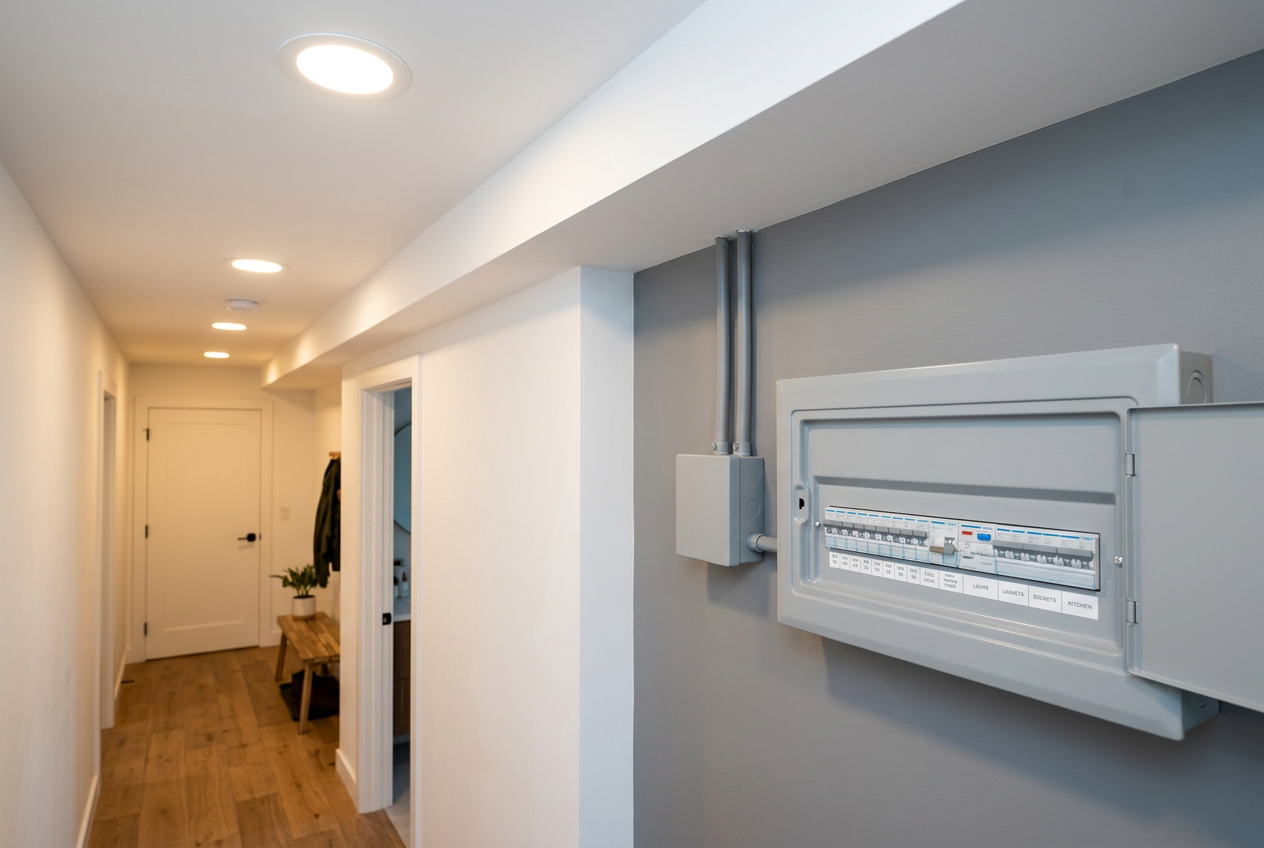
Most New Zealand homes run on single-phase power and never need anything more. But if you're running a home workshop, EV charger, or large heat pump system, you may have heard the term "three-phase" come up. Understanding the difference can help you make smarter decisions about your home's electrical setup — and know when to call in a licensed sparky.
What Is Single-Phase Power?
Single-phase power is the standard supply delivered to the vast majority of NZ homes. It arrives via two wires from the network — an active (live) conductor and a neutral — giving you a voltage of 230 V (volts) at 50 Hz. Your switchboard distributes this across the circuits in your home: lighting, power points, hot water, and so on.
Single-phase is perfectly adequate for everyday household loads — fridges, washing machines, ovens, heat pumps, and most EV chargers. The limitation is the maximum current your supply can deliver before the network fuse or your main switch trips.
What Is Three-Phase Power?
Three-phase power uses three active conductors (plus a neutral), each carrying an alternating current that is offset by 120 degrees from the others. In New Zealand, each phase delivers 230 V to neutral, but between any two phases you get around 400 V. This arrangement has two big advantages:
- Higher total power capacity — three phases working together can deliver roughly three times the power of a single-phase supply at the same current rating.
- Smoother, more consistent power delivery — the overlapping waveforms mean power is delivered more evenly, which is why large motors and industrial equipment run more efficiently on three-phase.
Three-phase supply is common in commercial and industrial buildings, but it is also available to residential properties in many parts of NZ — particularly in areas where the local network infrastructure supports it.
How to Tell Which Supply You Have
The easiest way is to look at your main switchboard:
| Feature | Single-Phase | Three-Phase |
|---|---|---|
| Main switch / incomer | Single 2-pole breaker | 3-pole or 4-pole breaker |
| Number of active cables entering board | 1 | 3 |
| Typical max supply current (as a guide) | 63–100 A | 63–100 A per phase |
| Voltage between phases | N/A | ~400 V |
If you're unsure, do not open the main switchboard yourself — the busbars and incoming cables are always live and extremely dangerous. Ask a licensed electrician to check for you.
Common Reasons NZ Homeowners Upgrade to Three-Phase
Most households never need three-phase, but it becomes worth considering if you have:
- A large workshop with heavy machinery (lathes, compressors, welders) that require three-phase motors
- Multiple high-draw appliances running simultaneously (e.g., EV charger + heat pump + electric oven + spa pool)
- A solar and battery system where your installer recommends three-phase for better load balancing
- A high-capacity EV charger — some faster home chargers (22 kW) require three-phase
- A large ducted HVAC system with a three-phase compressor
For most homes with a standard EV charger (7 kW), a heat pump, and normal appliances, single-phase is entirely sufficient.
Can You Upgrade from Single-Phase to Three-Phase?
Yes — but it depends on your local network operator (lines company) being able to provide a three-phase supply to your property. Not every street or rural area has three-phase available at the boundary. The process typically involves:
- A licensed electrician assessing your needs and existing wiring
- An application to your lines company (e.g., Vector, Orion, Powerco, WEL Networks) for a three-phase connection
- Upgrading your main switchboard and potentially your metering equipment
- Electrical Workers Registration Board (EWRB) certification of all new work
Costs vary depending on how much infrastructure work the lines company needs to do, so get quotes from both your electrician and the network operator before committing.
What Work Is Legally Restricted?
In New Zealand, all work on your main switchboard, service connections, and fixed wiring is restricted electrical work under the Electricity Act 1992. This means it must be carried out by — or under the supervision of — a registered electrician, and a Certificate of Compliance (CoC) must be issued on completion.
Homeowners are permitted to do very limited tasks, such as replacing a light bulb or a plug on a flexible cord. Anything involving your switchboard, wiring, or supply upgrade is firmly in licensed-tradesperson territory. WorkSafe NZ takes illegal electrical work seriously — the risks include fire, electrocution, and voided home insurance.
When to Call a Professional
Call a registered electrician if you:
- Want to find out whether three-phase is available at your property
- Are planning a workshop, EV charger, or large appliance installation
- Notice your main breaker tripping regularly (a sign your single-phase supply may be undersized)
- Are building or significantly renovating (the NZ Building Code requires compliant electrical installations)
- Need a new or upgraded switchboard
You can find qualified, local electricians on tradedirectory.co.nz — look for those with current EWRB registration.