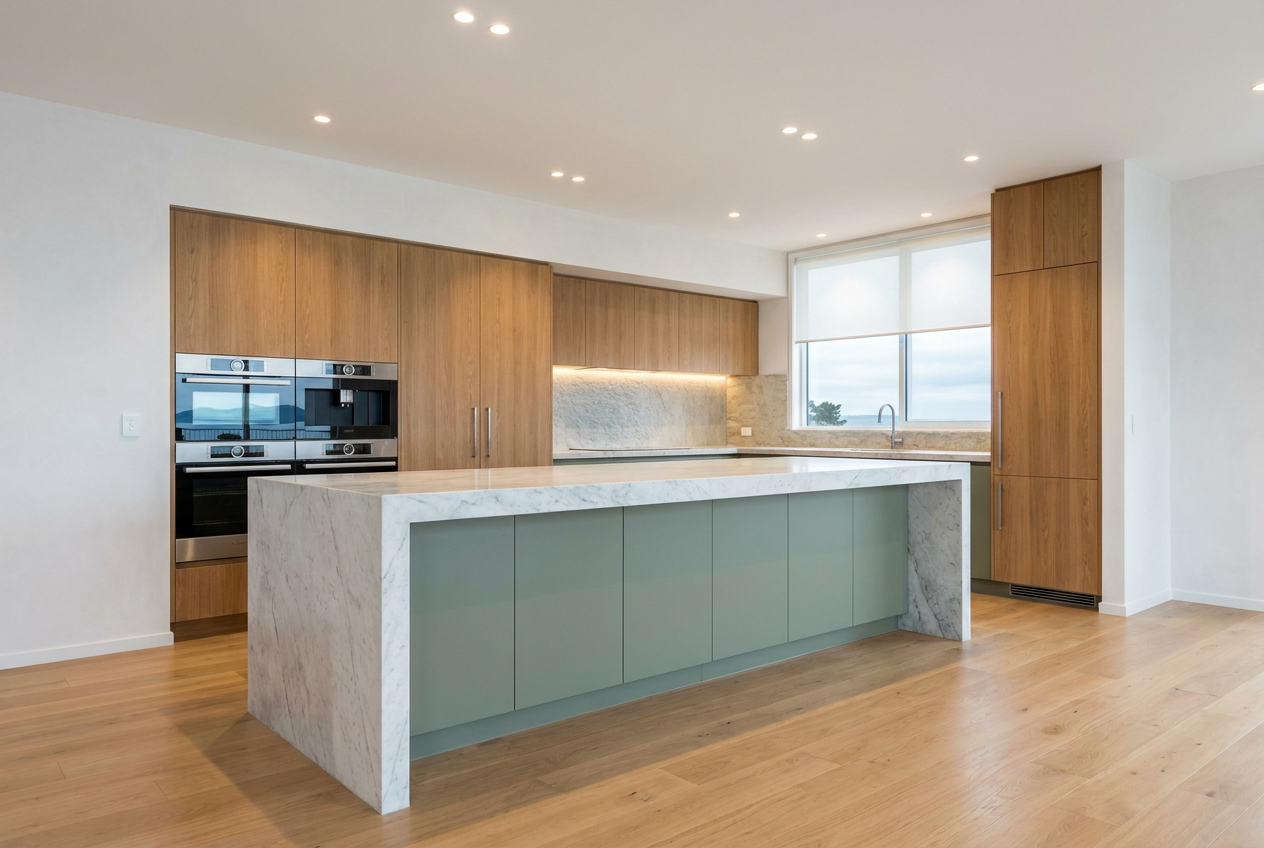
Choosing the right material for your kitchen, bathroom or laundry cabinetry is one of the most important decisions you'll make in a renovation. In New Zealand, the three most common cabinet substrate materials are melamine-coated board, MDF (medium-density fibreboard), and plywood — and each has genuine strengths and weaknesses depending on where and how it's used. Here's what you need to know before you commit.
What Is Melamine Board?
Melamine is not a substrate on its own — it's a finish. Melamine-coated board is typically a particleboard or MDF core with a thin, hard resin-impregnated paper fused to the surface under heat and pressure. The result is a smooth, wipe-clean surface that comes in a huge range of colours and woodgrain patterns.
Melamine board is the workhorse of the flat-pack and budget cabinet industry. It's dimensionally stable, easy to machine, and the surface is reasonably durable for everyday use. However, the edges must be finished with edge-banding (a thin strip of matching material) because the raw core is exposed and will swell if it gets wet.
Best for: Wardrobes, pantries, laundry cabinets, and budget kitchen carcasses in dry areas.
Watch out for: Moisture. Particleboard-core melamine is particularly vulnerable — swollen, crumbling cabinet bases under a leaky sink are a very common NZ repair job.
What Is MDF?
MDF (medium-density fibreboard) is made from fine wood fibres bonded with resin under heat and pressure. It has a very smooth, consistent surface with no grain, making it the preferred substrate for painted cabinetry and routed decorative profiles (think shaker-style door panels).
MDF is heavier than particleboard and holds screws reasonably well in the face, though not as well as plywood in the edge. Standard MDF is not moisture-resistant, but moisture-resistant MDF (MR MDF) — identifiable by its green-tinted core — is available from suppliers like Bunnings and Mitre 10 and is a better choice near water.
MDF is commonly used for door and drawer fronts rather than carcass construction, because its weight and moisture sensitivity make it less ideal for the structural box of a cabinet.
Best for: Painted door fronts, decorative panels, furniture components.
Watch out for: Weight (large MDF panels are heavy), and the fact that standard MDF will swell and delaminate if it gets persistently wet.
What Is Plywood?
Plywood is made from thin layers (plies) of real wood veneer glued together with alternating grain directions. This cross-grain construction gives plywood excellent strength, screw-holding ability, and resistance to warping. It's significantly more dimensionally stable in humid conditions than particleboard or standard MDF.
For cabinetry, furniture-grade or cabinet-grade plywood (often birch or pine ply) is used. In New Zealand, you'll find structural and furniture ply at PlaceMakers and specialist timber merchants. Quality varies — look for void-free inner plies and a smooth face veneer if you're painting or veneering over it.
Plywood costs more than melamine board or MDF, but it's the preferred choice of quality cabinet makers for carcass construction, especially in kitchens and bathrooms where moisture is a real risk.
Best for: Kitchen and bathroom cabinet carcasses, high-end joinery, areas with humidity or potential moisture exposure.
Watch out for: Cost (it's the priciest of the three), and visible edge grain that needs finishing.
Side-by-Side Comparison
| Feature | Melamine Board | MDF | Plywood |
|---|---|---|---|
| Core material | Particleboard or MDF | Wood fibre | Layered wood veneer |
| Surface finish | Factory-applied laminate | Paint, veneer or laminate | Paint, veneer or laminate |
| Moisture resistance | Low (standard) | Low–Medium (MR grade) | Medium–High |
| Screw holding | Moderate | Moderate (face) / Poor (edge) | Good |
| Weight | Medium | Heavy | Medium–Heavy |
| Cost (as a guide) | Budget–Mid | Budget–Mid | Mid–Premium |
| Best use | Dry area carcasses, shelving | Door fronts, painted panels | Carcasses, wet areas, quality joinery |
NZ Climate and Building Code Considerations
New Zealand's climate varies enormously — from the humid subtropics of Northland to the cold, damp winters of Southland. In wetter regions or poorly ventilated homes, moisture inside cabinetry is a genuine concern. The NZ Building Code clause E3 (Internal Moisture) requires that internal linings and fittings resist the effects of moisture likely to occur in normal use.
For bathroom and kitchen cabinetry, this means choosing materials and finishes that can handle steam, splashes, and humidity. BRANZ research consistently highlights moisture damage as a leading cause of premature cabinet failure in NZ homes. MR MDF or plywood carcasses with properly sealed edges and quality hardware will significantly outlast standard particleboard in these environments.
If your home falls under the Healthy Homes Standards (relevant for rental properties), adequate ventilation in kitchens and bathrooms also plays a role in protecting cabinetry long-term — see Tenancy Services for landlord obligations.
Which Material Should You Choose?
- Tight budget, dry area (e.g. wardrobe, pantry): Melamine particleboard is perfectly adequate and cost-effective.
- Painted kitchen or bathroom doors: MR MDF gives a smooth, paint-ready surface that holds up well.
- Kitchen or bathroom carcasses: Plywood is worth the extra investment for longevity and moisture resistance.
- High-end or custom joinery: A quality cabinet maker will often combine plywood carcasses with MDF or solid timber door fronts for the best of all worlds.
When to Call a Professional
While a confident DIYer can assemble flat-pack melamine cabinets, custom cabinetry design, installation, and any work involving modifications to plumbing or electrical services must involve licensed tradespeople. Plumbing connections (e.g. moving a sink or dishwasher) are restricted work under the Plumbers, Gasfitters and Drainlayers Board, and electrical work must be carried out by a registered electrician licensed with the EWRB.
For structural alterations or built-in joinery that forms part of the building fabric, check whether a Licensed Building Practitioner (LBP) is required. A skilled cabinet maker will also ensure your cabinetry is properly fixed to wall framing — not just plasterboard — which is critical for safety, especially in earthquake-prone NZ.
You can find qualified, local cabinet makers and joiners on tradedirectory.co.nz to get the job done right.