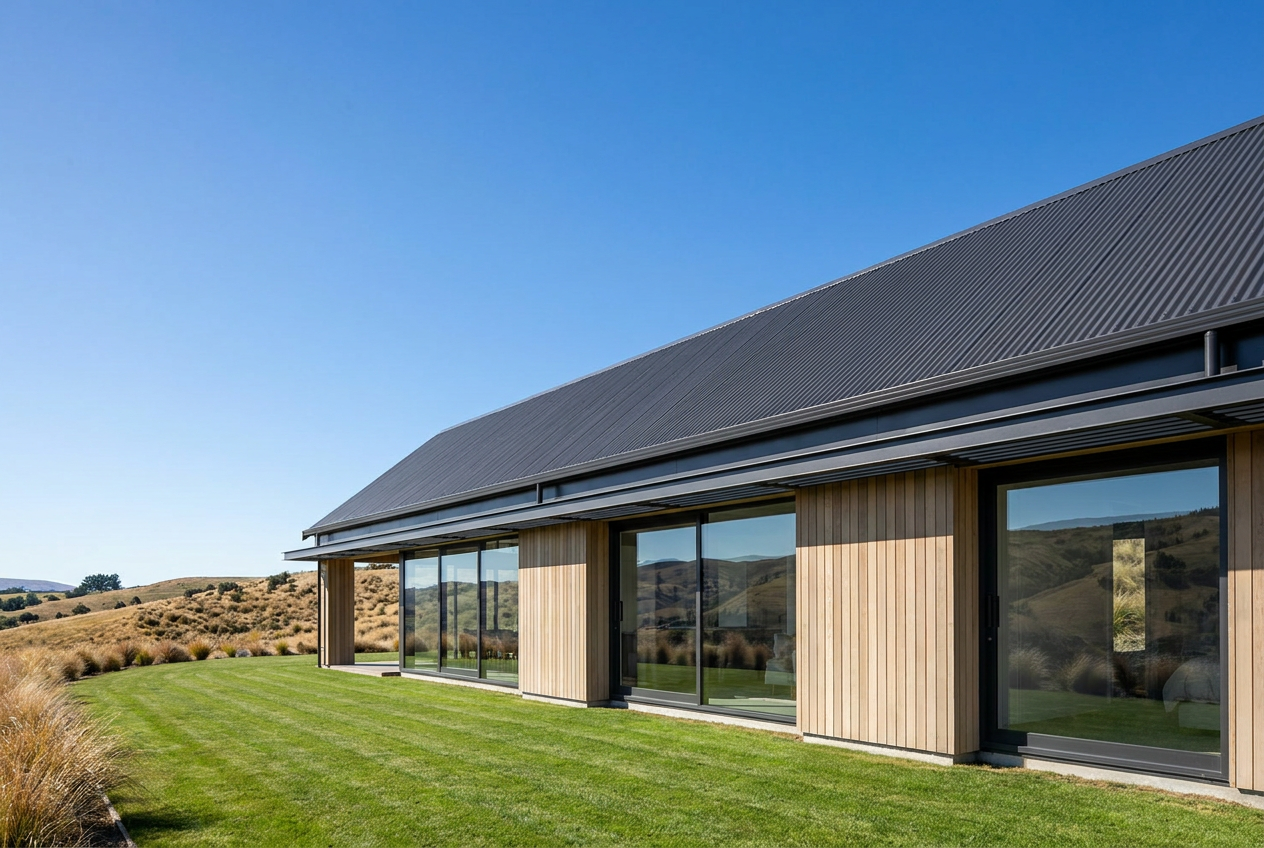
Choosing a new roof is one of the biggest decisions you'll make as a homeowner, and in New Zealand the debate usually comes down to two main options: longrun metal roofing or concrete/clay tile roofing. Both are widely used across the country, but they suit different homes, budgets, and climates. Here's what you need to know before you decide.
What Is Longrun Roofing?
Longrun roofing (sometimes called long-run or continuous-run roofing) is made from steel or aluminium sheets that run the full length of a roof slope in one piece — or as few joins as possible. The most common profiles in NZ are corrugate, tray/standing seam, and ribbed profiles such as Colorsteel® Endura® or Maxx®. Because the sheets are roll-formed to length on-site or at a factory, there are minimal horizontal laps, which reduces leak risk.
Longrun steel is typically coated with a Zincalume® or Galvabond® base and a painted finish. James Hardie and a range of NZ steel manufacturers supply longrun products, and you'll find a wide selection at Bunnings and PlaceMakers.
What Is Tile Roofing?
Tile roofing uses individual overlapping units — either concrete tiles or clay (terracotta) tiles — fixed to timber battens over a sarking or underlay. Concrete tiles are by far the most common in NZ due to lower cost and local availability. Clay tiles are less common but prized for their longevity and classic look. Tiles are heavier than metal, which means the roof structure must be engineered to carry the load — an important consideration for older homes or additions.
Key Differences at a Glance
| Feature | Longrun Metal | Concrete/Clay Tile |
|---|---|---|
| Weight | Light (approx. 4–7 kg/m²) | Heavy (40–55 kg/m²) |
| Minimum pitch | As low as 3° (profile-dependent) | Typically 15°+ |
| Lifespan | 40–70+ years (coating-dependent) | 50+ years (concrete); 100+ years (clay) |
| Maintenance | Low — occasional cleaning, check flashings | Moderate — replace cracked tiles, repoint ridge |
| Noise | Can be louder in heavy rain | Quieter in rain |
| Cost (as a guide) | Generally lower installed cost | Generally higher installed cost |
| Insulation | Lower thermal mass | Higher thermal mass |
| Appearance | Modern/contemporary or classic corrugate | Traditional/Mediterranean styles |
Roof Pitch and Structure
One of the most practical differences is minimum roof pitch. Longrun profiles can be installed on very low-pitched roofs — some standing seam systems go as low as 3 degrees — making them the go-to choice for modern low-slope designs. Tiles require a steeper pitch (generally 15 degrees or more) to allow water to shed properly between overlapping units. If your roof is low-pitched, longrun is almost certainly your only compliant option under the NZ Building Code.
Tiles are significantly heavier, so if you're re-roofing an older home or adding a tiled roof to an extension, a structural engineer may need to confirm the framing can handle the load. This is especially relevant for homes built to earlier versions of NZS 3604 (the timber-framed buildings standard).
NZ Climate Considerations
New Zealand's climate varies enormously — from the humid, high-rainfall West Coast and Northland to the dry, UV-intense Central Otago and the wind-battered Cook Strait region. BRANZ research highlights that roofing material choice should account for local wind zones, rainfall intensity, and coastal salt exposure.
- Coastal areas: Longrun steel must be a high-grade coated product (e.g., Colorsteel® Maxx®) rated for marine environments. Standard galvanised steel corrodes quickly near the sea. Clay tiles perform well in coastal conditions.
- High-wind zones: Longrun roofing must be fixed to manufacturer and NZS 3604 specifications — screw patterns and fastener type matter. Tiles must be mechanically fixed (not just gravity-laid) in high-wind zones.
- High-rainfall areas: Longrun's minimal joins are an advantage. Tile roofs need well-maintained pointing and underfelt to manage heavy rain.
Maintenance Requirements
Longrun roofs are generally low maintenance — clear gutters and downpipes, wash off lichen or debris annually, and inspect flashings every few years. Tile roofs need periodic repointing of ridge and hip mortar, replacement of cracked or slipped tiles, and moss/lichen treatment. Neglected tile roofs can develop leaks that are harder to trace. Either way, a professional roof inspection every five to ten years is good practice.
Cost Considerations
As a broad guide, longrun metal roofing typically has a lower installed cost than concrete tile, and clay tile is generally the most expensive option. However, costs vary significantly with roof complexity, pitch, region, and contractor. Always get at least two or three quotes from qualified roofers. You can find licensed local roofers on tradedirectory.co.nz.
Aesthetic and Resale Value
Both roofing types can look excellent when well chosen. Longrun suits contemporary, coastal, and rural NZ architecture — think modern mono-pitch homes or classic Kiwi farm sheds. Tiles suit traditional suburban homes, Mediterranean-inspired designs, and some heritage streetscapes. In some areas, local council district plans or heritage overlays may restrict roofing materials, so check with your council before committing.
When to Call a Professional
Roofing work is physically demanding and carries serious fall risks. WorkSafe NZ requires that work at height follows strict safety protocols — for most homeowners, roof work beyond cleaning gutters from a ladder should be left to a qualified roofer. A Licensed Building Practitioner (LBP) with a roofing licence is required to carry out or supervise restricted building work on your home's roof, including re-roofing. You can verify an LBP's licence at lbp.govt.nz. Find a qualified local roofer through tradedirectory.co.nz to ensure the work is done safely and to code.