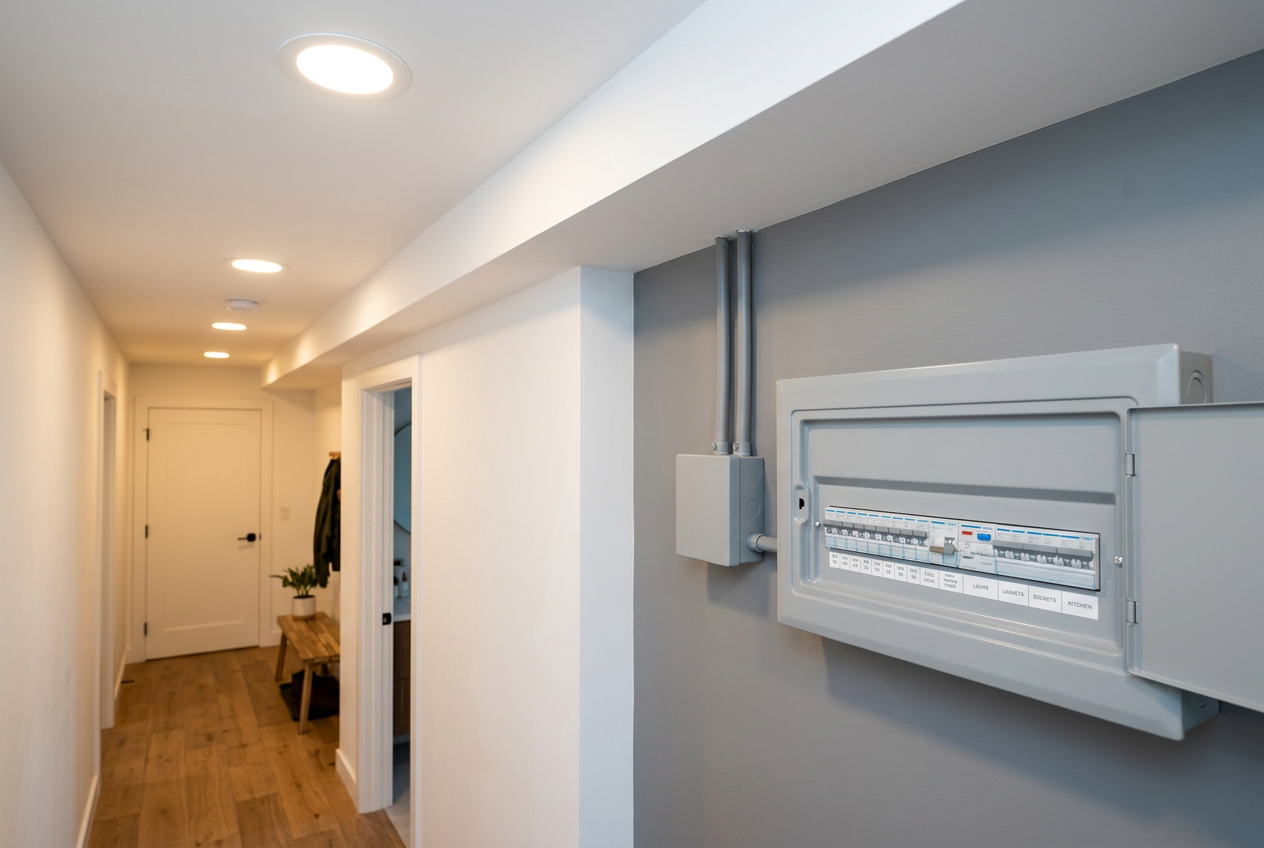
Your home's switchboard is the heart of its electrical system, and the protective devices inside it — fuses, circuit breakers, and RCDs — are what stand between a minor fault and a serious hazard. Understanding what each one does helps you respond confidently when something trips or blows, and know when it's time to call a professional.
What Is a Fuse?
A fuse is the oldest form of electrical protection. It contains a thin wire or strip of metal designed to melt and break the circuit if too much current flows through it. Once a fuse blows, it must be replaced — it cannot be reset.
Older New Zealand homes (generally those built before the 1980s) often still have rewirable fuse boards, where the fuse wire is wrapped around ceramic carriers. Some homes have cartridge fuses instead, which look like small cylinders.
What fuses protect against: Overloads and short circuits — situations where more current flows than the wiring can safely handle.
Limitations: Fuses don't protect against electric shock. They also require replacement after every fault, which can be inconvenient and, if done incorrectly, dangerous.
What Is a Circuit Breaker?
A circuit breaker (often called an MCB — Miniature Circuit Breaker) does the same job as a fuse but uses an internal switch mechanism instead of a sacrificial wire. When a fault occurs, the breaker trips to the OFF position. Once the fault is resolved, you simply reset it by flipping it back on.
Most New Zealand homes built or rewired from the 1980s onwards have a modern switchboard fitted with circuit breakers. Each breaker is rated for a specific current (e.g. 10 A for lighting circuits, 20 A for power circuits) and protects the wiring on that circuit.
What circuit breakers protect against: Overloads and short circuits — same as fuses, but with the convenience of being resettable.
Limitations: Like fuses, standard circuit breakers do not protect people from electric shock.
What Is an RCD?
An RCD (Residual Current Device) — sometimes called a safety switch — is a fundamentally different type of protection. Rather than monitoring the total amount of current, an RCD constantly compares the current flowing out on the active wire with the current returning on the neutral wire. If there's a difference (meaning current is leaking — possibly through a person), the RCD trips in milliseconds.
This is the device that can genuinely save your life. A standard circuit breaker won't trip fast enough to prevent a fatal shock, but a correctly functioning RCD can disconnect power before serious injury occurs.
What RCDs protect against: Electric shock and earth leakage faults — including situations where someone touches a live wire or a faulty appliance.
RCDs in New Zealand Law
Under the New Zealand Building Code and amendments to the Electricity (Safety) Regulations, RCD protection is required for socket outlets in new builds and significant alterations. If you're a landlord, the Healthy Homes Standards don't specifically mandate RCDs, but MBIE Building Performance guidance strongly recommends them, and any electrical work carried out must comply with current regulations. WorkSafe NZ also recommends RCDs as a key safeguard against electrocution.
Quick Comparison: Fuse vs Circuit Breaker vs RCD
| Feature | Fuse | Circuit Breaker (MCB) | RCD (Safety Switch) |
|---|---|---|---|
| Protects against overload | ✅ | ✅ | ❌ |
| Protects against short circuit | ✅ | ✅ | ❌ |
| Protects against electric shock | ❌ | ❌ | ✅ |
| Resettable | ❌ (replace) | ✅ | ✅ |
| Common in NZ homes | Older homes | Modern homes | Modern homes |
What About RCBOs?
An RCBO (Residual Current Breaker with Overcurrent protection) combines the functions of an MCB and an RCD in a single unit. These are increasingly common in modern NZ switchboards as they provide both overload/short-circuit protection and shock protection on the same circuit.
Does Your Home Have Adequate Protection?
If your home still has an old fuse board, it's worth having a licensed electrician assess it. Older boards may not meet current standards and could lack RCD protection entirely. BRANZ research has highlighted that many older New Zealand homes have switchboards that no longer reflect best practice for safety.
Signs your switchboard may need attention:
- Fuses that blow repeatedly
- No RCD or safety switch present
- Visible corrosion, burning smells, or discolouration around the board
- Breakers that won't stay reset
Testing Your RCD
RCDs should be tested every three to six months using the TEST button on the device. Press it — the power to that circuit should cut immediately. If it doesn't trip, the RCD may be faulty and should be inspected by a licensed electrician. This is a simple check any homeowner can do safely.
When to Call a Professional
Electrical work in New Zealand is restricted work under the Electricity Act 1992. This means that installing, replacing, or modifying fuses, circuit breakers, or RCDs inside your switchboard must be carried out by a registered electrician — it is illegal for homeowners to do this themselves.
You can check that your electrician is registered with the Electrical Workers Registration Board (EWRB) before they start work.
What homeowners can do safely:
- Reset a tripped circuit breaker or RCD
- Replace a plug fuse (the small fuse inside a plug top)
- Test an RCD using the TEST button
For anything inside the switchboard, or if you're unsure, contact a qualified local electrician. You can find licensed electricians in your area at tradedirectory.co.nz.