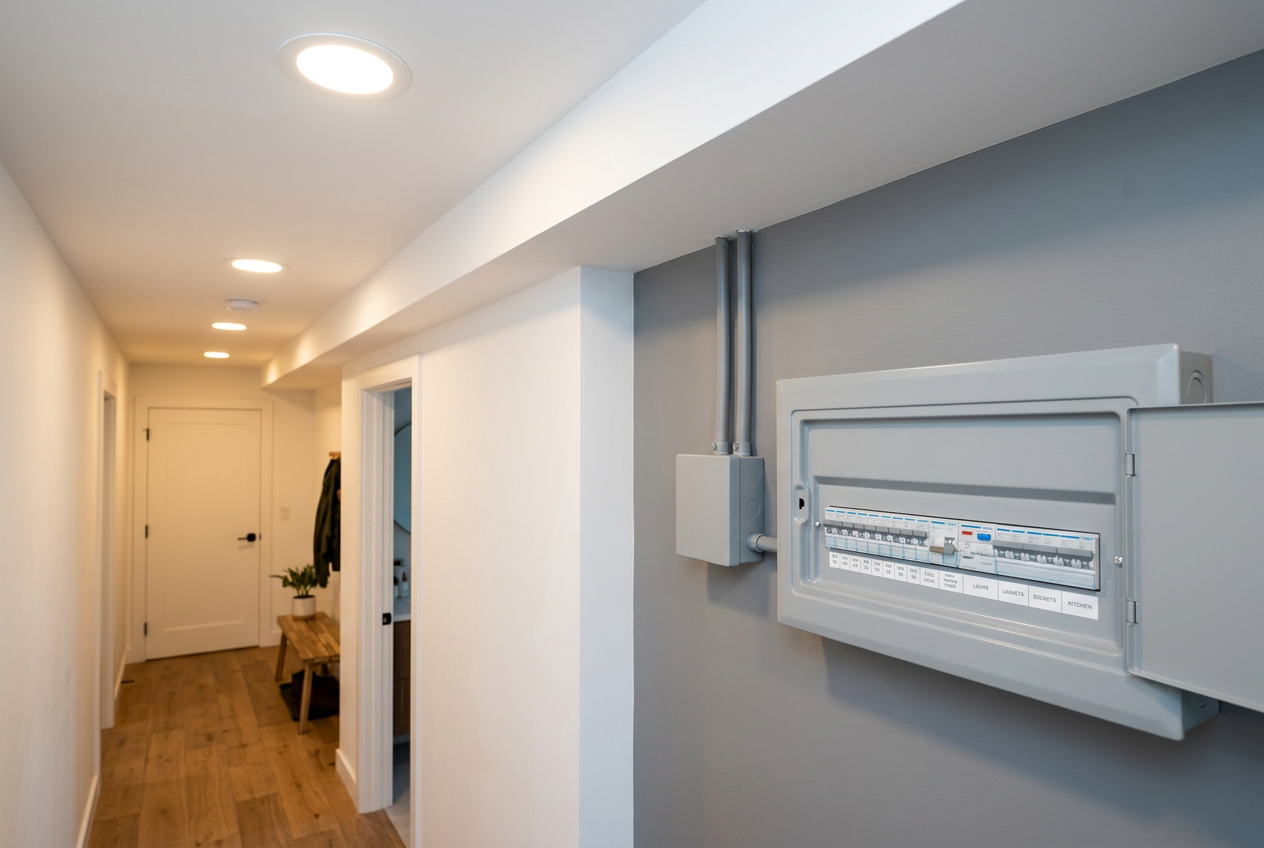
Understanding the watt limits of your home's power points and circuits helps you avoid tripped breakers, overheating, and potentially dangerous electrical faults. New Zealand homes follow specific wiring standards, and knowing the basics can save you from costly mistakes — or worse, a house fire. Here's what every Kiwi homeowner should know.
How NZ Power Points and Circuits Are Rated
Most standard NZ power points (also called GPOs — general power outlets) are rated at 10 amps at 230 volts, which works out to a maximum of around 2,300 watts per outlet. However, just because a single socket can theoretically handle that load doesn't mean you should routinely push it to the limit. Sustained high loads cause heat build-up in wiring and connections over time.
The circuit that feeds those power points is equally important. A typical general-purpose power circuit in a NZ home is protected by a 16-amp circuit breaker, giving a circuit capacity of roughly 3,680 watts. That circuit usually supplies multiple power points throughout a room or area, so the total load across all outlets on that circuit must stay within that limit.
Common Household Appliance Loads
To put those numbers in context, here's a rough guide to how much power common appliances draw:
| Appliance | Approximate Wattage |
|---|---|
| LED light bulb | 5–15 W |
| Laptop | 45–100 W |
| Flat-screen TV | 80–200 W |
| Fridge/freezer | 100–400 W |
| Microwave | 800–1,200 W |
| Electric kettle | 2,000–2,400 W |
| Portable heater | 1,000–2,400 W |
| Washing machine | 500–2,500 W |
As you can see, a single electric kettle or portable heater can come close to maxing out one outlet on its own. Plugging a kettle and a toaster into the same double socket via an adaptor is a recipe for a tripped breaker — or worse.
What Happens When You Overload a Circuit?
When the total load on a circuit exceeds the breaker's rating, the circuit breaker trips and cuts power. This is a safety feature, not a fault — it's protecting your wiring from overheating. Repeatedly tripping a breaker is a sign your circuit is undersized for your needs.
More concerning is overloading a power point with a cheap multi-plug adaptor or daisy-chaining power boards. This can cause localised overheating at the socket or plug, which may not trip the breaker but can still start a fire. WorkSafe NZ highlights electrical faults as a leading cause of house fires in New Zealand.
Dedicated Circuits for High-Draw Appliances
Some appliances draw enough power that they should be on their own dedicated circuit. In NZ, the following typically require or strongly benefit from a dedicated circuit:
- Electric oven/hob (often 32–40 A circuits)
- Heat pump (usually hardwired on its own circuit)
- Electric hot water cylinder
- Dishwasher
- Clothes dryer
- EV charger
The MBIE Building Performance guidance and the NZ Building Code set out requirements for electrical installations in new and altered homes. For existing homes, BRANZ is a great resource for understanding best-practice standards.
Using Power Boards and Adaptors Safely
- Always use power boards with a built-in overload/surge protector — look for ones that meet NZS 3820.
- Never daisy-chain one power board into another.
- Don't run high-draw appliances (heaters, kettles, irons) through a power board — plug them directly into a wall socket.
- Replace any power board or lead that shows signs of heat damage, discolouration, or a burning smell immediately.
Older NZ Homes: A Special Caution
If your home was built before the 1980s, it may have older wiring (such as aluminium wiring or older insulation types) that is rated for lower loads than modern cable. Older switchboards with rewireable fuses rather than modern circuit breakers also offer less protection. If you're unsure about the condition of your wiring, have a licensed electrician carry out an inspection before adding new loads.
When to Call a Professional
Electrical work in NZ is tightly regulated. Under the Electricity Act 1992, most electrical wiring work is restricted work that must only be carried out by a registered electrician. This includes:
- Installing new circuits or power points
- Upgrading your switchboard or adding circuit breakers
- Installing dedicated circuits for appliances
- Any wiring inside walls, ceilings, or floors
The Electrical Workers Registration Board (EWRB) maintains the register of licensed electricians in NZ. Always ask to see your electrician's practising licence before work begins, and ensure they issue you a Certificate of Compliance on completion — this is a legal requirement.
What homeowners can do themselves includes changing a lightbulb, replacing a plug on a flexible cord (with care), and resetting a tripped breaker. If your breaker keeps tripping, that's a job for a professional — don't simply replace it with a higher-rated one.
If you're regularly running out of power points or tripping breakers, it's worth having a qualified electrician assess your home's load and potentially add circuits or upgrade your switchboard. You can find trusted local electricians on tradedirectory.co.nz.