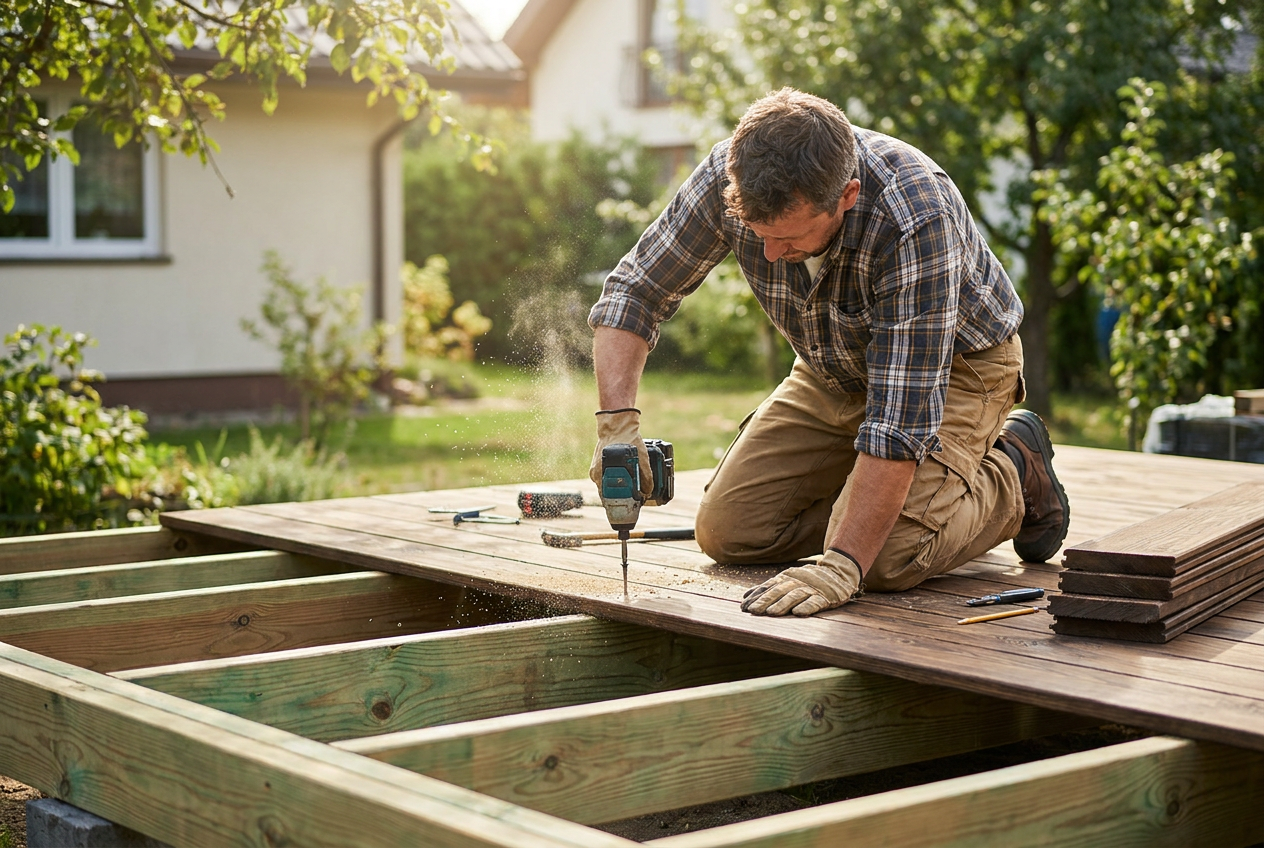
Rotted deck boards are a common problem in New Zealand, where our humid summers and wet winters can take a real toll on outdoor timber. The good news is that replacing an individual board is a straightforward DIY task for a confident homeowner — as long as the rot hasn't spread to the structural framing underneath.
Assess the Damage First
Before you grab a pry bar, take time to properly assess how far the rot has spread. Surface rot on just one or two boards is generally fine to tackle yourself. Structural rot — where the joists, bearers, or posts are affected — is a different matter entirely and may require a building consent depending on the extent of work.
Use a sharp screwdriver or bradawl to probe the timber around the damaged board. If the screwdriver sinks in easily more than a few millimetres, the rot has penetrated deeply. Check the joists directly below the board the same way. If the framing feels spongy or crumbles, stop and call a licensed carpenter before going further.
Safety note: Older decks (pre-2004) may have been treated with CCA (copper chrome arsenate) timber preservative. CCA-treated timber contains arsenic and should not be burned or machined without appropriate PPE. Check with WorkSafe NZ for safe handling guidance.
Tools and Materials You'll Need
- Pry bar and hammer
- Drill/driver and drill bits
- Circular saw or hand saw
- Tape measure and pencil
- Safety glasses, gloves, and dust mask
- Replacement decking timber
- Stainless steel or hot-dipped galvanised fixings
- Timber preservative and decking oil or stain
Choosing the Right Replacement Timber
This is one of the most important steps. In New Zealand's outdoor environment, you need timber that is appropriately treated for the hazard zone. For decking in contact with the weather (but not the ground), you typically need H3.2 treated timber at minimum. If the board is close to or touching the ground, H4 treatment may be required.
Common decking species available at NZ suppliers include treated pine, kwila (merbau), and hardwood alternatives. Make sure any timber you buy is clearly labelled with its treatment level. You'll find suitable options at Bunnings, Mitre 10, or PlaceMakers.
Try to match the width and thickness of your existing boards as closely as possible — standard NZ decking is often 140 × 32 mm or 90 × 32 mm.
Step-by-Step: Removing the Rotted Board
- Locate the fixings. Screws are straightforward to remove. Old nails may need to be punched through or levered out carefully.
- Cut the board if needed. If only part of a board is rotted, you can cut it back to the nearest joist on each side of the damage using a circular saw set to the depth of the board only — be careful not to cut into the joist below.
- Pry the board free. Work slowly to avoid damaging adjacent boards or the joists.
- Inspect and treat the joists. Once the board is off, brush any exposed joist timber with a quality timber preservative and allow it to dry before fitting the new board.
Fitting the New Board
- Cut the new board to length, allowing a 5–10 mm gap at each end if it butts up against a wall or post, to allow for moisture movement.
- Leave a 5–6 mm gap between boards for drainage and airflow — a couple of nails or a purpose-made spacer tool work well for this.
- Pre-drill your fixing holes to prevent splitting, especially near the ends of boards.
- Use stainless steel or hot-dipped galvanised screws — never bright zinc-plated (BZP) fixings outdoors, as they will corrode quickly in NZ conditions. Two fixings per joist crossing is standard practice.
- Treat all cut ends immediately with an end-grain timber preservative before fixing.
Finishing and Protecting the New Board
Once fixed, apply a quality decking oil, stain, or paint to the new board to match the rest of your deck as closely as possible. Resene, Dulux, and Wattyl all offer suitable exterior decking finishes. Bear in mind a new board may weather differently to older timber, so a full deck re-coat is often the best way to achieve a uniform finish.
Do You Need a Building Consent?
Replacing like-for-like deck boards is generally exempt from building consent under Schedule 1 of the Building Act 2004, provided you are not altering the structure. However, if you are replacing joists, bearers, or posts, or significantly changing the deck, you should check with your local council first. The MBIE Building Performance website has clear guidance on what work is exempt.
When to Call a Professional
Call a qualified carpenter or Licensed Building Practitioner (LBP) if:
- The rot has spread to structural framing (joists, bearers, posts, or ledger boards)
- Multiple boards are affected across a large area
- The deck is elevated (more than 1.5 m above ground) and working at height safely requires scaffolding or edge protection
- You're unsure of the timber treatment requirements for your specific situation
- A building consent may be required for the scope of repairs
You can find qualified local carpenters and Licensed Building Practitioners on tradedirectory.co.nz.