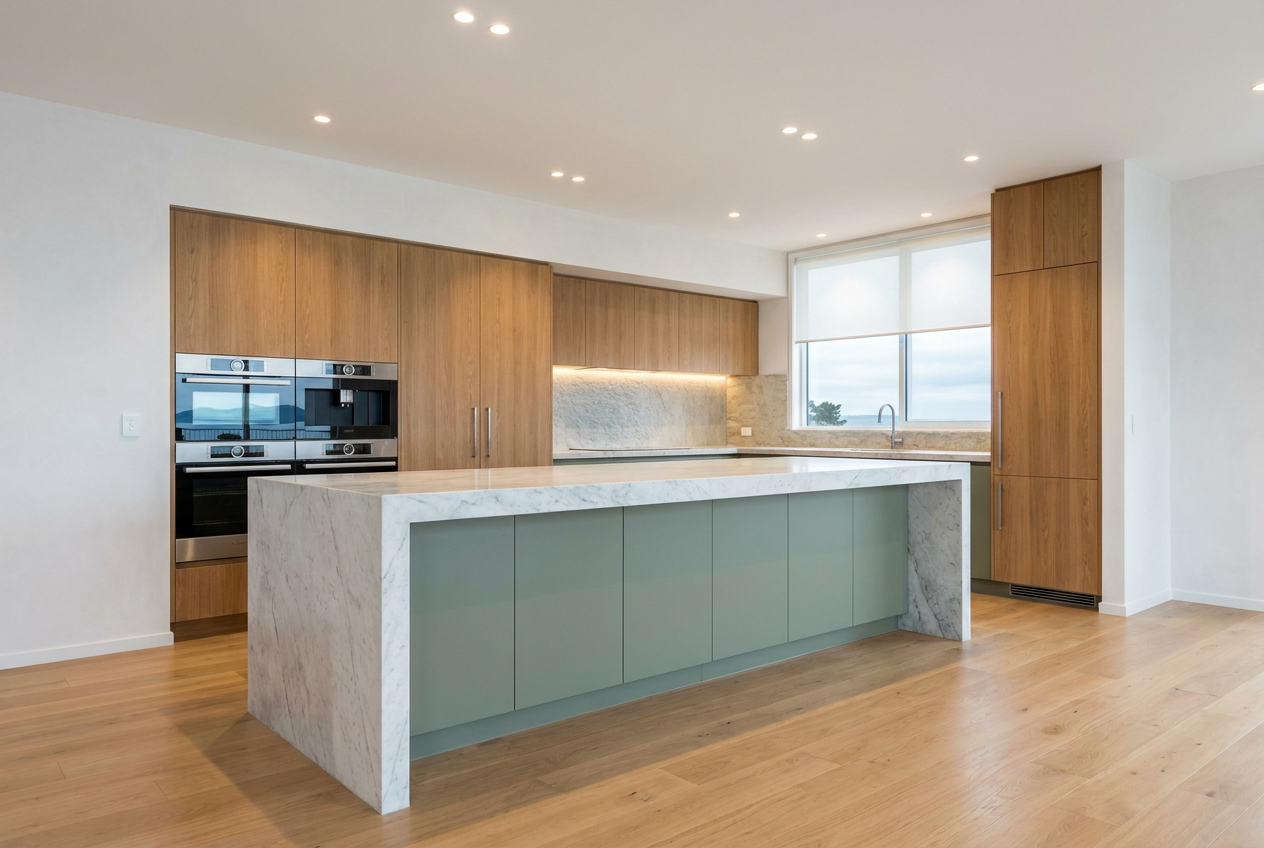
A kitchen cabinet door that won't close properly is one of the most common household frustrations — but the good news is that it's usually a straightforward fix. In most cases, the culprit is a misaligned hinge that just needs a small adjustment with a screwdriver. Here's how to diagnose the problem and get your door closing smoothly again.
Diagnose the Problem First
Before reaching for your tools, take a close look at how the door is sitting. Ask yourself:
- Does the door hang too high or too low?
- Is it sitting crooked (one corner sticking out)?
- Does it spring back open, or just sit slightly ajar?
- Is the door itself warped or swollen?
The answer will point you toward the right fix.
Understanding Your Hinges
Most modern kitchen cabinets use concealed European-style cup hinges (also called Blum, Grass, or clip-on hinges). These are the round hinges hidden inside the cabinet — and they're brilliant because they have built-in adjustment in three directions:
| Adjustment | What it does | How to adjust |
|---|---|---|
| Side (lateral) | Moves door left or right | Turn the side screw on the hinge arm |
| Depth | Moves door in or out from the cabinet face | Loosen the mounting plate screw and slide |
| Height | Moves door up or down | Loosen the mounting plate and shift up/down |
Older cabinets may use butt hinges (flat, visible hinges on the door edge), which have fewer adjustment options.
Step-by-Step: Adjusting a European Cup Hinge
What you'll need
- Phillips head screwdriver (or a Pozidriv — check your screws)
- Possibly a small flathead screwdriver
- A spirit level (optional but handy)
Steps
- Open the door and locate the two hinges on the inside of the cabinet.
- Identify the problem — is the door sitting too far left, right, in, or out?
- Make small adjustments — turn the relevant screw a quarter-turn at a time. Less is more.
- Close the door and check after each adjustment.
- Repeat until the door sits flush and closes cleanly.
- Once happy, tighten all screws firmly so nothing shifts again.
If the screws are spinning without gripping (the hole is stripped), remove the screw, pack the hole with a wooden toothpick and a dab of PVA glue, let it dry, then re-drive the screw.
Loose or Damaged Hinges
Sometimes the hinge itself is the problem — it may be loose, bent, or cracked. Check that:
- All screws are tight (loose screws are a very common cause of drooping doors)
- The hinge cup hasn't cracked or deformed
- The mounting plate is sitting flat against the cabinet
Replacement European hinges are widely available at Bunnings and Mitre 10. Take your old hinge in-store to match the cup diameter (commonly 26 mm or 35 mm) and the overlay (how much the door overlaps the cabinet frame).
Swollen or Warped Doors
In New Zealand's more humid regions — particularly in older homes without adequate ventilation — cabinet doors made from MDF or particleboard can absorb moisture and swell or warp. This is especially common near sinks, dishwashers, or in poorly ventilated kitchens.
Signs of a swollen door include:
- The door rubs against the cabinet frame
- The door has visibly bowed or twisted
- Hinge adjustment alone doesn't fix the gap
For minor swelling, improving kitchen ventilation may help over time. For warped or badly swollen doors, replacement is usually the most practical solution. A cabinet maker can supply and fit new doors to match your existing cabinetry.
BRANZ has useful guidance on managing moisture in NZ homes, which can help prevent the problem recurring.
Magnetic Catches and Soft-Close Mechanisms
If the hinge alignment is fine but the door still won't stay shut, check the door catch:
- Magnetic catches can wear out or shift — they're easy to reposition or replace
- Soft-close dampers (built into many modern hinges) can fail and may need the hinge replaced
- Check that nothing inside the cabinet is pushing the door open
Cabinet Door Alignment After Renovation
If your kitchen has recently had new flooring, benchtops, or wall linings installed, the cabinet carcasses may have shifted slightly. In this case, you may need to re-level the cabinet boxes themselves before adjusting the doors. Adjustable leg levellers (under most modern cabinets) can be turned with a flathead screwdriver to raise or lower each corner.
For significant movement — for example, after earthquake damage or major renovation — it's worth having a cabinet maker assess the whole installation.
When to Call a Professional
Most hinge adjustments are well within DIY reach. However, consider calling a qualified cabinet maker if:
- Multiple doors are misaligned across the whole kitchen (may indicate the carcasses have moved)
- Doors are warped, delaminating, or structurally damaged
- You need new doors made to match existing cabinetry
- The cabinet box itself is damaged or out of square
- You're unsure about the cause of the problem
A skilled cabinet maker can assess the whole kitchen and sort issues efficiently. You can find qualified local cabinet makers on tradedirectory.co.nz.
Safety note: Cabinet work is generally safe DIY territory, but take care when working overhead — use a stable step stool, not a chair. If your kitchen renovation involves any electrical or plumbing work (such as relocating power points or shifting a sink), those tasks are restricted work under NZ law and must be carried out by a licensed electrician (EWRB) or plumber (PGDB).