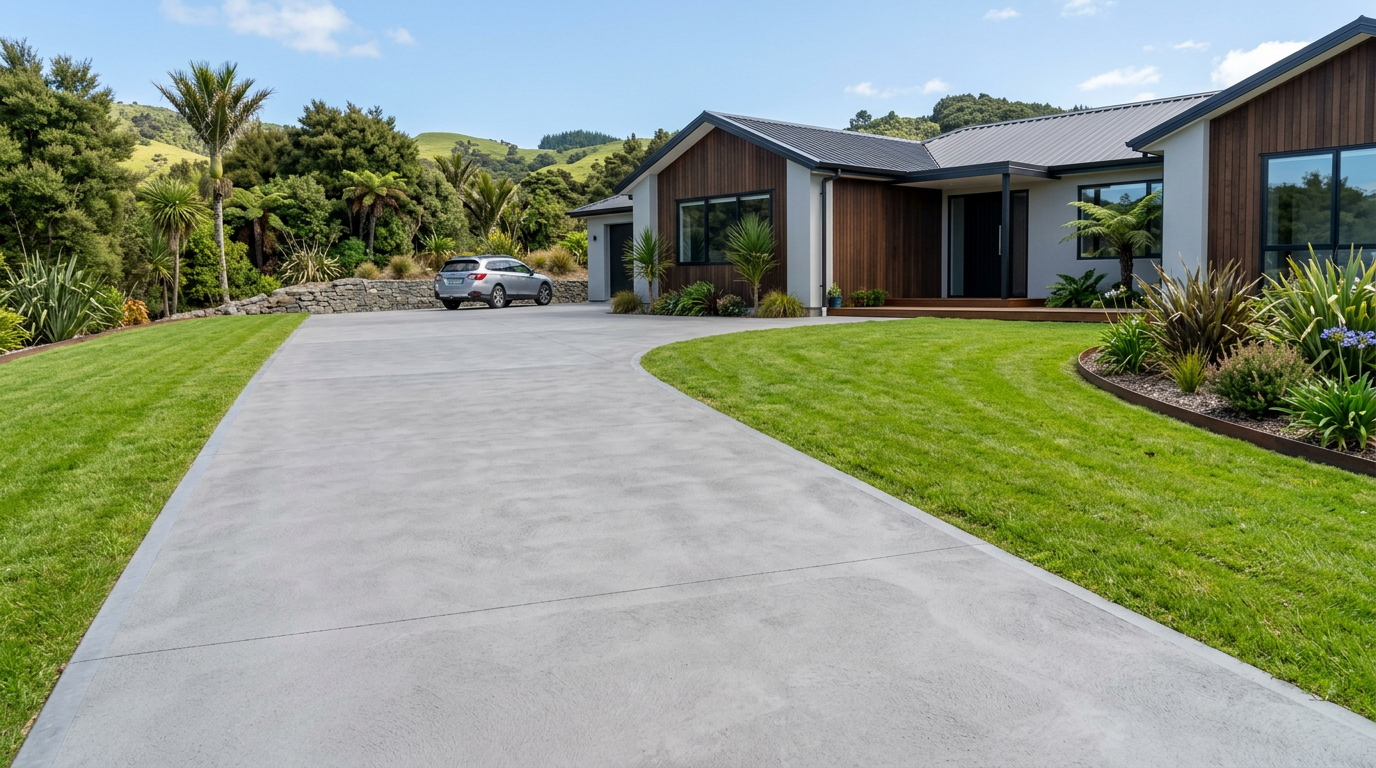
Yes, a homeowner can mix and pour their own concrete driveway in New Zealand — but it's a physically demanding job that requires careful planning, the right mix, proper preparation, and an understanding of what the NZ Building Code requires. Getting it wrong can mean cracking, subsidence, or a driveway that doesn't last. Read on to understand what's involved before you hire a concrete mixer or order a ready-mix truck.
Do You Need a Building Consent?
This is the first question to answer. In many cases, a residential driveway is exempt from building consent under Schedule 1 of the Building Act 2004 — but this depends on your specific situation. Factors that can change the picture include:
- Whether the driveway is within a certain distance of a boundary or structure
- Whether it involves retaining walls or significant earthworks
- Your local council's district plan rules (some councils have specific requirements)
- Whether the driveway connects to a public road (your local council or NZTA may have requirements around vehicle crossings)
Always check with your local council before you start. You can find general guidance on exemptions at MBIE Building Performance.
Planning Your Driveway
Before you mix a single bag of cement, work through these key decisions:
- Width and length: A standard single-car driveway is typically 2.7–3 m wide; double driveways are 5–6 m wide.
- Thickness: For a standard passenger vehicle driveway, 100 mm (10 cm) of concrete is the common minimum. If heavy vehicles (trucks, motorhomes) will use it, consider 125–150 mm.
- Sub-base: A well-compacted sub-base of at least 100 mm of AP20 (aggregate) is essential for drainage and load-bearing. Skipping this step is one of the most common causes of cracking.
- Reinforcing: Steel mesh (typically 665 mesh) or fibre-reinforced concrete helps control cracking. Check with a local supplier on what suits your conditions.
- Drainage: The driveway must be graded to shed water away from your house and not onto a neighbour's property. NZ Building Code clause E1 (Surface Water) is relevant here.
Choosing the Right Concrete Mix
For a residential driveway, you generally need a 25 MPa mix as a minimum — this is the compressive strength rating. In areas with heavy traffic or freeze-thaw conditions (such as parts of the South Island), a 30 MPa mix may be more appropriate.
You have three main options:
| Option | Best for | Notes |
|---|---|---|
| Bagged premix (e.g., from Bunnings or Mitre 10) | Very small areas | Expensive per m³, labour-intensive |
| Site-mixed (cement + sand + aggregate) | Small–medium jobs | Requires accurate ratios; harder to control quality |
| Ready-mix (ordered by the m³) | Any driveway over ~3 m² | Most consistent quality; minimum order quantities apply |
For anything larger than a small pad, ready-mix concrete is strongly recommended. You can order it from suppliers like Firth or Allied Concrete (both well-established NZ suppliers). Specify the MPa strength, slump (workability), and whether you want fibres added.
You can find bagged cement and premix products at Bunnings or Mitre 10, and reinforcing mesh at PlaceMakers.
Tools and Equipment You'll Need
- Formwork timber (to frame the slab edges)
- Pegs and string line (for levels and grades)
- Plate compactor (to compact the sub-base — hire one)
- Concrete mixer or ready-mix truck
- Screed board or straight edge (to level the surface)
- Bull float and hand float (for finishing)
- Edging tool and groover (for control joints and neat edges)
- Plastic sheeting or curing compound (for curing)
Pouring and Finishing
Once your formwork is set and sub-base compacted, work quickly once the concrete arrives — especially in warm or windy weather. Key steps:
- Pour and spread the concrete, working from one end.
- Screed the surface level with the formwork edges.
- Float the surface to close it up and remove screed marks.
- Cut control joints every 3–4 m to control where cracking occurs (this is important — without joints, cracks appear randomly).
- Cure properly — keep the surface moist for at least 7 days by covering with plastic or using a curing compound. This is critical for strength development.
Avoid finishing the surface when bleed water is still present, as this weakens the top layer.
When to Call a Professional
While DIY is possible, there are situations where hiring a qualified concreter is the smarter choice:
- Large driveways — coordinating a ready-mix pour with limited time to work is stressful without experience
- Sloped sites — grading and drainage become more complex
- Poor or unstable ground — a professional can assess and advise on sub-base requirements
- If you want a decorative finish — exposed aggregate, stamped, or coloured concrete requires specialist skills
- If you're unsure about consents or compliance
A qualified concreter will also know local conditions — soil types, climate, and council requirements vary across NZ. You can find experienced local concreters on tradedirectory.co.nz.
For safety on site, particularly around manual handling and working with cement (which is caustic and can cause skin burns), refer to guidance from WorkSafe NZ. Always wear gloves, eye protection, and waterproof boots when working with wet concrete.