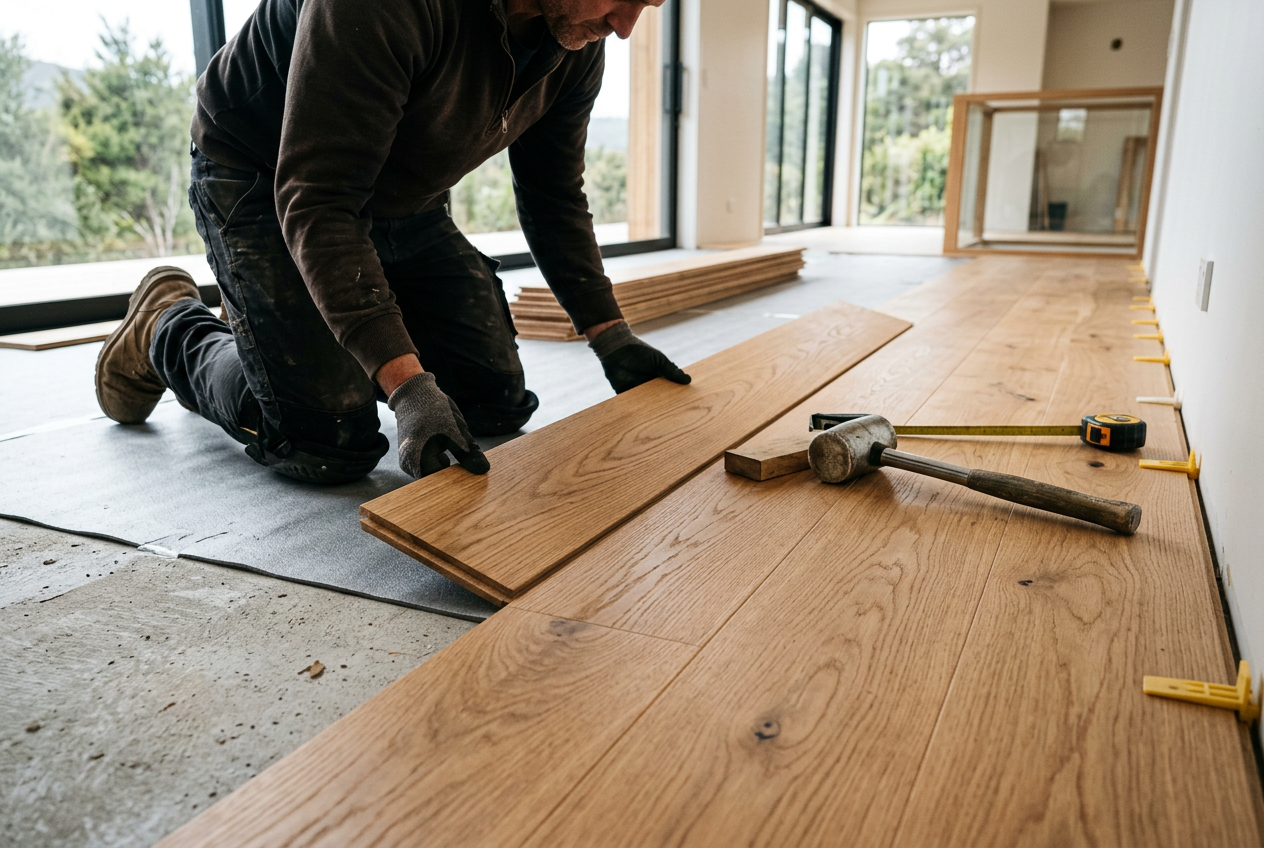
Engineered wood flooring is a popular choice in New Zealand homes — it handles our variable humidity better than solid timber and looks fantastic. But when the surface starts to show scratches, dents, or a dull finish, many homeowners wonder: can it actually be sanded back and refinished like a solid timber floor? The short answer is yes, but with important caveats that depend on your specific floor.
What Makes Engineered Wood Different from Solid Timber
Engineered wood flooring is made up of layers: a real hardwood veneer on top (called the wear layer) bonded to multiple layers of plywood or HDF (high-density fibreboard) underneath. This construction gives it stability, but it also means the wear layer has a finite thickness — and that's the key factor when it comes to sanding.
Solid timber boards can typically be sanded many times over their lifetime. Engineered boards, however, can only be sanded as many times as the wear layer allows before you risk cutting through to the core layers beneath.
How to Check Your Wear Layer Thickness
Before you do anything else, you need to find out how thick your wear layer is. Here's how:
- Check the manufacturer's documentation or the original packaging if you still have it.
- Look at the end of a board — in a doorway, wardrobe, or by removing a threshold strip, you can often see the layers in cross-section.
- Contact the supplier or installer who fitted your floor; they should have the product specs on file.
Wear layers are typically measured in millimetres. As a general guide:
| Wear Layer Thickness | Sanding Potential |
|---|---|
| Less than 2 mm | Not recommended — risk of sanding through |
| 2–3 mm | Usually one light sand possible |
| 3–4 mm | One to two sands possible |
| 4 mm or more | Best candidates; may allow two or more refinishes |
Keep in mind that each sanding pass removes material, so even a thick wear layer has limits. A professional floor sander will remove as little as possible to achieve a clean result.
What the Refinishing Process Involves
Refinishing an engineered floor follows a similar process to solid timber, but requires a lighter touch:
- Preparation — Furniture is removed, the floor is cleaned, and any protruding nail heads or staples are punched down.
- Sanding — A drum or belt sander is used for the main field, with an edge sander for perimeters. Engineered floors often need a finer grit and fewer passes than solid timber.
- Filling — Gaps and minor damage are filled with a suitable wood filler.
- Finishing — A new coat of oil, hardwax oil, or polyurethane is applied. Wattyl and Resene both offer floor coating products suitable for timber floors.
- Curing — The floor needs adequate drying and curing time before furniture is moved back.
Can You DIY It?
Light scuff-sanding (using a buffer or screen sander rather than a drum sander) and recoating is within reach of a careful DIYer — particularly if you're just refreshing the finish rather than removing deep scratches. However, drum sanding an engineered floor is genuinely risky if you're not experienced. Removing too much material in one pass can ruin the floor entirely. Hiring a professional floor sander is strongly recommended for anything beyond a light refresh.
NZ Climate Considerations
New Zealand's humidity swings — particularly in coastal areas and during seasonal changes — can cause engineered boards to expand and contract. BRANZ research highlights the importance of maintaining stable indoor humidity levels (generally between 40–60% relative humidity) to protect timber floors. Before refinishing, make sure any cupping, gapping, or movement has stabilised, otherwise the new finish may crack or peel prematurely.
When Refinishing Isn't the Right Answer
Sometimes a floor is beyond refinishing. Consider replacement if:
- The wear layer is too thin to sand safely.
- Boards are severely cupped, swollen, or water-damaged through to the core.
- There is widespread delamination (layers separating).
- The floor has already been sanded to its limit.
In these cases, you may be able to replace individual boards rather than the entire floor — another job best left to a professional.
When to Call a Professional
While recoating a floor is a manageable DIY task, sanding engineered timber floors should generally be handled by a qualified flooring professional, especially if:
- You're unsure of your wear layer thickness.
- The floor has significant scratches, staining, or unevenness.
- You've never operated a drum or belt floor sander before.
- The floor is glued down (common in NZ slab construction), which can complicate the process.
A professional flooring installer or floor sanding specialist will assess your floor, advise on whether refinishing is viable, and deliver a result that protects your investment. You can find qualified local flooring professionals on tradedirectory.co.nz.